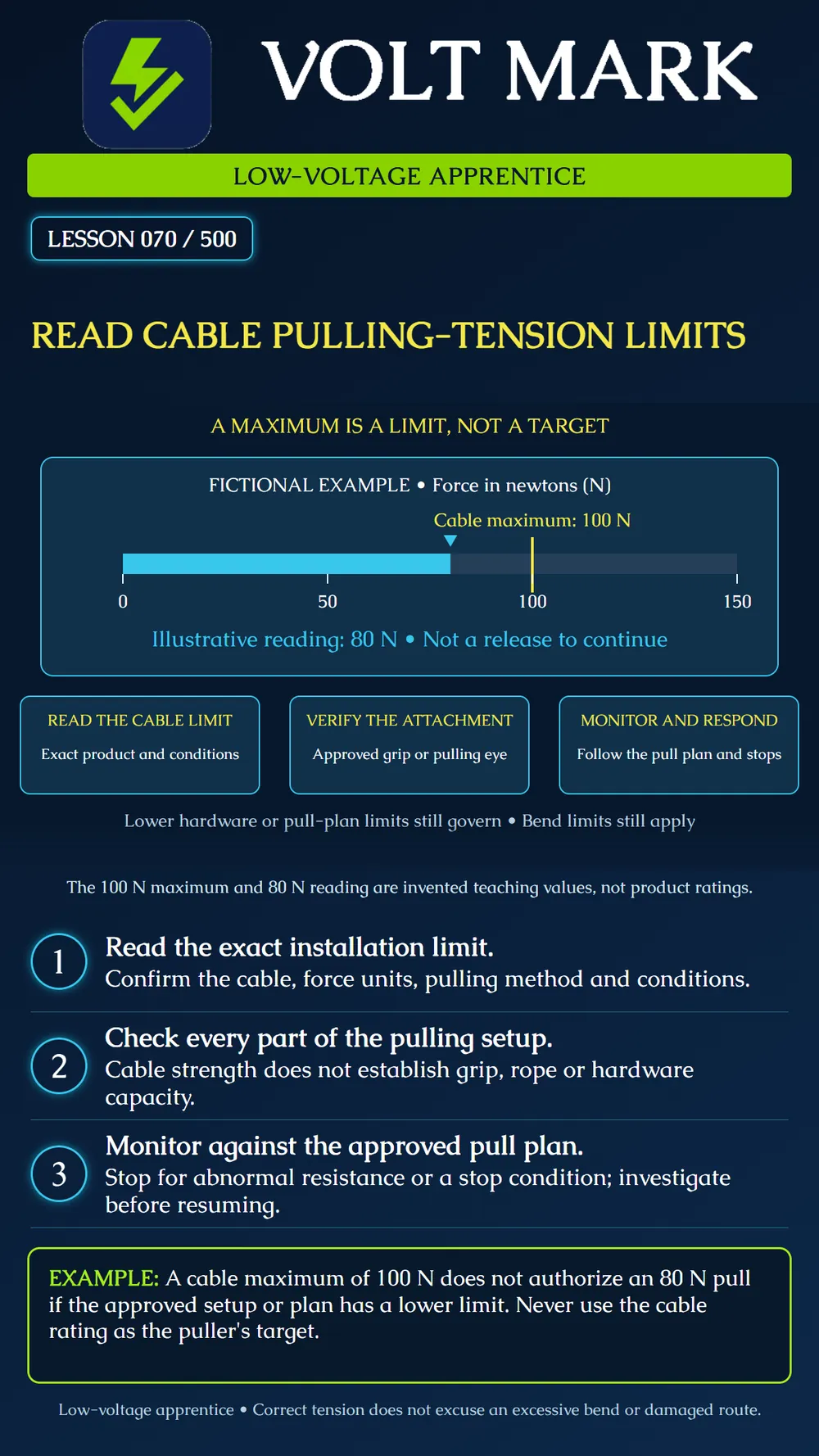
Identify the applicable pulling-tension limit, verify force units and explain why cable rating alone does not approve a pull.
Find the exact cable part number and its installation instructions. Identify the maximum permitted pulling force and any conditions attached to it. Do not confuse an installation limit with a breaking-strength figure, a long-term load rating or a specification for another construction.
The pulling attachment matters. FOA explains that fiber cable strength members commonly carry the pulling load, while jacket pulling is permitted only for cable designs and methods approved for it. Follow the actual cable and grip instructions. Do not pull on optical fibers, connectors or a jacket merely because they are convenient to hold.
A newton, symbol N, is a unit of force. Pound-force, written lbf, is also a force unit. NIST gives approximately 4.448 N per lbf. Thus 20 lbf is approximately 88.96 N. Keep the units beside every value and compare like units.
Kilograms alone are a mass unit. Do not relabel a kilogram reading as newtons or treat lb and lbf as interchangeable without understanding the documentation. If a product sheet or instrument display uses ambiguous units, resolve them before applying the limit.
The poster's force scale is fictional. Its cable maximum is 100 N, and the illustrated reading is 80 N. The scale extends from zero to 150 N so the location of both values is visible. No actual field measurement or product rating is represented.
Eighty is below one hundred, but that comparison does not approve the operation. A lower limit in the approved setup or pull plan may control. The reading also does not establish acceptable bend radius, sidewall pressure, attachment or route condition. A maximum is not a target to reach.
Identify the permitted pulling attachment, rope, connectors, swivels and equipment. Check their documented allowable uses and ratings. A powerful puller cannot increase the cable's allowable force. Likewise, a cable's rating cannot establish the capacity of unidentified hardware.
The responsible installer must evaluate the complete system and route. Limits are not always interchangeable numbers measured at the same location. Use the approved plan rather than merely comparing a few catalog values and assuming the lowest visible number settles every issue.
Use the specified monitoring and protective arrangements. Confirm instrument units and the meaning of its reading. Understand stop signals and who controls the pull. Abrupt resistance or an unexpected force increase calls for investigation under the plan, not a harder pull.
FOA describes tension monitoring and finding the source of excessive friction. Polywater's guidance also emphasizes that bends and pull direction affect tension and sidewall pressure. A cable can encounter excessive local stress at a bend even when an isolated force reading looks acceptable.
A trainee reads "maximum pulling force 100 N" in a training sheet. The planned setup has a lower authorized limit of 70 N. An illustrative display reaches 80 N. The cable maximum has not been exceeded, but the setup limit has. Stop and resolve the condition under the approved process. Do not substitute the higher cable figure. The 70 N value is an exercise input, not a recommended margin or universal percentage.
Cable and installation document: Maximum force and units: Permitted attachment: Setup and equipment limits: Monitoring location and instrument: Pull-plan stop conditions: Observed issues and disposition:
FOA — Fiber Optic Installation: pulling attachments, tension monitoring and excessive friction. https://www.thefoa.org/tech/ref/OSP/install.html
https://www.nist.gov/glossary-term/29611 Polywater — The Importance of Pull Direction in Cable Installation and the Role of Bends. https://www.polywater.com/en/knowledge-hub/the-importance-of-pull-direction-in-cable-installation-and-the-role-of-bends/ Polywater — Pull-Planner: evaluating tension and sidewall pressure. https://www.polywater.com/en/pull-planner/
Fictional force values are not installation specifications. Original VoltMark logo and Caudex fonts retained.
Free study material for low-voltage apprentices. This is a national foundation course: requirements differ by state and by local jurisdiction, and a practice that is common in one place is not a rule everywhere. Nothing here is a licence, a certification, or authority to work unsupervised, and completing it does not count as apprenticeship hours or continuing-education credit. Check the codes adopted where you are working, the licensing authority for that work, and your employer's safety programme. VoltMark is not affiliated with, endorsed by, or sponsored by NFPA, OSHA, NICET, BICSI, FOA, or any state or local licensing authority.
Electrician licensing exam prep: practice questions, timed exam simulations, and step-by-step help finding every answer in the NEC.