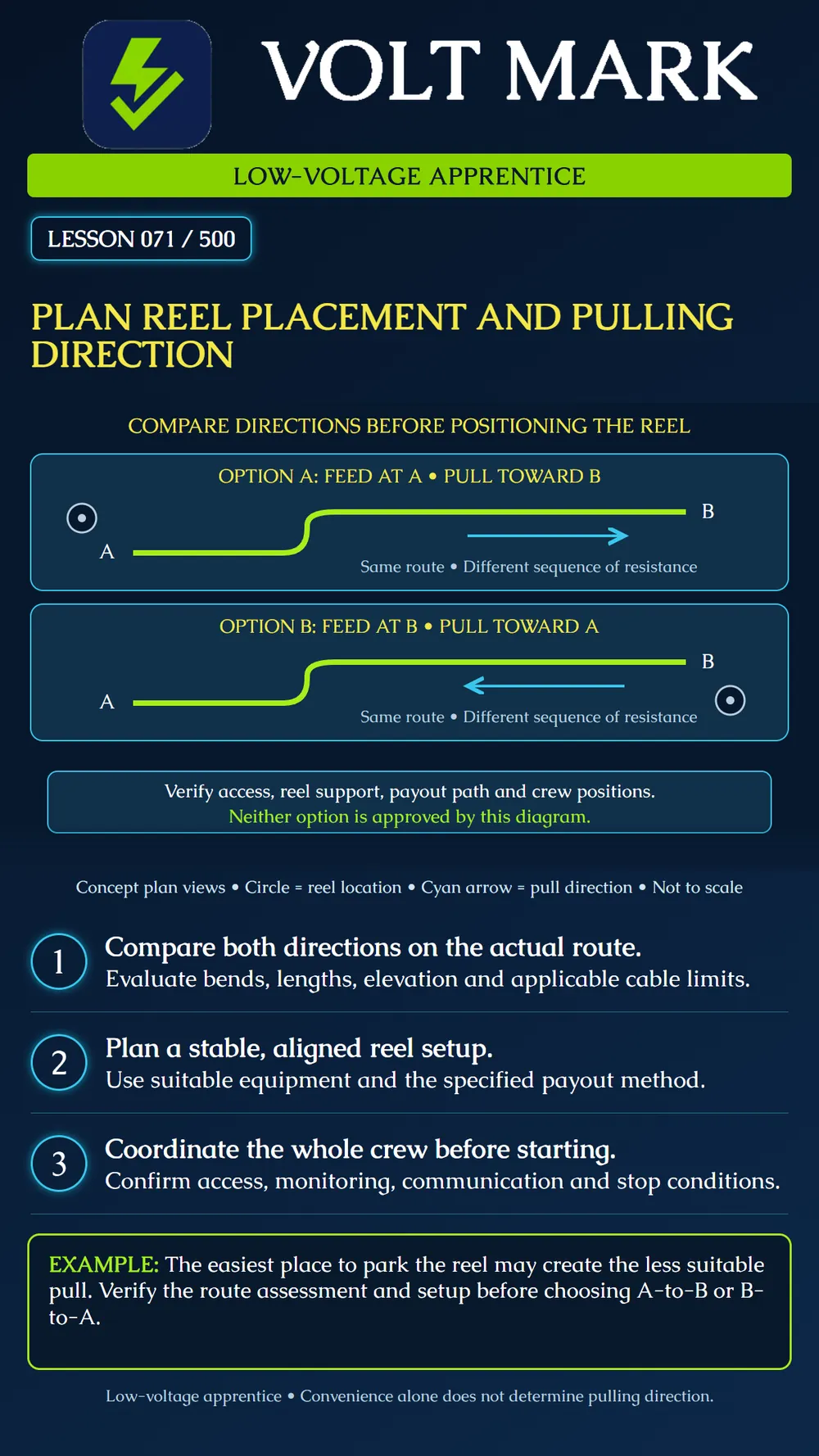
Explain why pulling direction, reel access and payout geometry must be planned together.
Begin with the surveyed pathway and exact cable. Identify straight sections, changes in elevation, bends and accessible intermediate points. Evaluate proposed directions against the cable limits and the planned equipment. Equal route length does not mean equal pulling conditions.
Polywater explains that the order of straight sections and bends can change pulling tension and sidewall pressure. A bend reached after substantial friction has accumulated may behave differently from that same bend encountered earlier. Do not turn this into a rule that one compass direction or one end of every route is always better. Use the actual route assessment.
Confirm access for delivery and setup, room for the reel and handling equipment, suitable support conditions and a controlled path into the first guide or entry. Keep the working arrangement within the approved area and maintain required access around it. The place nearest a doorway is not automatically a suitable reel station.
Use reel handling and support equipment appropriate to the reel and its load. Follow its setup and stability instructions. A storage reel and an operating payout reel are different conditions: do not improvise supports, assume a loose reel is controlled or confuse storage chocks with a complete payout system.
For reeled cable, arrange controlled payout using the cable and equipment instructions. FOA describes rolling cable from the reel rather than pulling loops over the flange, which can introduce twist. Avoid dragging the cable across sharp edges or forcing it into a tight turn immediately after leaving the reel.
Some product packaging uses a different designed payout method. A pull box is not automatically handled like a rotating reel. Confirm the packaging instructions for the actual cable. Do not transfer a technique from one product to another merely because both contain communications cable.
The responsible installer must confirm feeding and pulling locations, any intermediate crew, monitoring points and the communication method. Identify the stop conditions and how the equipment operator will receive them. Keep personnel clear of rotating equipment, pinch points and tensioned lines according to the site procedure.
If route or access conditions change, revisit the plan. Moving the reel to the opposite end can change the pull rather than simply moving a piece of equipment. Long or complex routes may require an engineered staged or intermediate approach; this lesson does not authorize an improvised midpoint pull.
A crew can place the reel at A without moving stored materials. At B, access requires coordination. The supervisor asks which direction is suitable. The apprentice should provide the route survey and both proposed arrangements, identify the access issue and obtain the required pulling assessment. "A is easier to reach" is useful planning information, but it is not proof of acceptable cable stress.
Cable and reel identification: Surveyed route and revision: Direction options and assessment reference: Selected feed and pulling ends: Reel equipment, access and payout arrangement: Intermediate positions and monitoring: Communication and stop procedure:
Polywater — The Importance of Pull Direction in Cable Installation and the Role of Bends. https://www.polywater.com/en/knowledge-hub/the-importance-of-pull-direction-in-cable-installation-and-the-role-of-bends/ FOA — Installing Fiber Optic Cable: reel payout and cable handling. https://www.thefoa.org/tech/ref/install/installcbl.html FOA — Receiving Cable Onsite: reel handling and protection. https://www.thefoa.org/tech/ref/install/receipt.html FOA — Fiber Optic Installation: planning and staged pulling considerations. https://www.thefoa.org/tech/ref/OSP/install.html
No direction, reel stand or rigging arrangement is approved by the concept diagram.
Free study material for low-voltage apprentices. This is a national foundation course: requirements differ by state and by local jurisdiction, and a practice that is common in one place is not a rule everywhere. Nothing here is a licence, a certification, or authority to work unsupervised, and completing it does not count as apprenticeship hours or continuing-education credit. Check the codes adopted where you are working, the licensing authority for that work, and your employer's safety programme. VoltMark is not affiliated with, endorsed by, or sponsored by NFPA, OSHA, NICET, BICSI, FOA, or any state or local licensing authority.

Electrician licensing exam prep: practice questions, timed exam simulations, and step-by-step help finding every answer in the NEC.