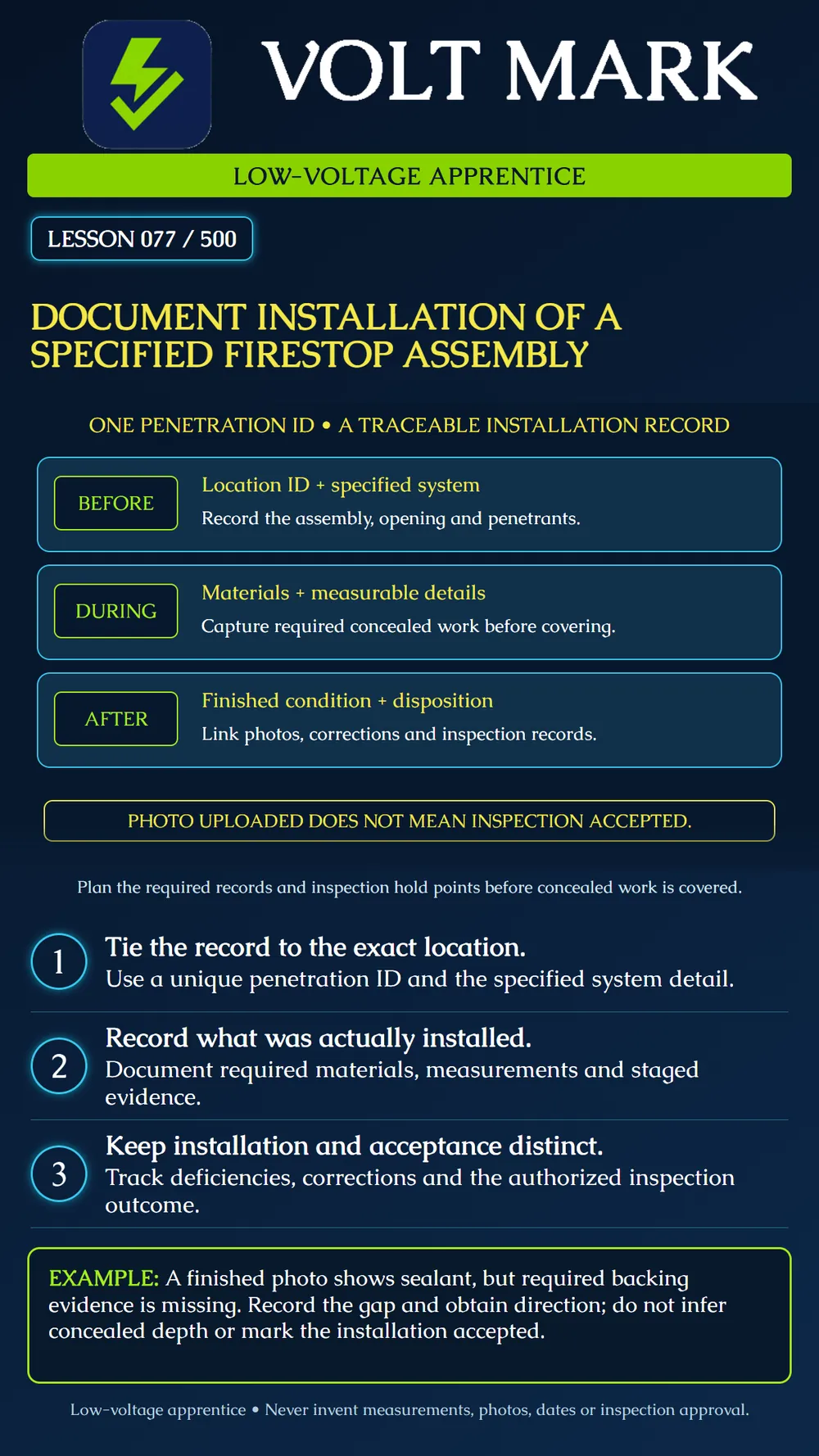
Create a traceable installation record without mistaking documentation for inspection acceptance.
Confirm the specified system and the project's documentation and inspection requirements. Identify who installs, who records information, who inspects and who authorizes concealment or acceptance. Required inspections must be coordinated with the work sequence. A complete-looking folder cannot replace an inspection that was required at a particular stage.
Assign or use the project's unique penetration ID. Link it to a drawing location and enough description for someone else to find the opening. Keep that same ID on photographs, forms, system details, deficiency records and correction records. Similar-looking openings in adjacent rooms are not interchangeable evidence.
The STI Firestop Report describes linking modeled locations with system information. Such a report can organize the intended work, but a model does not prove what was installed in the field. Record actual observations separately.
Record the assembly, opening and penetrating items needed to demonstrate a match with the specified system. Reference the full system detail and its applicable revision or date. Note any discrepancy rather than silently choosing another detail. Retain approved technical resolutions with the location record.
Capture context photographs as required, including enough surroundings to identify the penetration. Close-ups should complement the location view, not replace it. Avoid using a generic example picture as evidence for an actual installation.
Document the named materials and the system-specific measurable conditions required by the project. These may include backing, packing, sealant depth, annular spaces or other details that will become concealed. The selected system determines what applies; this lesson does not prescribe a universal backing or depth.
Plan photographs, measurements and inspection access before those details are covered. Include units and explain what was measured. A ruler held near a finished surface does not automatically establish the hidden depth beneath it. Record the actual measurement method where needed.
Capture the completed condition and required identification. Retain installer and date information, product traceability fields required by the project, and links to the staged evidence. Record the installation status separately from the inspection status.
UL's firestop guidance distinguishes documentation, inspection and reporting responsibilities. A photograph supports a record but cannot establish every concealed property or automatically serve as an authorized acceptance. Do not add certification marks, inspection signatures or approval labels that have not actually been issued.
If evidence is missing, write what is missing. Do not reconstruct a measurement from memory as if it were a contemporaneous observation. Ask the responsible project personnel how the condition must be evaluated. Any opening-up, repair or further inspection must follow the authorized process.
Record PEN-027 has a finished photograph and the specified system detail. Its required backing evidence is absent. The proper entry is "Installation recorded; backing evidence incomplete; inspection disposition pending," together with an action owner and next step. It is not "passed" merely because the visible sealant looks neat.
If a correction is made, retain the original deficiency and add the correction evidence, date and review outcome. Replacing the entire record with a clean photograph can hide the history needed to understand what changed.
No to all four. Preserve location-linked evidence and the actual review history.
Penetration ID and drawing location: Specified system and detail revision: Actual assembly, opening and penetrants: Installer and installation date: Material identification and required traceability: Measurements with units and method: Before, during and after evidence: Required inspection or hold point: Deficiency, corrective action and evidence: Authorized disposition and date:
UL Solutions — Firestop Systems: An Important Line of Defense for Fire Safety: documentation supports compliance verification. https://www.ul.com/news/firestop-systems-important-line-defense-fire-safety UL Solutions — Firestop and Joint Application Guide: inspector qualifications, contractor documentation, scheduling and reporting. No generic sampling rate is reproduced. https://www.ul.com/sites/default/files/2024-10/Firestop-and-Joint-application-guide-final-draft-4-29-24pm-1.pdf STI — What is the Firestop Report? Location and system-detail organization. https://knowhow.stifirestop.com/digital/what-is-the-firestop-report-in-fcm Fischer — Digital FireStop Documentation: photographic documentation workflow, not U.S. code authority. https://www.fischer-international.com/-/media/fixing-systems/rebrush/fiint/service/informationmaterial/documents/brochures/firestop/firestop-documentation.pdf
PEN-027 is fictional. No real installation, qualified inspection or acceptance is claimed.
Free study material for low-voltage apprentices. This is a national foundation course: requirements differ by state and by local jurisdiction, and a practice that is common in one place is not a rule everywhere. Nothing here is a licence, a certification, or authority to work unsupervised, and completing it does not count as apprenticeship hours or continuing-education credit. Check the codes adopted where you are working, the licensing authority for that work, and your employer's safety programme. VoltMark is not affiliated with, endorsed by, or sponsored by NFPA, OSHA, NICET, BICSI, FOA, or any state or local licensing authority.

Electrician licensing exam prep: practice questions, timed exam simulations, and step-by-step help finding every answer in the NEC.