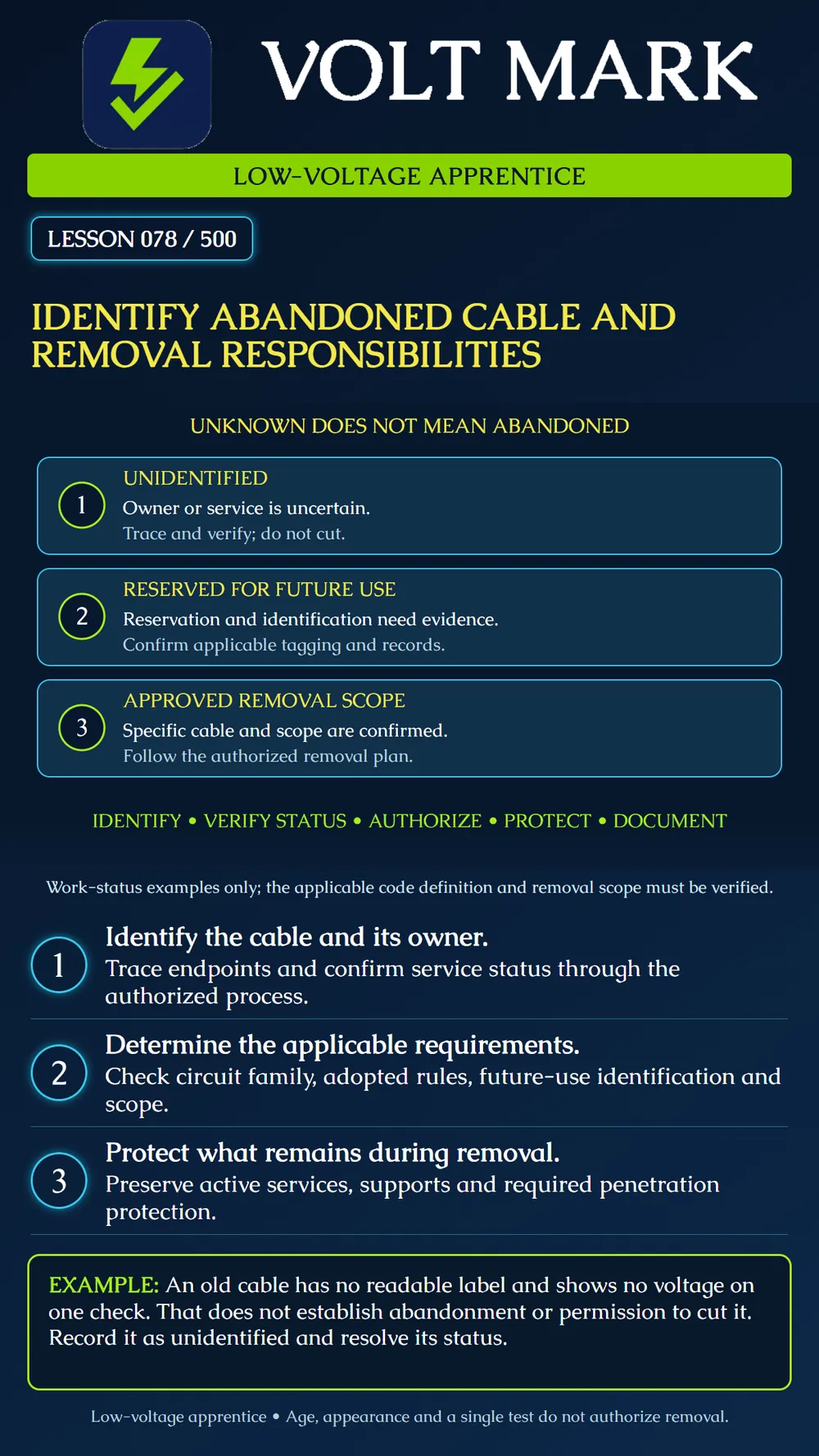
Distinguish uncertain cable status from an authorized removal scope and identify the responsibilities needed before removal.
A cable without a readable label is unidentified. It is not automatically abandoned. Old color, dust, a disconnected end or an apparently idle device is not enough to establish the status of the whole cable. Identify the cable and its endpoints through the approved tracing and verification process.
A single no-voltage reading also does not establish abandonment. A circuit may be intermittent or supplied from another location. Optical fiber cannot be classified as unused by a voltage check. Use methods appropriate to the system and follow its access and safety procedures.
Determine the cable family and the adopted requirements for the job. Definitions and removal provisions must be read in their actual scope, including any accessible-portion or future-use conditions. Do not treat a general summary as a universal demolition instruction for every cable in every location.
FOA's premises guidance describes abandoned optical fiber in relation to termination and future-use identification and emphasizes positive identification before cutting for removal. Its description is useful background, but the governing edition and actual installation conditions still require verification.
A cable may be intentionally reserved for future service. Confirm the owner's intended use and the required identification and records. A private note in one person's notebook may not meet the applicable tagging requirement. Conversely, adding an unsupported "future use" label is not a substitute for a valid disposition.
Keep the reservation linked to the cable identifier, endpoints and responsible owner. Do not remove a documented spare simply because it is not carrying traffic during your visit.
Determine who owns the cable, who confirms service status, who authorizes the removal scope and who performs the work. Coordinate with the responsible system personnel, particularly where a change can affect life-safety, security or shared network services. Owner consent does not waive applicable requirements; a removal requirement does not eliminate the need to identify and protect active systems.
Agree on the cable IDs and portions included in the work. Resolve unclear boundaries, inaccessible portions and contractual responsibilities before removal. Document required outages or impairment procedures through the project's process. This lesson does not authorize an apprentice to disconnect a live system.
Plan how the identified cable will be removed without damaging neighboring cables or supports. Pulling one cable through a crowded pathway can disturb others. Stop if the observed route or condition differs from the plan rather than forcing the cable free.
Removal can change a firestopped opening. Check the applicable system and arrange the required restoration or approved modification. An empty space left by a removed cable is not automatically covered by the previous arrangement. Keep relevant penetration records linked to the removal work.
Cable U-14 has an unreadable tag. One end appears disconnected, and a trainee obtains a zero reading at that end. The trainee proposes cutting it at an intermediate tray.
The correct record is "Unidentified; removal not authorized." Resolve the endpoints, ownership, service status and applicable disposition. A second cable, R-08, has confirmed ownership and documented future use. Evaluate its identification against the applicable requirements rather than treating it as scrap.
Cable ID and verified endpoints: Owner and system contact: Service-status verification: Applicable definition and disposition: Future-use identification, if retained: Authorized removal portions: Protection and restoration responsibilities: Completion, remaining issues and updated records:
FOA — Premises Site Preparation: positive identification, future-use distinction and careful removal. https://thefoa.org/tech/ref/install/premsite.html FOA — Installation Standard 2025, Section 8.4: abandoned-cable planning context; confirm governing requirements for the actual site. https://thefoa.org/tech/ref/1pstandards/FOA%20Installation%20Standard%202025%20V1.pdf FOA — Outside Plant Installation: identification at intermediate locations to prevent mistaken removal. https://www.thefoa.org/tech/ref/OSP/install.html UL Solutions — Beyond Installation: Challenges in Passive Fire Protection Compliance: changes to penetrants and opening conditions. https://www.ul.com/thecodeauthority/knowledgecenter/beyond-installation-challenges-passive-fire-protection-compliance
U-14 and R-08 are fictional. No real cable removal or service interruption is authorized by this lesson.
Free study material for low-voltage apprentices. This is a national foundation course: requirements differ by state and by local jurisdiction, and a practice that is common in one place is not a rule everywhere. Nothing here is a licence, a certification, or authority to work unsupervised, and completing it does not count as apprenticeship hours or continuing-education credit. Check the codes adopted where you are working, the licensing authority for that work, and your employer's safety programme. VoltMark is not affiliated with, endorsed by, or sponsored by NFPA, OSHA, NICET, BICSI, FOA, or any state or local licensing authority.
Electrician licensing exam prep: practice questions, timed exam simulations, and step-by-step help finding every answer in the NEC.