Apply defined battery-sizing adjustments without confusing a demand margin with an available-capacity fraction or treating example factors as universal rules.
Use the actual equipment instructions, approved design and applicable adopted requirements. Record the method and revision. A required worksheet may already include allowances for particular conditions. Determine what its factors cover before adding anything else.
Altronix's ACM-series guide includes a model-specific battery worksheet and sizing factor. That factor is not a nationwide rule for all low-voltage systems. Do not reduce a required standby period simply to make a battery fit; resolve the design through the responsible reviewer.
Battery capacity depends on the evaluated discharge rate, endpoint voltage and conditions. Power-Sonic's technical manual describes temperature effects on available lead-acid capacity and service life. Its PG-12V100 data sheet provides model-specific discharge information and separate operating temperature ranges.
Use current documentation for the exact battery. A general technical manual does not override a narrower product limit. A battery being permitted to discharge at a temperature does not mean it delivers its full rated capacity there or may be charged under the same conditions.
Cold conditions can reduce available lead-acid capacity. Higher temperature can shorten useful life. Charging may require temperature compensation and must remain within the equipment's permitted conditions. These are separate issues. A larger Ah rating does not authorize operation outside a temperature limit or correct an incompatible charging profile.
Identify the relevant battery environment, including enclosure conditions and expected extremes, rather than relying only on a nearby room thermostat. Document the design temperature basis and the source of any correction.
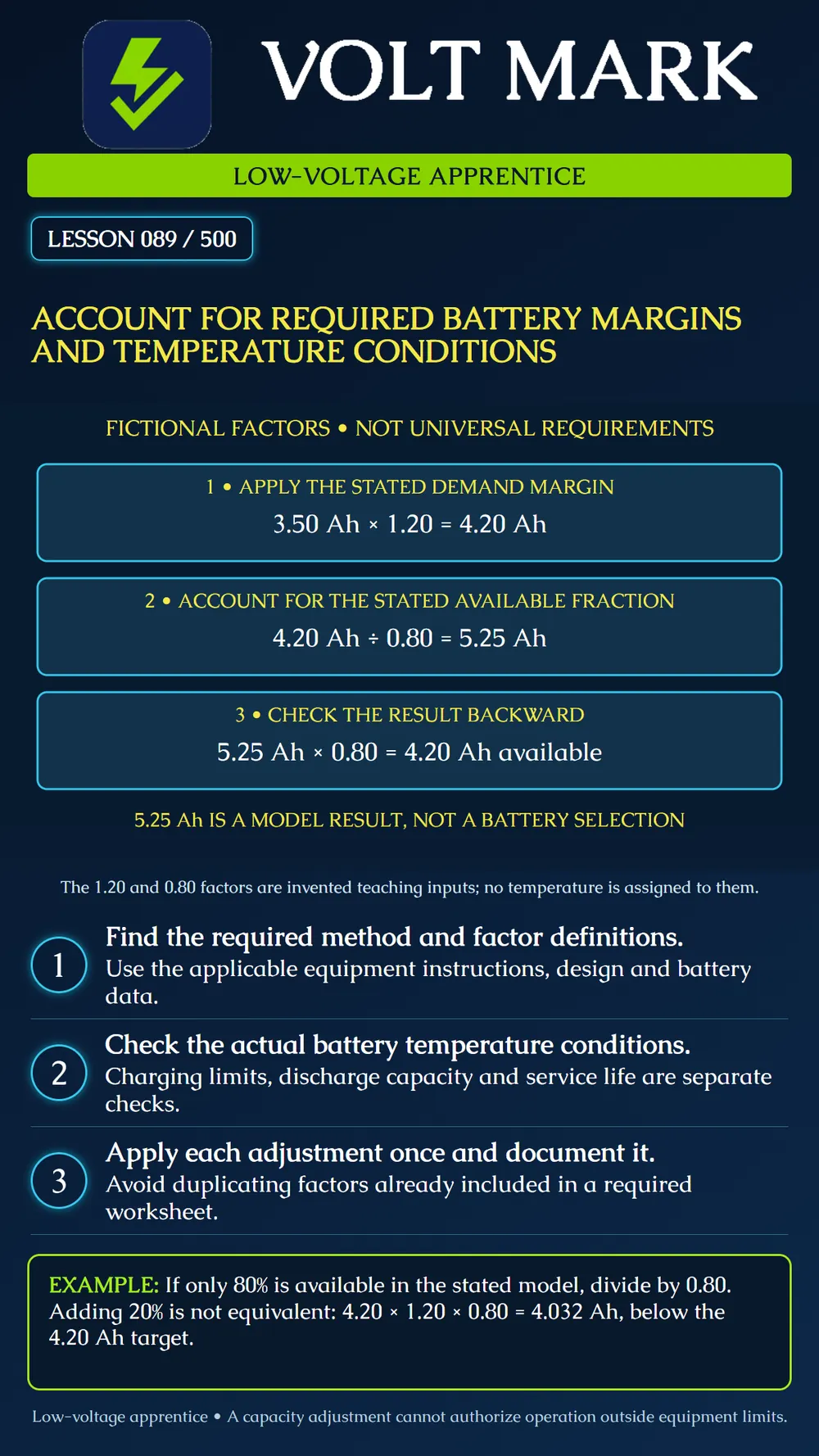
Start with the 3.50 Ah baseline from Lesson 088. For this exercise only, assume a separate demand-margin multiplier of 1.20. Also assume an available-capacity fraction of 0.80 under the evaluated condition. Assume these fictional adjustments cover separate effects and may be combined in this simplified model.
No real temperature is mapped to 0.80. Neither value is a code requirement or a recommendation for a specific product.
Step 1: 3.50 x 1.20 = 4.20 Ah adjusted demand. Step 2: 4.20 / 0.80 = 5.25 Ah equivalent rated-capacity requirement in the model. Step 3: 5.25 x 0.80 = 4.20 Ah available, matching the adjusted demand.
"80% available" means available capacity = rated capacity x 0.80. To solve for the rating, divide the needed capacity by 0.80. Adding 20% instead gives 4.20 x 1.20 = 5.04 Ah; 80% of that is only 4.032 Ah. It does not provide the 4.20 Ah target in this model.
Do not add an aging allowance again if the required method already includes that same allowance. Conversely, do not omit a separately required correction merely because some other factor is present. Document the meaning and order of each operation. A product-specific method may use tables or discharge curves instead of this simple equation.
The exercise result of 5.25 Ah is not permission to select an arbitrary battery at or above that label rating. Check the applicable discharge data, cutoff voltage, supported battery type and capacity, recharge capability, enclosure and system requirements. Resolve contradictory or missing data with the responsible manufacturer or reviewer.
Baseline duty-cycle demand: Required sizing method and revision: Battery model, discharge rate and cutoff: Battery temperature basis: Each factor, meaning and source: Effects already included: Calculation and backward check: Charging/environment limits: Candidate capacity and charger compatibility: Open questions and reviewer disposition:
Altronix - ACM Series Installation Guide, equipment-specific battery worksheet. https://www.altronix.com/library/pdf/installation_instructions/ACMseries.pdf Power-Sonic - Technical Manual, temperature and capacity discussion. https://www.power-sonic.com/wp-content/uploads/2018/12/Technical-Manual.pdf Power-Sonic - PG-12V100 data sheet: rate/endpoint information and operating temperature limits. https://www.power-sonic.com/wp-content/uploads/datasheets/pg-12v100.pdf
No actual temperature correction, battery selection or installation approval is established by the fictional factors.
Free study material for low-voltage apprentices. This is a national foundation course: requirements differ by state and by local jurisdiction, and a practice that is common in one place is not a rule everywhere. Nothing here is a licence, a certification, or authority to work unsupervised, and completing it does not count as apprenticeship hours or continuing-education credit. Check the codes adopted where you are working, the licensing authority for that work, and your employer's safety programme. VoltMark is not affiliated with, endorsed by, or sponsored by NFPA, OSHA, NICET, BICSI, FOA, or any state or local licensing authority.

Electrician licensing exam prep: practice questions, timed exam simulations, and step-by-step help finding every answer in the NEC.