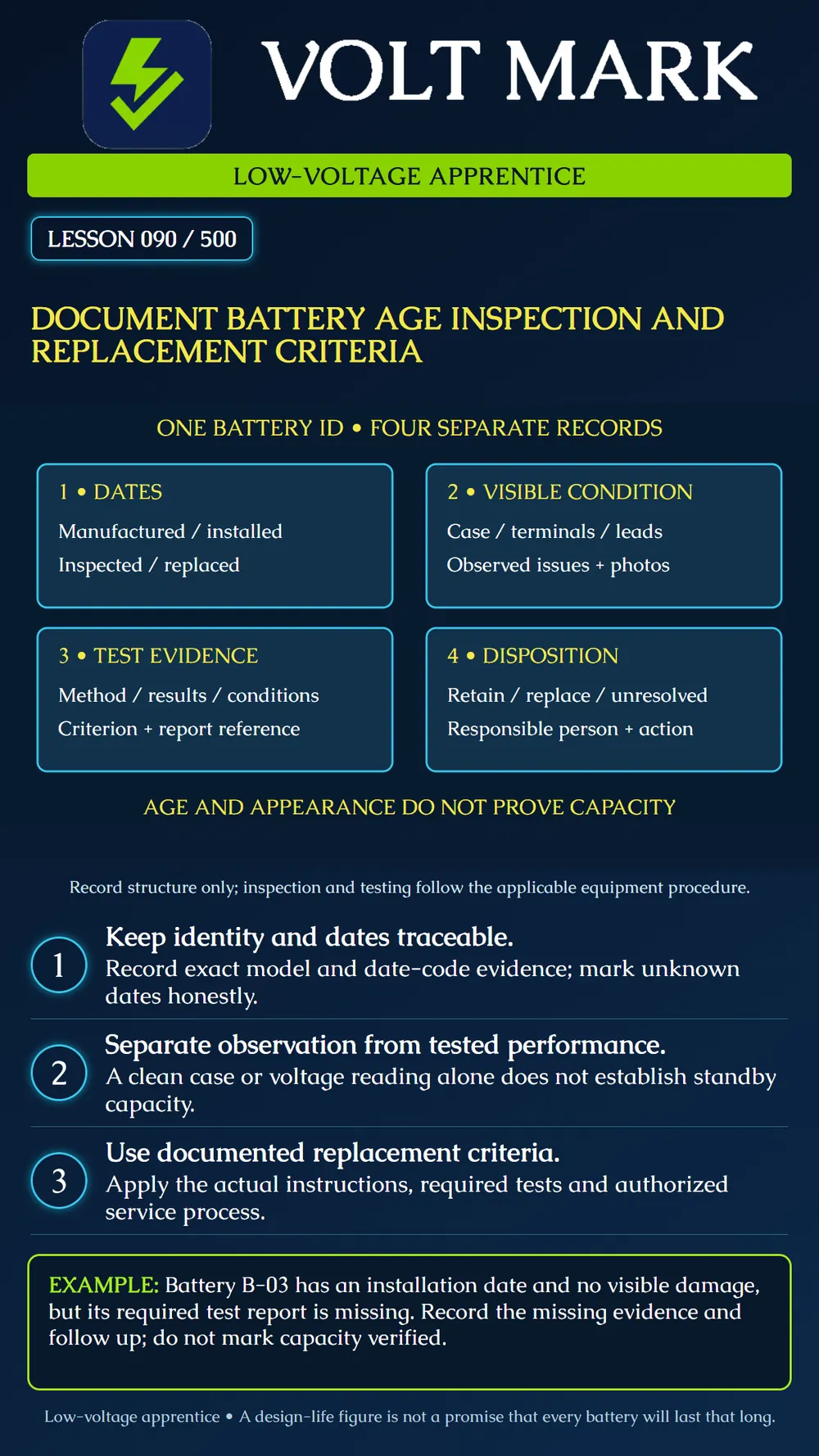
Create a traceable battery record that distinguishes age, condition, test evidence and the reason for retention or replacement.
Record the equipment ID, battery position, exact manufacturer/model, chemistry, nominal voltage, capacity rating and identifying code. If the system contains multiple batteries, identify each and preserve the approved arrangement in the record.
Separate manufacture, receipt, installation, inspection and replacement dates. A date printed on a case may be a manufacturing code, not an installation date. Decode it using the manufacturer's information. If the installation date is unknown, write unknown and record the evidence available; do not invent a date from appearance.
Design life describes expected performance under specified conditions, not a guarantee for each installed battery. Power-Sonic's manual explains that temperature, storage and duty affect service life. Check the current battery-specific documentation as well as the system's maintenance instructions.
The Altronix AL400ULX-series guide provides an example of equipment-specific maintenance and replacement guidance. Its stated timing is not a universal interval for every low-voltage battery. Record the actual applicable criterion and revision for the system being maintained.
Through the authorized inspection process, record observable case damage, swelling, leakage, corrosion, lead damage, insecure connections or unusual heat indications. Describe the specific location and evidence rather than writing only "bad battery." Photographs can support the record but do not replace the applicable inspection procedure.
An abnormal condition needs the site's appropriate response and qualified evaluation. Do not continue charging or handling a visibly damaged battery merely because its age is below a planned replacement interval. This lesson does not prescribe disconnection order, torque values or energized handling.
A battery may look clean and have an apparently normal voltage while failing to provide the required standby performance. Record what was actually tested. Voltage, conductance/internal-resistance indications and a discharge-capacity evaluation do not measure exactly the same thing.
Use the test method and acceptance criteria required for the actual equipment and application. Include test date, instrument identification, relevant condition of charge, temperature, load or duration when applicable, endpoint criteria and result. Link the full report rather than reducing every result to an unexplained checkmark.
Do not improvise a load test on an operating life-safety or security system. Required coordination, impairment controls and restoration checks belong to the authorized service procedure.
State whether the applicable criteria support retention, require replacement or remain unresolved. Identify the responsible person and follow-up action. Missing evidence is not a pass; it also does not by itself prove that the battery has failed. Resolve the gap using the required procedure.
For replacement, record the reason, approved replacement identification, date, service reference and required post-service verification. Check charger and system compatibility as covered in Lesson 087. Follow manufacturer requirements for replacing batteries within a set; do not casually mix models or ages. Keep disposal/recycling evidence as required by the service process.
Battery B-03: Installation date: recorded in the service log. Manufacture code: photograph retained; interpretation not yet confirmed. Accessible visual inspection: no damage observed. Required performance-test report: missing. Disposition: performance verification unresolved; assigned for follow-up under the maintenance plan.
Do not change "no damage observed" into "battery capacity passed." When the report becomes available, record the applicable criterion, result and authorized disposition.
System ID / battery position: Manufacturer / model / chemistry / rating: Manufacture code and interpretation source: Installation date and evidence: Inspection date and conditions: Visible observations: Required test method and criterion: Results and report reference: Replacement trigger or unresolved item: Responsible person and due action: Replacement ID/date, if performed: Post-service verification and next scheduled action:
Altronix - AL400ULX Series Installation Guide, maintenance section: equipment-specific checks and replacement guidance. https://altronix.com/library/pdf/installation_instructions/AL400ULX_series_DIP.pdf Power-Sonic - Sealed Lead-Acid Batteries Technical Manual: service-life, storage, temperature and handling context. Confirm current individual product instructions. https://cdn.power-sonic.com/documents/SLA_Technical_Manual.pdf Source note: the older power-sonic.com/2018/12/Technical-Manual.pdf address redirected to the homepage during this check; the manufacturer's CDN manual above was retrieved instead.
B-03 is fictional. No actual inspection, battery test or replacement has been performed.
Free study material for low-voltage apprentices. This is a national foundation course: requirements differ by state and by local jurisdiction, and a practice that is common in one place is not a rule everywhere. Nothing here is a licence, a certification, or authority to work unsupervised, and completing it does not count as apprenticeship hours or continuing-education credit. Check the codes adopted where you are working, the licensing authority for that work, and your employer's safety programme. VoltMark is not affiliated with, endorsed by, or sponsored by NFPA, OSHA, NICET, BICSI, FOA, or any state or local licensing authority.

Electrician licensing exam prep: practice questions, timed exam simulations, and step-by-step help finding every answer in the NEC.