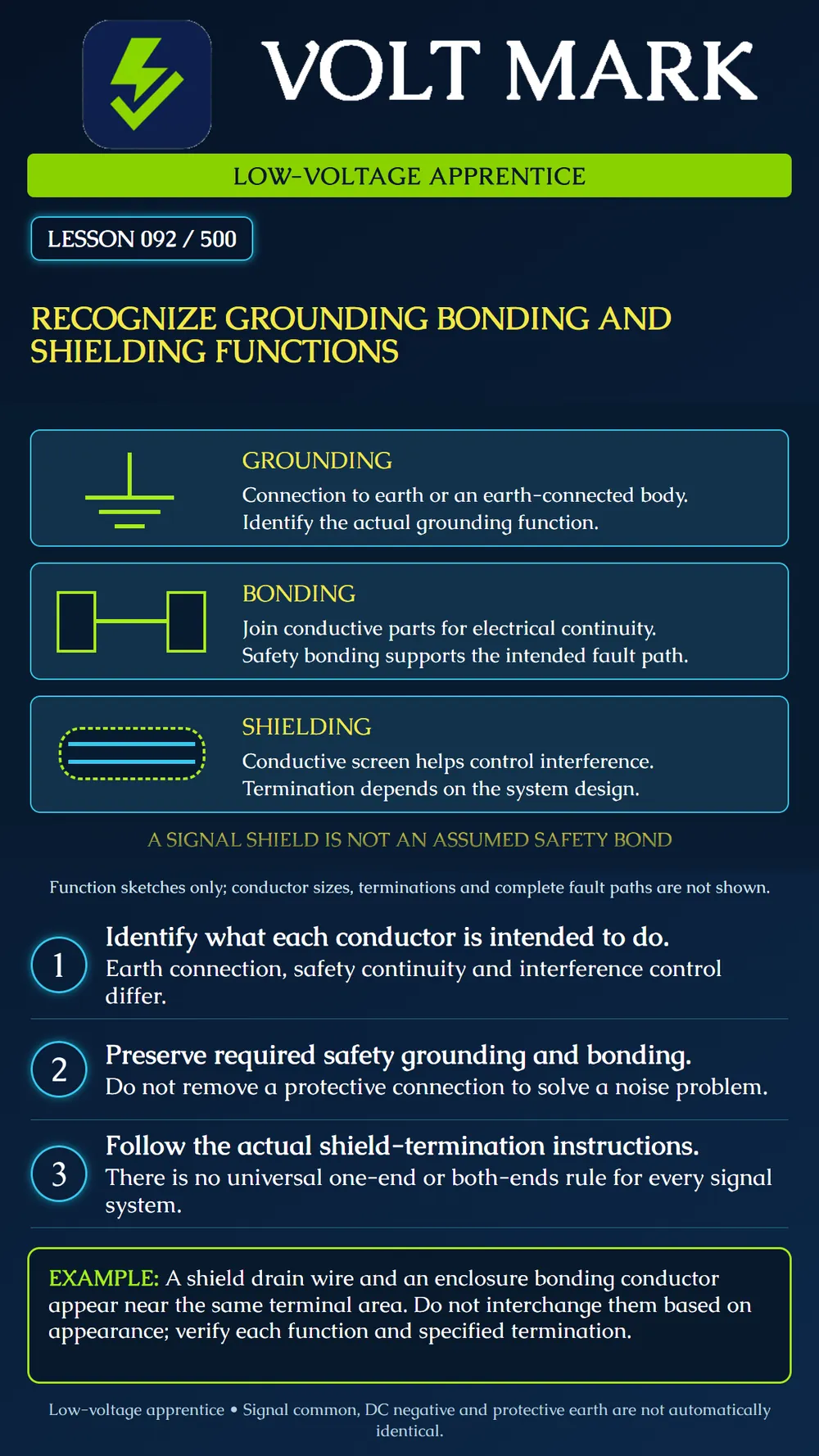
Recognize grounding, bonding and shielding as related but distinct functions and locate the correct installation requirements.
In electrical safety usage, grounding concerns connection to earth or to a conductive body that extends an earth connection. Equipment documentation may also use terms such as signal ground or circuit common for a reference node that is not necessarily connected to earth. Read the diagram and terminal definition rather than treating every ground label as interchangeable.
The earth symbol in the poster is conceptual. It does not prescribe a new electrode, a separate ground rod or a connection location. A standalone earth connection is not a substitute for the required equipment bonding and fault-return arrangement.
Bonding joins conductive parts to establish electrical continuity. Safety bonding forms part of the intended conductive path that supports protective-device operation during a fault and helps limit hazardous differences of potential.
Fault current returns to its source through the available circuit paths; it does not simply disappear into soil. Required connections must have the continuity and capacity appropriate to their purpose. OSHA's construction grounding guidance emphasizes continuity and the ability of grounding/bonding conductors to carry imposed fault current. Apply actual requirements within their scope; this lesson does not size a bonding conductor or specify a mains connection.
For a rack, enclosure or equipment frame, locate the approved bonding provisions and instructions. Do not assume painted metal contact, loose hardware or a nearby cable shield establishes the required bond. An unresolved bond is a condition for the responsible qualified person to evaluate.
A cable shield is a conductive screen used to reduce electromagnetic coupling. Its performance depends on cable construction, connectors, termination and the system's frequency and interference environment.
The poster's shield sketch shows a screen around signal conductors. It deliberately does not show an end connection. Belden's category-cable discussion demonstrates that shield termination affects performance and that potential differences between connected locations matter. That discussion does not establish one rule for every instrumentation, audio, video, control or data system.
Follow the exact equipment and cabling instructions. Some signal systems specify particular single-point arrangements; other systems rely on continuous shielding through connectors and bonds at multiple points. Do not copy a practice from a different system merely because both use shielded cable.
A drain wire provides a means of connecting certain cable shields; it is not automatically a protective bonding conductor. A shield may have an additional signal-return role in some cable types, such as coaxial arrangements, so removing it can interrupt the intended signal path.
DC negative, signal common and protective earth are not automatically the same node. Bonding them without the approved design can alter system operation. Conversely, removing required protective earth or bonding to silence hum creates an unacceptable change to the safety arrangement.
Use a de-energized training diagram and the equipment manual. Identify a marked enclosure bonding connection, a signal common terminal and a shield termination. For each, write its function, the relevant drawing reference and the specified termination. Mark uncertain symbols for clarification rather than joining them experimentally.
"Enclosure bond and shield drain appear adjacent. Functions and termination references verified separately before work." This is a documentation example, not permission to work inside an energized panel.
System and equipment model: Conductor/terminal identification: Function: earth connection, bonding, shield or signal reference: Drawing and manufacturer instruction: Applicable grounding/bonding requirement: Observed condition and uncertainty: Responsible reviewer and disposition:
OSHA - Construction eTool, Grounding: continuity and fault-current capability of grounding/bonding paths within the cited construction context. https://www.osha.gov/etools/construction/electrical-incidents/grounding Belden - What's the Difference Between Shielded and Unshielded Category Cable for AV? Shield bonding and system performance context. https://www.belden.com/blog/whats-the-difference-between-shielded-and-unshielded-category-cable-for-av
Conceptual diagrams do not specify an actual grounding electrode, conductor size or shield termination.
Free study material for low-voltage apprentices. This is a national foundation course: requirements differ by state and by local jurisdiction, and a practice that is common in one place is not a rule everywhere. Nothing here is a licence, a certification, or authority to work unsupervised, and completing it does not count as apprenticeship hours or continuing-education credit. Check the codes adopted where you are working, the licensing authority for that work, and your employer's safety programme. VoltMark is not affiliated with, endorsed by, or sponsored by NFPA, OSHA, NICET, BICSI, FOA, or any state or local licensing authority.

Electrician licensing exam prep: practice questions, timed exam simulations, and step-by-step help finding every answer in the NEC.