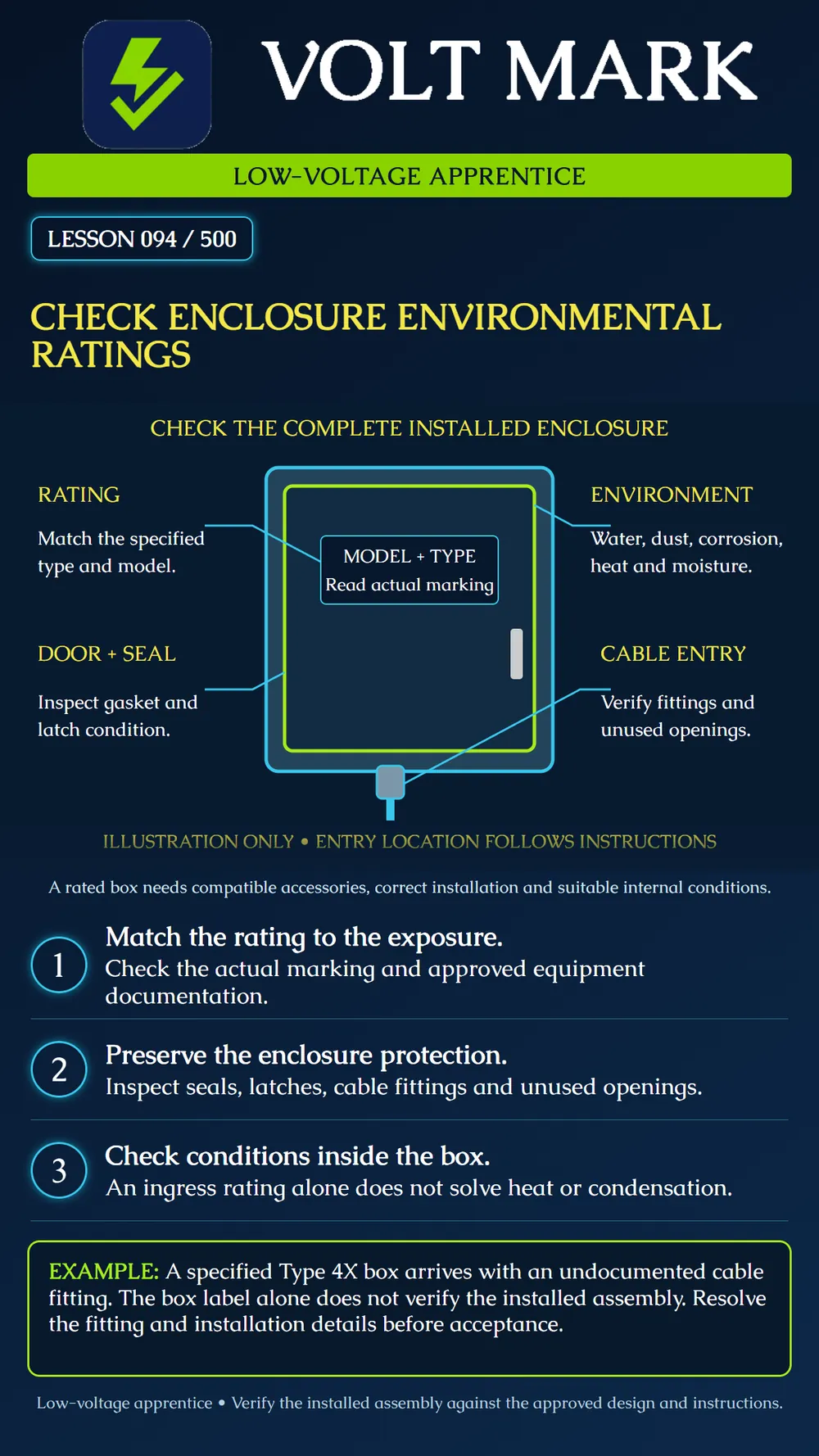
Compare the enclosure and its installed accessories with the documented environment and approved equipment requirements. Explain why an enclosure label alone is not an acceptance record for the completed assembly.
Start with where the equipment will operate. A camera interface, security power supply, access-control controller or fiber termination enclosure may face very different conditions even on the same campus. Record whether the location is indoors or outdoors and what reaches it: rain, cleaning spray, airborne dust, corrosive substances, sunlight, heat, cold and moisture. Refer unusual exposures for design review instead of selecting a box by appearance.
Read the exact manufacturer, model and environmental marking. A NEMA Type designation and an IP designation describe different rating systems; do not treat a matching-looking number or informal conversion chart as evidence that an offered product satisfies the specified requirement. Verify the actual documentation for the required rating. An enclosure rating also does not establish the temperature limits of the electronics installed inside it.
Some distinctions help you recognize a mismatch. Type 12 is associated with indoor protection against dust and dripping liquids. Type 4 includes protection against hose-directed water, and Type 4X adds corrosion protection. These are abbreviated distinctions, not complete definitions or a selection table. Type 4X does not mean immunity to every chemical or permission for every cleaning method. Confirm the material and product instructions for the actual exposure. Do not infer hazardous-location approval from these ordinary environmental ratings.
Now examine the installed assembly. The poster highlights a model/type label, door seal, latch and cable entry. The drawing is illustrative: its bottom entry is not an instruction to drill there. Compare the actual entries and accessories with the approved arrangement. Obtain evidence for cable fittings, plugs, drains, vents and other penetrations; follow their installation instructions and the enclosure instructions. Missing seals, damaged gaskets, loose closures or undocumented openings need resolution. Do not assume field-added sealant restores a rating.
Moisture can become a problem inside a box even without an obvious rain leak. nVent describes condensation risks associated with temperature swings, humid air and installation details, and says an arbitrary drain or breather does not preserve the agency rating. Use a documented solution suited to the enclosure and equipment. Do not drill an improvised drain hole. Heat and moisture management belong in the equipment plan, with any accessories assessed as part of the assembly.
The approved schedule requires a Type 4X enclosure for an outdoor low-voltage controller. The delivered box bears that marking, but the cable fitting has no supporting documentation. Record the enclosure identification and the fitting evidence gap. Request the approved fitting details and verify installation before accepting the assembly. A working controller does not demonstrate environmental protection. This scenario does not select a particular fitting or approve any actual installation.
On a de-energized training enclosure, identify the label, closure hardware, gasket, entries and unused openings. Compare each with the supplied drawing and instructions. Record one evidence gap without modifying the enclosure. Ask your supervisor to review the proposed disposition.
Asset and location: Manufacturer and exact model: Required environmental rating and source: Actual marking and documentation: Exposure conditions: Fittings, plugs, vents and drains: Seal and latch condition: Internal temperature/moisture requirements: Evidence gap, responsible person and disposition: Reinspection evidence:
Schneider Electric, FA219529, NEMA Housing and Enclosure Rating Information. Used for limited Type 4/4X/12 distinctions, not its broad application recommendations. https://www.se.com/us/en/faqs/FA219529//
nVent HOFFMAN, H2Omit Condensation Solution System FAQ, FAQ00005_1807. Used for condensation and appropriately rated openings/accessories. https://origin-nvent.nvent.com/sites/default/files/acquiadam_assets/2021-07/FAQ-00005.pdf
nVent HOFFMAN, Technical information, sections on degrees of protection, environment and enclosure selection. Used for rating scope, exposure and internal-environment considerations. https://go.nvent.com/rs/760-EGW-100/images/Technical_Information_nVent_HOFFMAN.pdf
Research limitation: NEMA enclosure-types PDF returned 404 and an alternate nVent white paper returned 403. Neither inaccessible full document was used as verified evidence. Scope: National apprentice fundamentals, not jurisdiction-specific approval or a complete enclosure selection procedure.
Free study material for low-voltage apprentices. This is a national foundation course: requirements differ by state and by local jurisdiction, and a practice that is common in one place is not a rule everywhere. Nothing here is a licence, a certification, or authority to work unsupervised, and completing it does not count as apprenticeship hours or continuing-education credit. Check the codes adopted where you are working, the licensing authority for that work, and your employer's safety programme. VoltMark is not affiliated with, endorsed by, or sponsored by NFPA, OSHA, NICET, BICSI, FOA, or any state or local licensing authority.
Electrician licensing exam prep: practice questions, timed exam simulations, and step-by-step help finding every answer in the NEC.