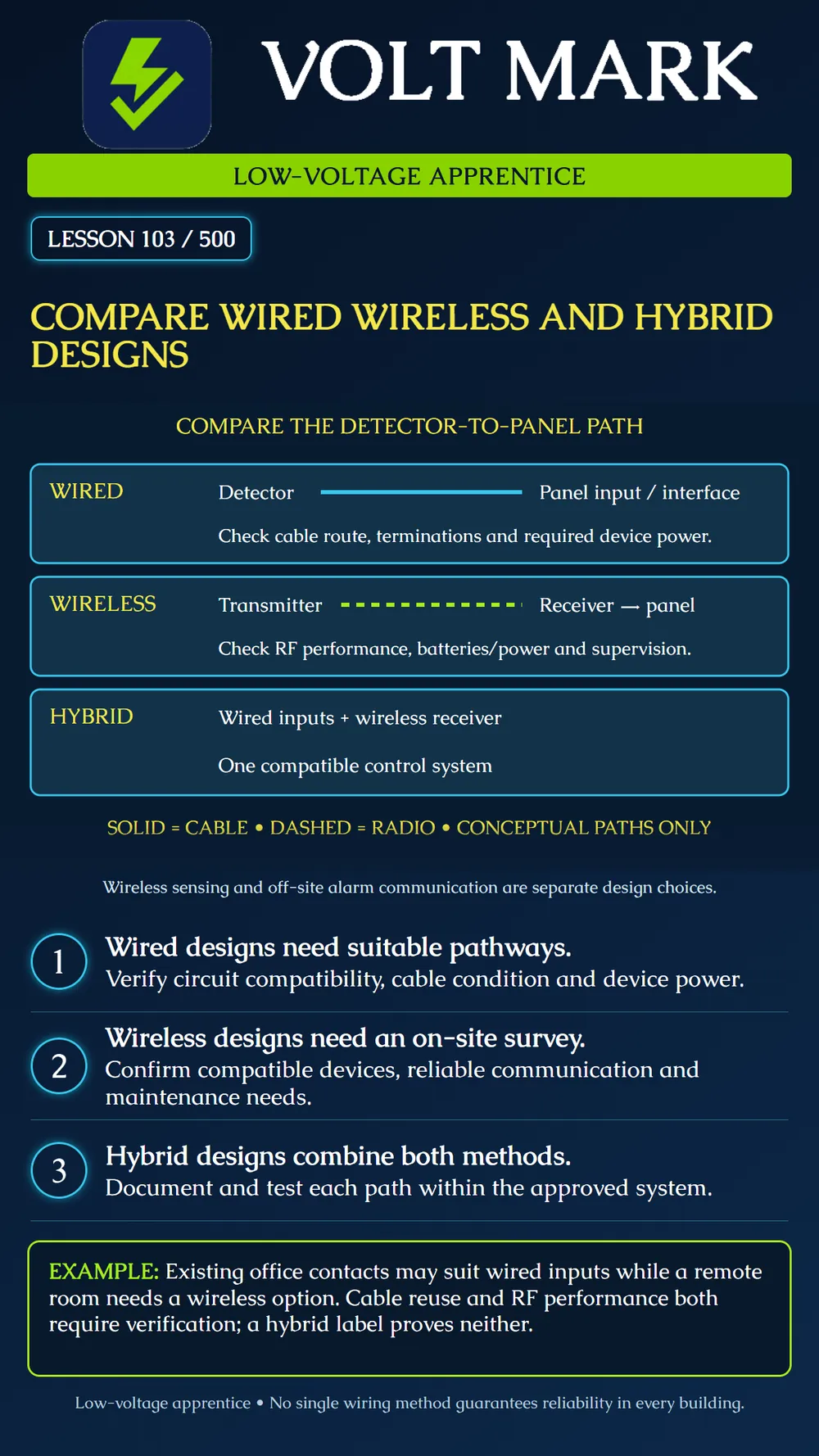
Compare detector-to-panel architectures by signal path, power, supervision and maintenance requirements.
Wired, wireless and hybrid describe how field devices connect to the control system. Keep this separate from the panel's off-site reporting path. A wired detector system can report through a cellular communicator. A wireless detector system can use an IP reporting service. The two choices answer different questions.
A detector connects through a cable circuit or compatible wired interface. Review the approved circuit design, pathway and terminations. Existing cable is useful only when its condition and characteristics suit the proposed equipment. Some contacts are passive switches, while powered detectors need the specified supply arrangement. Do not assume every wired detector receives power in the same way or that every circuit uses the same supervision components.
A transmitter communicates by radio with a compatible receiver or integrated radio interface. Wireless reduces the need for a signal cable to that device, but it does not remove power and maintenance requirements. Identify the actual battery or external supply arrangement for each model. The panel and separate receiver may still require wiring.
A manufacturer's advertised range is not a substitute for checking the proposed locations. DMP's 1100XH guide includes a location survey and model-specific supervision provisions; it also shows a wired panel connection for that receiver. This illustrates why a wireless design still needs attention to placement, equipment compatibility and the receiver's connection. Use the actual survey procedure and acceptance criteria for the chosen product. Do not generalize one model's frequency, distance or supervision interval to every system.
A compatible control system combines wired and wireless inputs. DSC describes PowerSeries Neo as a modular hardwired system supporting wireless devices and peripherals. Hybrid is a design option, not automatic permission to combine arbitrary products. Verify the supported panel, receiver, device family and software/firmware requirements before selecting components.
For a renovation, examine which cable paths are available and which existing devices can be reused under the approved design. For radio locations, consider the real building conditions and document the survey. Plan access for future service and any battery replacement required by the device instructions. Record how each path is supervised and how trouble conditions will be reviewed under the approved test plan.
No architecture is maintenance-free. A neatly installed cable does not prove circuit performance, and a wireless device enrolling successfully near the panel does not prove performance at its final location. Verify the completed arrangement and keep evidence.
The office has existing door-contact cable. A separate room has no approved cable route yet. The designer is considering a hybrid arrangement. List two unresolved checks: suitability of the existing circuit and documented wireless performance at the proposed location. Do not mark either passed simply because the products are called hybrid.
Device and location: Proposed wired / wireless path: Supported panel / interface / receiver: Power source and maintenance requirement: Cable or RF evidence: Supervision requirement and source: Final-location test and result: Off-site reporting path, recorded separately: Open issue / responsible person:
DMP 1100XH Series Installation and Programming Guide, LT-1823; receiver architecture, location survey, panel connection and supervision: https://assets.dmp.com/assets/LT-1823.pdf DSC PowerSeries Neo North America product-family description; hybrid architecture (search-index excerpt reviewed; direct page fetch failed): https://www.dsc.com/dsc-security-products/g/PowerSeries%20Neo%20-%20North%20America/6
Scope: National intrusion architecture concepts. No universal radio range, battery interval, circuit configuration or product compatibility is asserted.
Free study material for low-voltage apprentices. This is a national foundation course: requirements differ by state and by local jurisdiction, and a practice that is common in one place is not a rule everywhere. Nothing here is a licence, a certification, or authority to work unsupervised, and completing it does not count as apprenticeship hours or continuing-education credit. Check the codes adopted where you are working, the licensing authority for that work, and your employer's safety programme. VoltMark is not affiliated with, endorsed by, or sponsored by NFPA, OSHA, NICET, BICSI, FOA, or any state or local licensing authority.

Electrician licensing exam prep: practice questions, timed exam simulations, and step-by-step help finding every answer in the NEC.