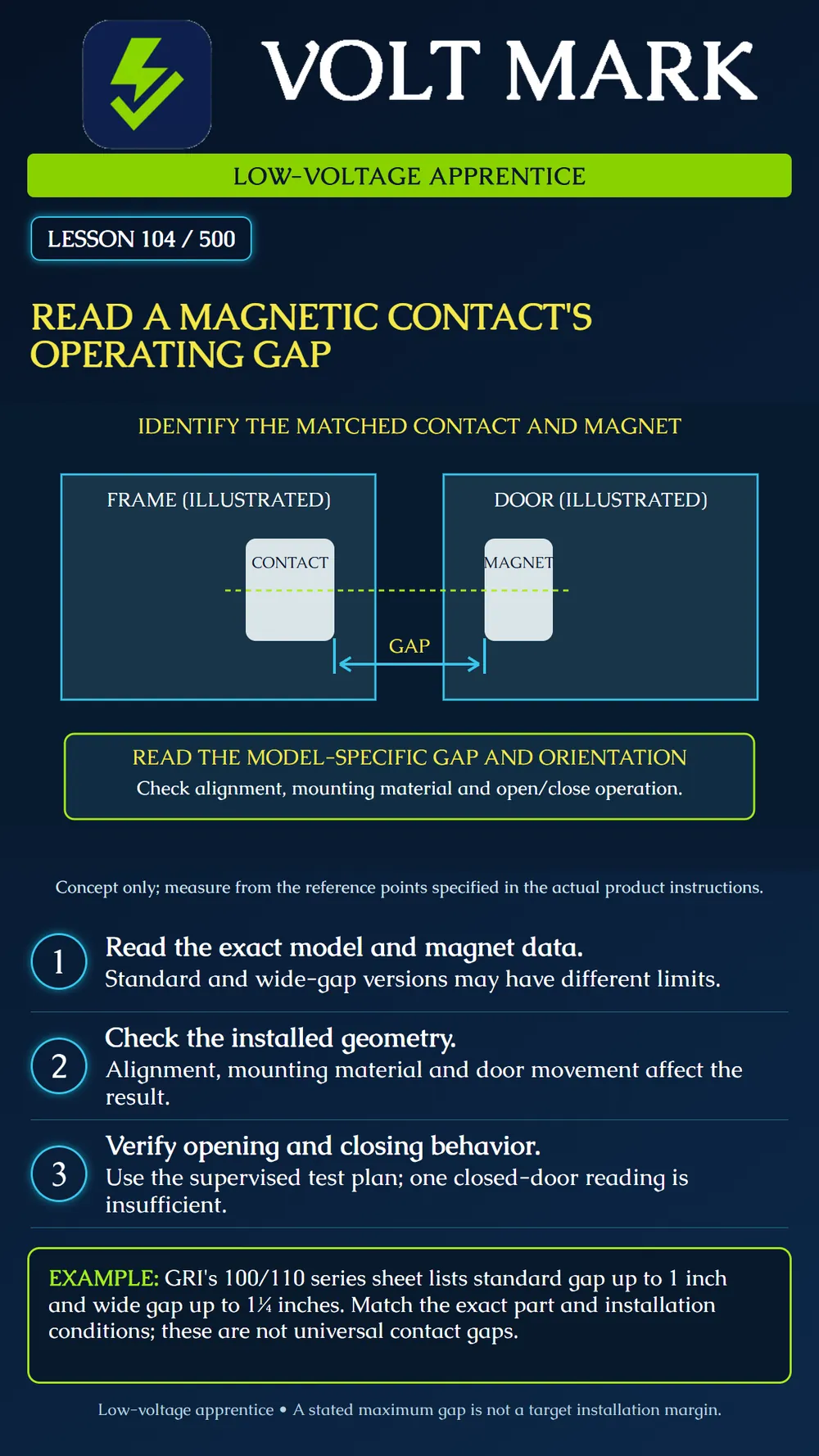
Find the correct gap specification for a matched contact and magnet, then relate it to the actual installation geometry and supervised functional check.
A magnetic contact responds to the field from its associated magnet. The physical distance between the two is only part of the installation. Identify the exact contact, the specified magnet, their orientation and the manufacturer's measurement reference points.
GRI's 100/110 series sheet distinguishes standard-gap and wide-gap part numbers. It lists standard gap up to 1 inch and wide gap up to 1-1/4 inches. A suffix can therefore matter. Those values describe that product family; they are not a universal setting for magnetic contacts or an instruction to install every unit at its maximum advertised separation.
Do not confuse case dimensions with operating gap. A heading describing a two-inch switch body does not mean that it operates over a two-inch separation. Read the gap entry and model identification together. If the sheet does not resolve the proposed mounting arrangement, obtain the appropriate instructions or manufacturer clarification before accepting it.
The poster illustrates a contact and magnet aligned beside each other. It is not a scale drawing or a placement instruction for every product. Use the required sensing side and orientation for the actual set. Check the mounting material, any specified spacers and the door or window's movement. Where steel or other installation conditions require different product data, use that data instead of assuming the published gap applies unchanged.
Door sag, looseness or movement can change the installed relationship. Do not rely on a single favorable position. The supervised test plan should confirm the intended panel indication when the opening is closed and when it is opened, using the actual device and panel configuration.
Reed-switch operate and release thresholds can differ. Littelfuse's reed-switch data distinguishes pull-in from drop-out characteristics. That component-level behavior is a reason to check both approach and separation rather than assuming an identical switching point in both directions. The component data does not supply a door-contact gap for another manufacturer's assembled product.
Do not confuse a magnetic contact's electrical state with the panel's programmed interpretation. Loop type, interface and programming affect what the panel displays. This lesson introduces gap reading; it does not prescribe a resistor arrangement or universal normally-open/normally-closed connection.
A trainee reads “2 inch miniature surface mount switch set” and proposes a 2 inch installed gap. The correct response is to distinguish housing description from the operating-gap table. For the cited GRI family, review the exact standard or wide-gap part and the applicable instructions. Do not approve the proposed separation from the product heading.
On a disconnected training sample, identify the contact and matching magnet from supplied documentation. Mark the prescribed measurement reference points on a sketch. Under supervision, record the observed opening and closing behavior using the approved training setup. Do not trigger a live monitored system for this exercise.
Contact model / magnet model: Manufacturer document and revision: Gap entry and stated conditions: Reference points and orientation: Mounting material / specified accessories: Installed measurement and units: Door or window movement observations: Opening test / closing test: Panel indication and expected result: Discrepancy / supervisor disposition:
GRI 100/110 Series specification sheet, gap listings and part-number variants: https://www.grisk.com/mdocs-posts/100-110-series-update/110-series-update/ Littelfuse FLEX-14 reed-switch datasheet, pull-in and drop-out characteristics (component-level reference, not a door-contact installation limit): https://www.littelfuse.com/assetdocs/littelfuse_reed_switches_flex_14_datasheet.pdf?assetguid=feaa6313-92de-4888-b25f-c3fdcf69c043 Honeywell 7939WG product overview, matched contact/magnet and model-specific installation gap: https://buildings.honeywell.com/ae/en/products/by-category/sensors/contact-sensors/7939wg-magnetic-contact
Scope: National intrusion fundamentals. Exact installed geometry and acceptance depend on the chosen product, mounting conditions and approved test procedure.
Free study material for low-voltage apprentices. This is a national foundation course: requirements differ by state and by local jurisdiction, and a practice that is common in one place is not a rule everywhere. Nothing here is a licence, a certification, or authority to work unsupervised, and completing it does not count as apprenticeship hours or continuing-education credit. Check the codes adopted where you are working, the licensing authority for that work, and your employer's safety programme. VoltMark is not affiliated with, endorsed by, or sponsored by NFPA, OSHA, NICET, BICSI, FOA, or any state or local licensing authority.

Electrician licensing exam prep: practice questions, timed exam simulations, and step-by-step help finding every answer in the NEC.