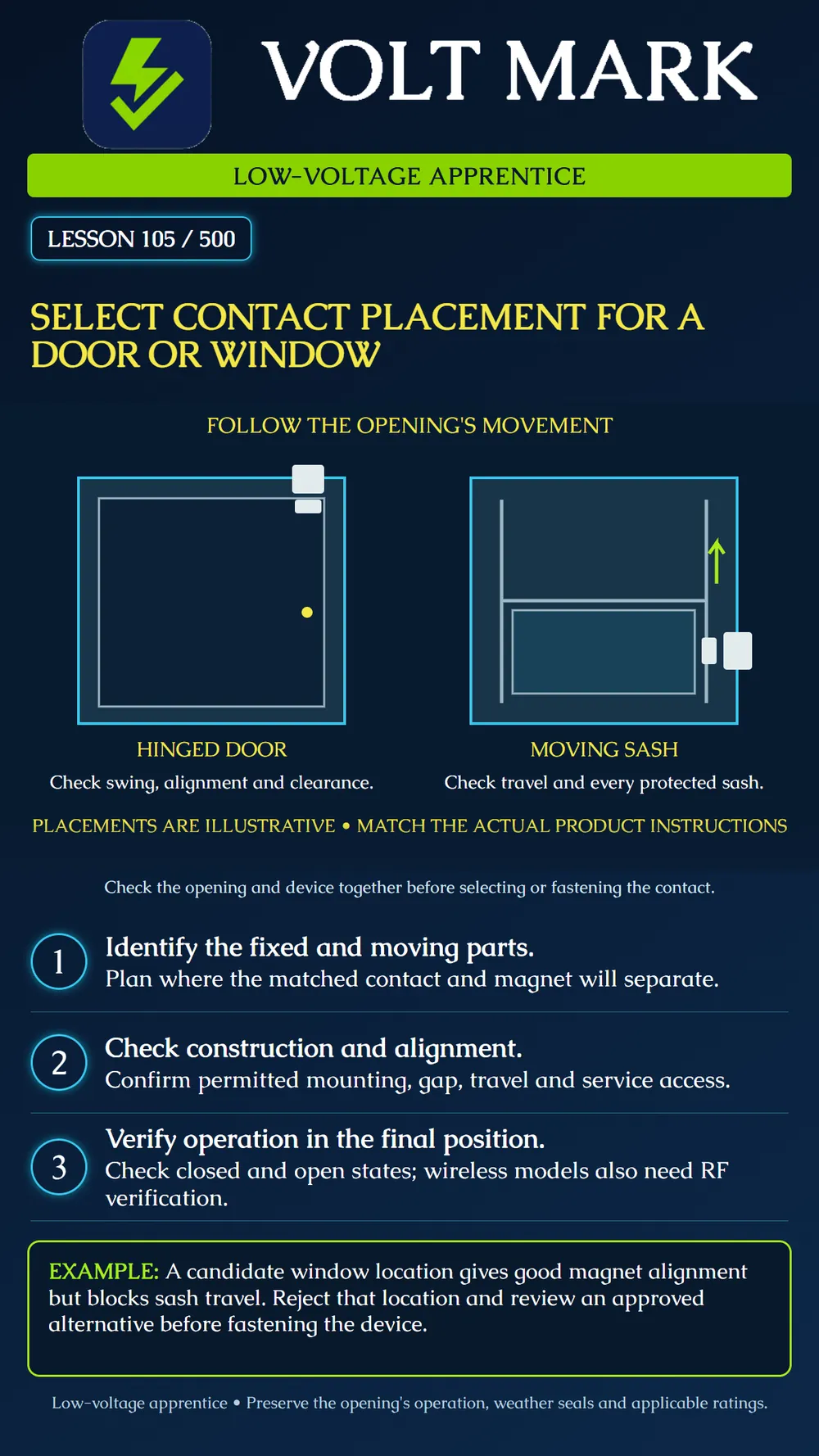
Evaluate a proposed contact location against the opening's movement, construction and the actual device instructions.
Begin with the opening, not the first convenient flat surface. Identify which parts remain fixed and which move. Observe the full permitted movement of a hinged door, sliding panel or moving sash. Identify each leaf or sash the design intends to monitor. Monitoring one moving piece does not automatically monitor every part of a multi-part opening.
The poster illustrates a fixed contact and moving magnet on two types of opening. These are conceptual arrangements, not universal mounting locations. Use the selected contact's sensing side, matched magnet, orientation and permitted mounting method. Do not copy the drawing's dimensions or treat its top-door location as mandatory.
Check that the proposed installation leaves room for the full swing or travel, closing hardware, locks, seals and routine service. Confirm the substrate is permitted for the selected product. Do not drill an unknown opening or alter a rated assembly based on a generic lesson. Resolve any attachment or modification restriction with the responsible manufacturer or project authority before work.
Check the closed relationship and how the magnet separates during opening. An attractive location is unsuitable if the parts collide, the magnet remains within the sensing region during an opening that must be detected, or the mounting prevents normal movement. Recheck the permitted gap and alignment using the actual instructions.
DMP's 1106 guide locates the magnet near the transmitter's magnetic reed switch and provides a model-specific separation limit. It calls for supplied screws for listed and commercial installations, includes an exact-location wireless survey and a post-installation check-in test, and restricts the cited ANSI/UL 1023 application to non-conductive surfaces. These details belong to that model and application. They demonstrate why tape, metal mounting and location choices cannot be assumed acceptable for every contact.
For wireless equipment, magnetic operation and radio communication are separate checks. A well-aligned magnet does not prove a reliable radio path. Likewise, successful RF communication does not prove the opening produces the intended point status. Use the appropriate supervised procedures for both.
For wired equipment, plan the approved cable entry and route so normal movement does not pinch or damage conductors. Keep any accessible service point usable. Select the actual circuit and interface under the design; this lesson does not provide wiring instructions.
A window contact and magnet align when the sash is closed, but the proposed housing projects into the sash travel path. Mark the location unsuitable. Review a permitted alternative with the supervisor and repeat the movement, alignment and communication checks before fastening. Do not shorten the sash's operation or improvise a different magnet just to make the location work.
Use an unconnected training door/window mock-up or a drawing. Label fixed and moving parts and mark a candidate location. Describe one reason to reject it and the evidence needed to accept a revised location. No live alarm activation or physical modification is required.
Opening ID / type / protected moving parts: Contact and matched magnet: Installation instruction revision: Substrate and permitted attachment: Sensing side / orientation / gap: Full travel and interference check: Cable route or RF survey reference: Closed-state and opening-state evidence: Service access: Unresolved restriction / supervisor disposition:
DMP 1106 Series Wireless Universal Transmitters Installation Guide, LT-1377 1.01 24401: location, mounting, testing and application restrictions. https://assets.dmp.com/assets/LT-1377.pdf
Scope: National intrusion placement fundamentals. Device-specific instructions, opening restrictions and approved project requirements control the actual installation.
Free study material for low-voltage apprentices. This is a national foundation course: requirements differ by state and by local jurisdiction, and a practice that is common in one place is not a rule everywhere. Nothing here is a licence, a certification, or authority to work unsupervised, and completing it does not count as apprenticeship hours or continuing-education credit. Check the codes adopted where you are working, the licensing authority for that work, and your employer's safety programme. VoltMark is not affiliated with, endorsed by, or sponsored by NFPA, OSHA, NICET, BICSI, FOA, or any state or local licensing authority.

Electrician licensing exam prep: practice questions, timed exam simulations, and step-by-step help finding every answer in the NEC.