Explain why a PIR coverage drawing is a starting point for an installation assessment, then record evidence from a supervised walk test without inventing a universal range.
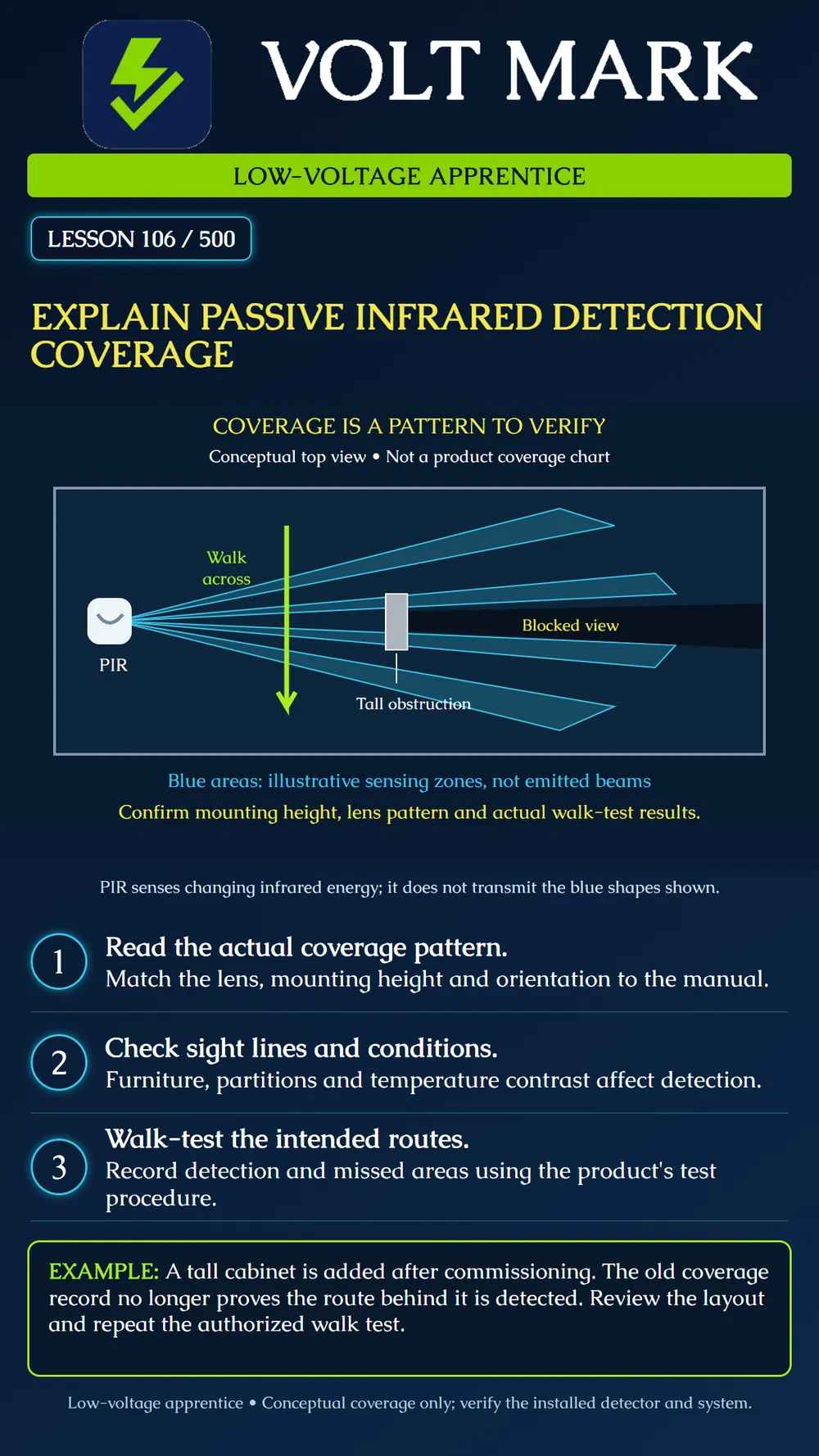
A passive infrared detector responds to changes in received infrared energy. Its optics divide the view into sensing zones. These are receiving directions, not beams transmitted into the room. Movement, target-to-background temperature contrast and the selected lens influence response. Ordinary glass is not a reliable path for this detection. A tall solid obstruction can hide part of a route from the detector. The illustration is conceptual: its wedges, spacing and footprint do not describe a particular product.
Use the actual detector manual and lens pattern. A wall detector, ceiling detector and narrow-pattern detector are not interchangeable simply because they all use PIR. Read both plan and side views where provided. A plan view alone does not establish coverage close to the floor or directly below the device. Product limits and settings belong with the installed model and manual revision.
OPTEX's product guidance demonstrates that mounting height, lens installation, masking and walk-test mode depend on the series. Follow the chosen model's sequence, including warm-up and test-mode timing, and test the intended detection area with the required cover or lens installed. Do not copy another product's height or time interval.
Use an instructor-prepared, authorized training setup. Before any live intrusion test, have the responsible person arrange the required system and monitoring test status. Obtain the approved drawing, exact detector identity and current instructions. Have the instructor identify the intended protected routes and the expected evidence. Do not change installed settings or reposition equipment without authorization.
On a blank room sketch, mark the detector identifier, candidate routes A and B, fixed furniture, partitions and the intended protection boundary. Write the actual installation information separately from the conceptual poster. Leave unknown fields marked UNKNOWN rather than filling them with remembered values.
Under supervision, perform the manufacturer's walk-test procedure along the agreed routes. Record the route and direction, relevant settings, test time and observed indication. An untested route must stay NOT TESTED. A missed response requires investigation and retest; it does not justify marking the route covered because it lies inside a drawing. Keep local detector response, panel event and remote monitoring receipt as separate evidence fields when those checks are in scope. A local indicator alone does not document every downstream step.
Return test settings and system status through the authorized closeout process. Retain unresolved items, who owns them and the required follow-up. This lesson is an educational overview, not a complete alarm-system acceptance procedure.
A stockroom record shows route A was checked before a tall cabinet was installed. The cabinet now stands between the detector and part of that route. The apprentice identifies the change, draws its location and requests an authorized coverage review. The previous result remains a historical result. It is not relabeled as a successful test of the changed room. No actual field test is claimed here.
Detector / model / lens: Manual revision / approved drawing: Mounting height / orientation / settings: Route and direction: Furniture or layout condition: Expected response / actual response: Local indication evidence: Panel or receiver evidence, if in scope: Unresolved item / owner / retest: Restoration confirmed by / date:
Answer: No. They illustrate sensing directions.
Answer: No. Use the installed product's instructions.
Answer: Document the change, review coverage and retest under authorization.
Researched 2026-09-30: Panasonic, Passive Infrared Motion Sensors FAQ, detection and obstruction principles: https://industry.panasonic.eu/products/components/sensors/passive-infrared-motion-sensors-papirs/passive-infrared-motion-sensors-faq Panasonic, PIR technology and lens options, conditional performance and lens patterns: https://na.industrial.panasonic.com/blog/pir-motion-sensors-technology-low-power-or-line-power-applications-and-lens-options OPTEX America FAQ, series-specific mounting and walk-test examples: https://optexamerica.com/faq DMP PDF retrieval was unavailable in this run; no DMP numeric requirement is asserted. The drawing, scenario, practice and record form are original instructional material. No universal legal or licensing requirement is asserted.
Free study material for low-voltage apprentices. This is a national foundation course: requirements differ by state and by local jurisdiction, and a practice that is common in one place is not a rule everywhere. Nothing here is a licence, a certification, or authority to work unsupervised, and completing it does not count as apprenticeship hours or continuing-education credit. Check the codes adopted where you are working, the licensing authority for that work, and your employer's safety programme. VoltMark is not affiliated with, endorsed by, or sponsored by NFPA, OSHA, NICET, BICSI, FOA, or any state or local licensing authority.

Electrician licensing exam prep: practice questions, timed exam simulations, and step-by-step help finding every answer in the NEC.