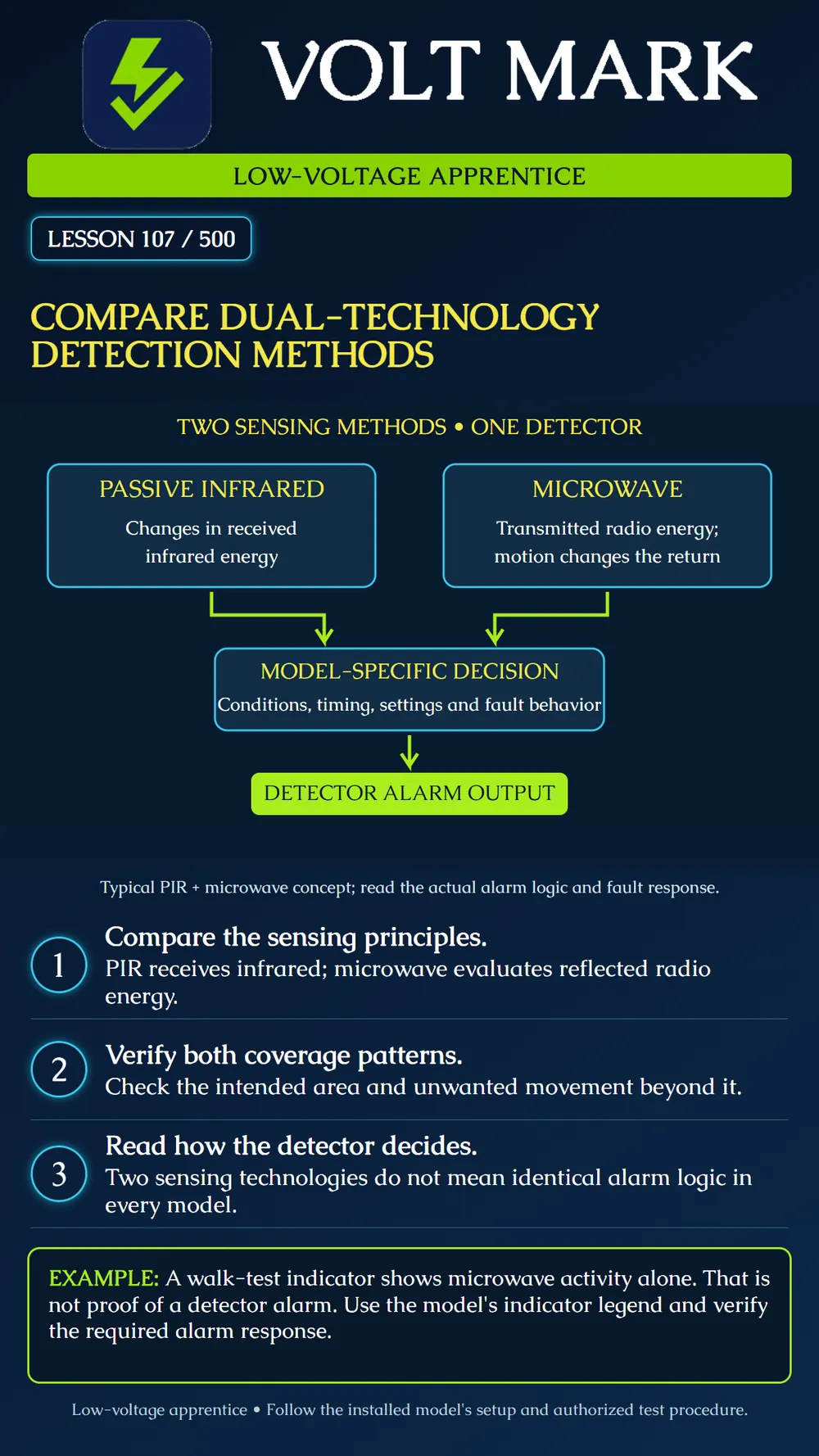
Compare the sensing principles in a typical PIR-plus-microwave intrusion detector and distinguish sensing activity from a confirmed detector alarm.
Passive infrared sensing evaluates changes in received infrared energy. Microwave motion sensing transmits radio energy and evaluates the return for motion-related changes. Bosch identifies its TriTech approach as a combination of PIR and microwave Doppler radar. Combining two methods can help reject disturbances that affect only one method, but installation and product-specific processing still matter. The poster shows conceptual signal flow, not wiring or a specific circuit.
Do not equate dual technology with two infrared elements, two lenses or two communication paths. Those labels describe different design features. Identify the actual sensing methods in the product documentation before comparing devices. The lesson concerns intrusion detection; a door activation sensor or occupancy control may have different intended operation.
A requirement for both technologies is a common normal operating approach, but it is not a universal description of all states. Read the selected model's alarm criteria and fault behavior. For example, the Bosch ZX835 instructions describe separate PIR and microwave walk-test indications, a detector alarm indication, and a default to PIR protection if the microwave subsystem fails. Those statements belong to that model. They do not authorize bypassing a fault or leaving defective equipment in service.
The ZX835 guide also warns that microwave energy can extend through glass and common nonmetallic walls. It directs installers to avoid excessive microwave range, assess the separate coverage patterns and then test detector coverage. PIR masking does not mask microwave coverage. The model's LED legend distinguishes technology activity from unit alarm. Use the exact installed product instructions rather than applying this older model's timings, colors or dimensions to another detector.
An apprentice sees an indicator illuminate during a supervised demonstration and records ALARM PASSED. The instructor asks which indication occurred and which manual defines it. The apprentice finds that the observed indication represented a sensing channel, not the final detector alarm. The original claim was too broad. The corrected record states what was observed and leaves the alarm-output verification open until it is actually completed. No field test result is asserted by this fictional example.
Use an approved training setup with a known model and readable instructions. Ask the instructor to identify the test objective and the evidence needed. If a monitored system is involved, the responsible person must arrange the authorized test status before initiating alarm conditions.
Make a comparison sheet with two columns labeled PIR and MICROWAVE. Enter the manufacturer's description of each method, coverage information and relevant environmental restrictions. In a third section, record what the manual says constitutes a detector alarm. Record fault indication and response separately. If a detail is absent, mark it unresolved and have the supervisor obtain the correct information.
Follow the manufacturer's setup and walk-test sequence under supervision. Observe and record the indication without guessing its meaning. Distinguish the detector indication, panel event and monitoring receipt wherever those separate checks are part of the approved exercise. An observation at one stage does not establish every later stage.
Do not arbitrarily increase range or sensitivity to make a test pass. Document a discrepancy, have the responsible person evaluate it, and retest after an approved correction. Close the exercise by restoring approved settings and system status, with unresolved items assigned for follow-up.
Detector identifier / model / manual revision: PIR sensing and coverage notes: Microwave sensing and coverage notes: Normal alarm decision description: Fault or degraded-operation description: Test route / required response / observed indication: Detector output evidence: Panel or monitoring evidence, if in scope: Discrepancy / corrective action / retest: Restoration confirmed by / date:
Answer: No. Interpret the actual model's indication and alarm criteria.
Answer: No. Communication paths and sensing methods are different features.
Answer: No. Read the model's documented behavior and escalate faults through the approved process.
Researched 2026-09-30: Bosch intrusion detectors product overview, TriTech sensing principles: https://media.boschsecurity.com/fs/media/pb/images/products/intrusion_alarm/dual_motion_detectors/Bosch_intrusion_detectors_product_overview.pdf Bosch ZX835 Installation Instructions, F01U069539-08, sections 2, 6, 8, 9 and 11: https://cdn.commerce.boschsecurity.com/public/documents/ZX835_TriTech_PIR_de_Installation_Manual_enUS_5286890891.pdf The older ZX835 manual supplies a bounded example, not a recommendation to install that model or universal instructions. Diagram, practice, scenario and record form are original teaching material.No universal code, licensing or acceptance claim is made.
Free study material for low-voltage apprentices. This is a national foundation course: requirements differ by state and by local jurisdiction, and a practice that is common in one place is not a rule everywhere. Nothing here is a licence, a certification, or authority to work unsupervised, and completing it does not count as apprenticeship hours or continuing-education credit. Check the codes adopted where you are working, the licensing authority for that work, and your employer's safety programme. VoltMark is not affiliated with, endorsed by, or sponsored by NFPA, OSHA, NICET, BICSI, FOA, or any state or local licensing authority.

Electrician licensing exam prep: practice questions, timed exam simulations, and step-by-step help finding every answer in the NEC.