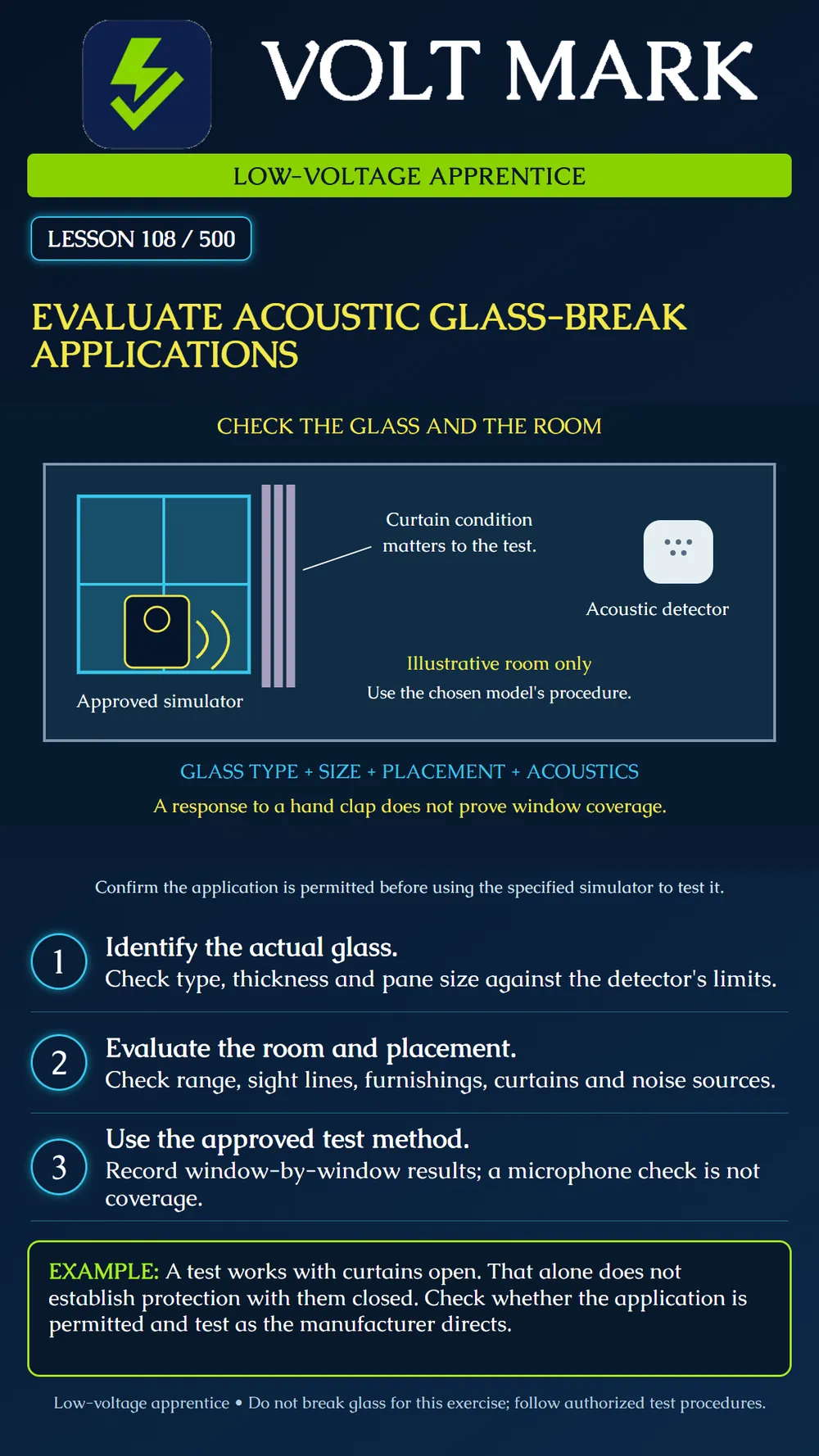
Evaluate whether an acoustic glass-break detector is suitable for a particular glazed opening and room, then distinguish an application check from evidence of successful coverage testing.
An acoustic glass-break detector evaluates sound associated with breaking glass. A product's application limits are part of the design decision. Do not assume that every glass type, thickness, pane size or room arrangement is acceptable. The poster is a conceptual room illustration, not a mounting drawing or a promise that its illustrated arrangement qualifies.
Bosch's DS1101i/1102i/1108i instructions identify specific glass types and sizes, mounting options and a maximum distance to the farthest point of protected glass. They also note reduced range in acoustically soft areas. These restrictions illustrate why a generic statement such as "it covers the room" is not enough. Use the documentation for the exact model rather than borrowing the dimensions of another sensor.
Room suitability matters before testing. Bosch's RADION glassbreak guidance includes restrictions involving noisy equipment, small rooms and sound-deadening window treatments. A passing simulator response does not erase a prohibited application. Resolve conflicts between the actual room and the selected detector's instructions through the responsible designer or supervisor.
Testing must follow the selected model's method. The RADION reference guide describes testing near the protected glass, including behind closed blinds or drapes when present, and warns against exceeding rated range even when the tester produces a response. It distinguishes a hand-clap microphone/power check from an alarm test. Resideo identifies its FG-701 simulator for checking compatible FlexGuard devices. Test tools and procedures are not automatically interchangeable.
A proposed room has two window groups, A and B. A demonstration is performed near group A with the curtains open. The trainee writes "all windows protected." That conclusion is unsupported: group B was not tested, curtain conditions were not evaluated, and the glass construction was not recorded. The corrected training record lists the observation at A, leaves B NOT TESTED and assigns the application questions for resolution. This is a fictional evidence-quality exercise, not a report of field testing.
Use an instructor-approved training system and the correct manufacturer's test equipment. Have the responsible person arrange any required monitoring test status before an alarm test. Do not strike or break a window for this lesson, and do not substitute a phone recording or improvised noise for the required simulator.
Begin with an opening inventory. Assign each pane or window group an identifier. Obtain the glass specification where available; if the type or thickness is unknown, mark it UNKNOWN and have the supervisor resolve it. Record relevant window coverings and normal room use. Keep the proposed detector identity and current instruction revision with this inventory.
Review the application against the manual before marking it suitable. If there is an unresolved exclusion, stop that application decision and request review. An apprentice should not independently waive a product restriction.
When the application is approved, follow the model's complete test sequence under supervision. Identify the test location, simulator, settings, room condition and observed result. Use the product's indication legend. Record detector response separately from any panel or monitoring event checks required by the test plan.
Do not copy a result from one window to another. Retain untested and failed items as open entries. After authorized corrections, retest and record the new evidence without deleting the original discrepancy. Restore the approved configuration and test status through the responsible person's closeout process.
Opening identifier / glass documentation: Glass type / thickness / pane size: Detector model / manual revision: Proposed location / applicable range check: Room use / noise / furnishings: Curtain or blind condition / application restrictions: Approved simulator / settings / test location: Expected indication / actual indication: Panel or monitoring evidence, if in scope: Unresolved item / owner / retest / restoration:
Answer: No. Follow the specified coverage/alarm test.
Answer: No. Suitability and test evidence are separate checks.
Answer: No. It remains untested until the required evidence exists.
Researched 2026-09-30 using primary manufacturer indexed material. Direct retrieval of several PDFs was unavailable; no ambiguous extracted pane-area units are reproduced. Bosch DS1101i/1102i/1108i Installation Instructions: https://cdn.commerce.boschsecurity.com/public/documents/DS1101i_1102i_1108i_Installation_Manual_enUS_2636464651.pdf Bosch RADION glassbreak data sheet: https://cdn.commerce.boschsecurity.com/public/documents/RADION_glassbreak_Data_sheet_enUS_12416698507.pdf Bosch RADION Transmitter Reference Guide, glassbreak testing: https://cdn.commerce.boschsecurity.com/public/documents/RADION_Special_enUS_19054651531.pdf Resideo FG-1625F product page, compatible simulator: https://www.resideo.com/us/en/pro/products/security/wired-sensors/glass-break-wired/0-001-030-01-fg-1625f-flush-mount-glassbreak-detector-0-001-030-01/ Diagram, scenario, practice and record form are original instructional material.No universal licensing, code or acceptance requirement is asserted.
Free study material for low-voltage apprentices. This is a national foundation course: requirements differ by state and by local jurisdiction, and a practice that is common in one place is not a rule everywhere. Nothing here is a licence, a certification, or authority to work unsupervised, and completing it does not count as apprenticeship hours or continuing-education credit. Check the codes adopted where you are working, the licensing authority for that work, and your employer's safety programme. VoltMark is not affiliated with, endorsed by, or sponsored by NFPA, OSHA, NICET, BICSI, FOA, or any state or local licensing authority.
Electrician licensing exam prep: practice questions, timed exam simulations, and step-by-step help finding every answer in the NEC.