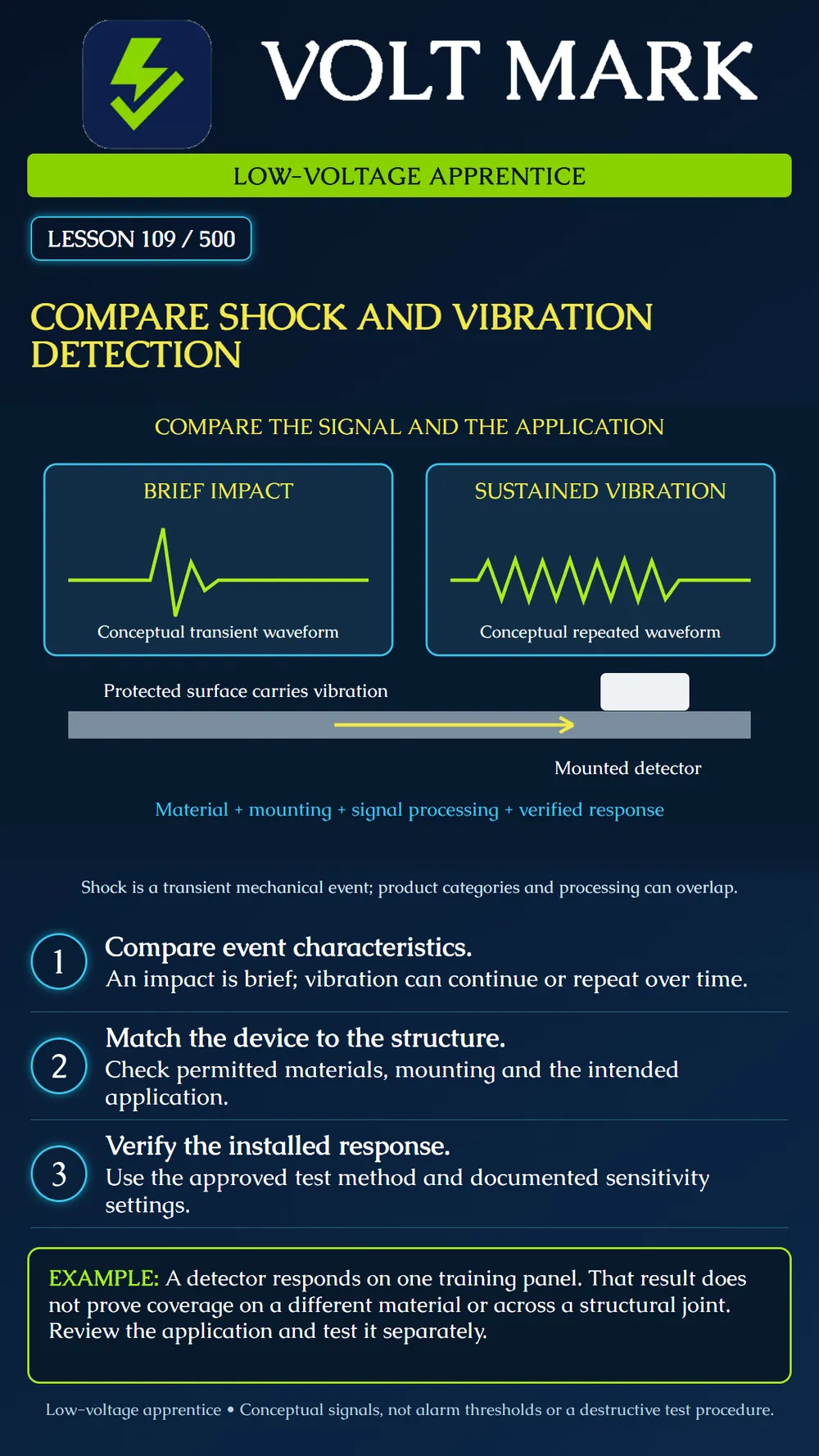
Compare brief mechanical impacts with sustained or repeated vibration, and explain why the detector, structure and mounting must be evaluated together.
A shock is a short mechanical disturbance, such as an impact. Vibration is mechanical motion that may oscillate or repeat. A shock can cause a structure to vibrate, so the terms overlap. They are not universal, mutually exclusive alarm-product categories. The poster's waveforms are conceptual: they have no calibrated axes, frequency, amplitude, time limit or alarm threshold.
A structure-mounted detector receives mechanical disturbance through its mounting connection. This differs from the acoustic glass-break application in Lesson 108, which evaluates sound reaching a microphone. Neither approach automatically substitutes for the other. Select the device for the intended protective function and approved application.
Texecom describes the Impaq S as using accelerometer technology, digital signal processing and selectable sensitivity. Bosch's ISN-SM family illustrates a different application: seismic intrusion detection for protected structures such as safes and vaults. These are examples of product approaches, not a claim that every shock detector is an accelerometer or that every vibration detector protects a safe.
Bosch's application guide describes processing structure-borne signals by strength, frequency and duration. It includes both impact detection and longer-duration integration functions. It emphasizes suitable steel or concrete surfaces, mounting arrangements and application-specific commissioning. Its data sheet ties sensitivity selection to the object, material and interference. A sensitivity label therefore cannot be interpreted independently of the actual product and installation.
An instructor demonstrates a response on training panel A. A trainee proposes using the same result for panel B, made from a different material. The instructor asks for the application instructions and separate test evidence. The original result remains valid only for the conditions recorded on A. B stays NOT TESTED until its suitability is established and its authorized test is completed. No actual installation or field result is claimed by this example.
Use a purpose-made, instructor-approved training assembly. Identify the detector model, instruction revision, mounting arrangement and protected material. Obtain the manufacturer's stated purpose and allowed test method. Do not improvise hammer strikes, drilling, cutting or damage to a customer's structure as a lesson exercise.
Prepare a comparison record before changing settings. Describe the input being evaluated: brief impact, sustained activity or another manufacturer-defined condition. Record what the model is supposed to report. Keep tamper, alarm and any separate diagnostic indication distinct.
Review the physical installation with the instructor. Does the actual mounting match the specified arrangement? Is the material documented? Are separate sections or joints part of the design review? Unknown conditions should remain unresolved rather than being replaced by assumptions. An apprentice should not decide coverage radius from the conceptual waveforms.
Under supervision, perform the approved test at the required locations and record the observed response. Include permitted normal operating conditions in the assessment where the manufacturer's procedure requires them. The goal is evidence for the intended application, not merely obtaining one indicator flash.
If response is missing or unwanted, preserve the original observation. Have the responsible person assess the cause and approve any correction. Do not silence the issue by arbitrarily lowering sensitivity or assert success by simply turning it to maximum. After correction, record the actual retest and restored configuration. Separate local detector observations from panel or monitoring evidence if those checks are included in the authorized exercise.
Detector identifier / model / manual revision: Protected material / object / mounting arrangement: Approved settings: Test method and tool: Test location and conditions: Expected response / observed response: Normal-operation observations: Panel or monitoring evidence, if required: Discrepancy / owner / approved correction / retest: Final settings and restoration confirmation:
Answer: No. An impact can produce vibration.
Answer: No. Evaluate the product and application together.
Answer: No. They illustrate event shapes only.
Researched 2026-09-30: Texecom Impaq S, technology and selectable sensitivity: https://www.texe.com/products/impaq-s/ Bosch ISN-SM Seismic Detectors data sheet, applications and sensitivity selection: https://cdn.commerce.boschsecurity.com/public/documents/ISN_SM_Seismic_Detec_Data_sheet_enUS_2638245003.pdf Bosch Seismic Detectors and Accessories Application Guide I-200153-1, April 2016, general principles, mounting and commissioning sections: https://cdn.commerce.boschsecurity.com/public/documents/Seismic_Detectors_an_Operation_Manual_enUS_32979985931.pdf Historical manufacturer examples do not establish current product availability, US listing suitability or local approval. No European grade is presented as a US requirement. Diagram, scenario, practice and record form are original instructional material.
Free study material for low-voltage apprentices. This is a national foundation course: requirements differ by state and by local jurisdiction, and a practice that is common in one place is not a rule everywhere. Nothing here is a licence, a certification, or authority to work unsupervised, and completing it does not count as apprenticeship hours or continuing-education credit. Check the codes adopted where you are working, the licensing authority for that work, and your employer's safety programme. VoltMark is not affiliated with, endorsed by, or sponsored by NFPA, OSHA, NICET, BICSI, FOA, or any state or local licensing authority.

Electrician licensing exam prep: practice questions, timed exam simulations, and step-by-step help finding every answer in the NEC.