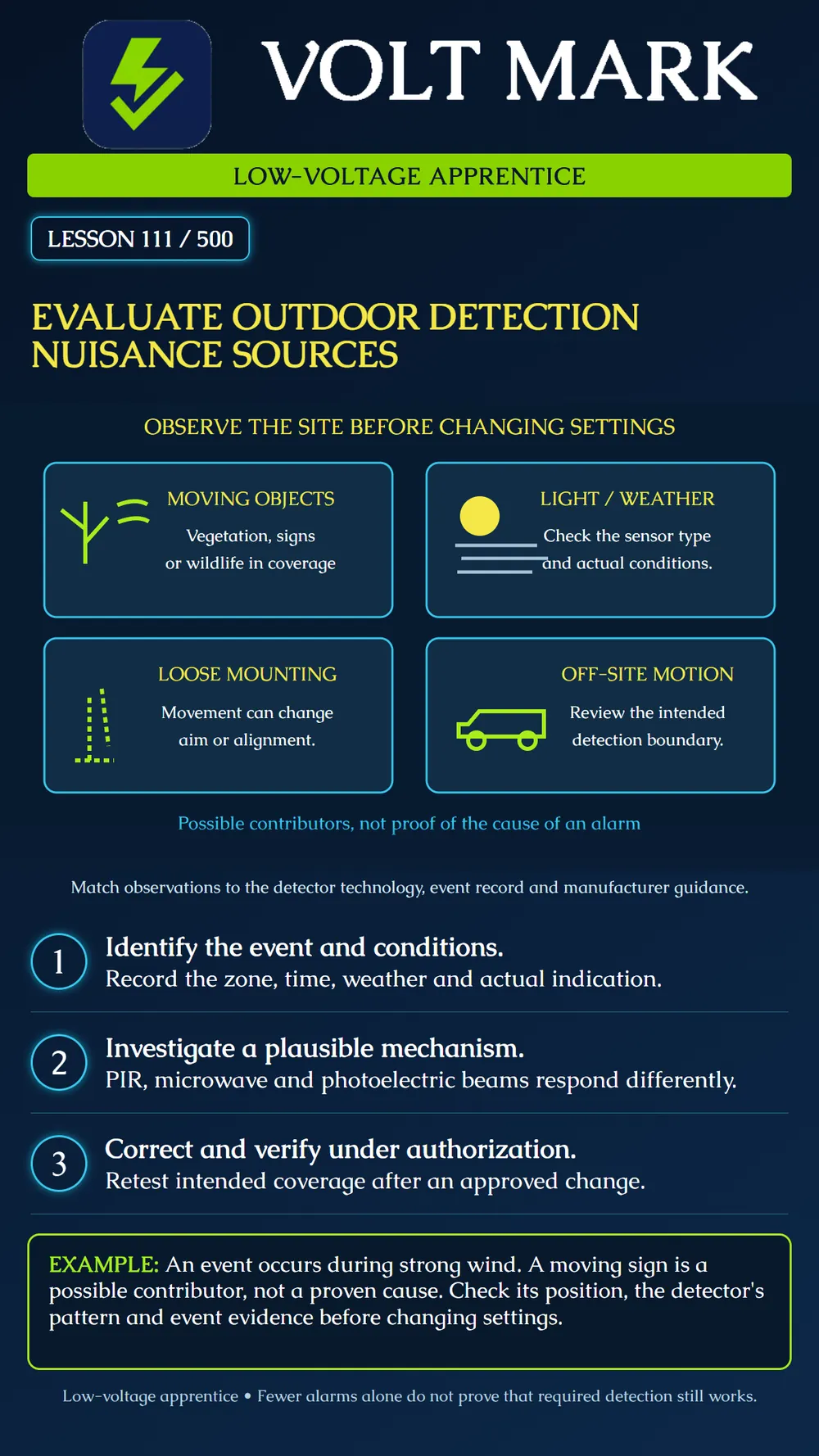
Identify plausible outdoor nuisance contributors, collect evidence and verify that an approved correction preserves intended detection.
An outdoor alarm deserves investigation. The word nuisance describes an unwanted result; it does not identify its cause. Wind, weather or nearby activity may coincide with an event without causing it. Begin with the actual event type and affected device. Alarm, tamper and trouble indications should not be grouped together as though they were identical.
The detector technology matters. PIR evaluates changing received infrared energy. Microwave evaluates reflected radio energy for motion-related changes. Photoelectric intrusion beams evaluate interruption of transmitted light according to their own processing. The same tree, sign or weather condition can interact differently with these technologies.
Bosch's OD850 installation guidance identifies traffic, wind-moved objects, wildlife and unstable mounting as application considerations. It cautions against leaving either sensing channel in a constant alarm condition. Those are product-specific instructions that support careful site evaluation; they are not a universal claim that every moving branch triggers every detector.
OPTEX describes processing that improves immunity to temperature changes and moving vegetation in its Shield range. Such features reduce nuisance susceptibility; they do not remove the need to follow placement restrictions or prove performance at the installed site. For photoelectric beams, the AX-TN/TF instructions address wind-moved obstructions, sunlight at the receiver and solid mounting. The appropriate investigation therefore depends on the chosen device and its actual role.
A training event occurs during strong wind. A sign is moving near the protected route. The apprentice writes "wind caused the alarm." The instructor asks whether the sign was in the detection pattern, which indication occurred and whether the time matched the event log. The supported statement is initially narrower: wind and sign movement were observed and are being investigated. After an approved correction, both nuisance observations and intended detection tests must be recorded. This scenario does not claim a real diagnosis.
Use an authorized system or training setup. Preserve the event record before changing configuration. Record the device identifier, time, event category, zone description, weather observations and available supporting evidence. Note differences between recorded facts and witness reports. If timestamps come from different systems, confirm how they relate before claiming a precise match.
Review the manufacturer's instructions and approved layout. Mark the intended protection boundary and any nearby traffic, vegetation, moving signs or unstable supports. Inspect only within your authorized work area. Do not remove landscaping, relocate equipment, enter traffic or change alarm routing without the responsible person's approval.
Create a short hypothesis table. For each candidate contributor, write the sensing mechanism that could connect it to the event and the evidence needed to evaluate that connection. A blank evidence field means the hypothesis remains unconfirmed. Keep other possibilities open when the facts do not support a single explanation.
Have the supervisor select an appropriate diagnostic or corrective action. Preserve the starting configuration. Avoid changing several unrelated settings at once, since that makes the result difficult to interpret. Do not automatically lower sensitivity, extend interruption timing or disable reporting merely to reduce the alarm count.
After an approved change, repeat the required detection test and document actual results. An absence of unwanted events during a short observation period is not proof of year-round performance. Record the observation conditions and any follow-up needed. Restore approved settings and monitoring status through the site's closeout process.
Device / model / manual / zone: Event category / timestamp / evidence: Observed conditions / witness reports: Candidate contributor and proposed mechanism: Evidence supporting or contradicting it: Approved action / original and final settings: Intended detection test and result: Observation period and conditions: Unresolved concern / owner / follow-up: Restoration confirmation:
Answer: No. It establishes a condition to investigate.
Answer: No. Evaluate the device's sensing mechanism and instructions.
Answer: No. Required detection must still be verified.
Researched 2026-09-30: Bosch OD850 installation guidance, indexed primary manufacturer excerpt: https://cdn.commerce.boschsecurity.com/public/documents/Bosch_OD850_Installation_Manual_all_2627312395.pdf OPTEX Shield Detector Series: https://optexamerica.com/intrusion-detection/shield-detector-series OPTEX AX-TN/TF manual, outdoor installation precautions: https://s3-eu-west-1.amazonaws.com/optex-europe/sensor-downloads/Intrusion-Detection/Manuals/optex-ax-tn-tf-manual-en.pdf?mtime=20170307130142 Examples do not establish current listing suitability or authorize an alarm-system design change. No blanket claim of false-alarm immunity is made. Diagram, scenario, practice and record form are original teaching material.
Free study material for low-voltage apprentices. This is a national foundation course: requirements differ by state and by local jurisdiction, and a practice that is common in one place is not a rule everywhere. Nothing here is a licence, a certification, or authority to work unsupervised, and completing it does not count as apprenticeship hours or continuing-education credit. Check the codes adopted where you are working, the licensing authority for that work, and your employer's safety programme. VoltMark is not affiliated with, endorsed by, or sponsored by NFPA, OSHA, NICET, BICSI, FOA, or any state or local licensing authority.

Electrician licensing exam prep: practice questions, timed exam simulations, and step-by-step help finding every answer in the NEC.