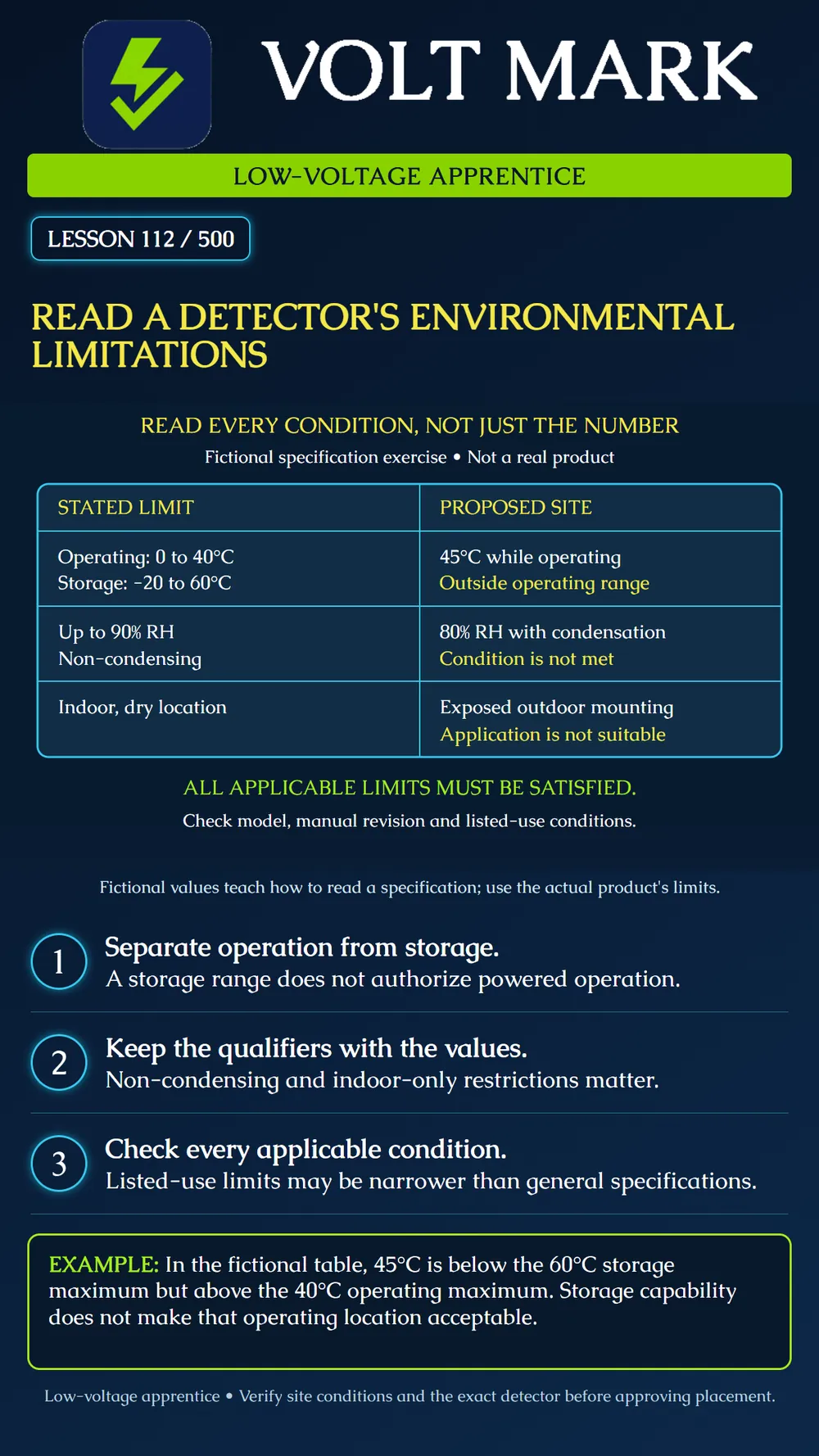
Read environmental specifications as a set of conditions and compare them with the intended installation without confusing storage capability, operating limits or qualified use.
A detector specification is more than a maximum temperature. Record the exact model and document revision, then identify the permitted operating temperature, humidity conditions and installation environment. Keep qualifications attached to each value. If a document gives different limits for a particular listed application, the general figure is not permission to ignore that qualification.
A primary example appears in Bosch's Commercial Series TriTech+ anti-mask A&E specification for ISC-CDL1-WA15G, WA15H and WA15K. It distinguishes general environmental figures from narrower limits for UL certified installations, and qualifies relative humidity as non-condensing. This lesson uses that example to teach careful reading, not to determine whether a particular installation is approved.
Operating and storage limits answer different questions. A stored, unpowered unit and a working detector may have different allowable conditions. When a manufacturer combines those ranges, read that statement exactly; when it separates them, do not interchange them. An enclosure rating, temperature range and humidity restriction are also different attributes. No single favorable entry establishes suitability by itself.
The poster's invented device is rated for operation from 0 to 40°C, storage from -20 to 60°C, humidity up to 90% RH without condensation, and indoor dry use. These values are not taken from a real product and must not be used to select equipment.
Case A proposes operation at 45°C. This is 5°C above the fictional operating maximum. The higher storage maximum does not resolve the mismatch. Case B proposes 80% RH with condensation present. The percentage is below 90%, but the non-condensing condition is not met. A humidity percentage alone does not establish that condensation cannot occur on a surface. Case C proposes exposed outdoor mounting. That does not satisfy the fictional indoor dry restriction.
Each case fails a different condition. A single passing item cannot cancel another failed item. The purpose is to identify the mismatch and request an appropriate design decision, not to invent a field workaround.
Select an instructor-approved detector and obtain its current installation instructions and specification. Record the exact variant, including suffixes. Create a table with one row per relevant environmental condition. Copy the units and qualifiers accurately into the training record, with a source reference. Mark an absent or unclear requirement UNKNOWN rather than guessing.
Describe the actual proposed location with the instructor. Separate measured observations from expected extremes and from information still needed. A comfortable room temperature during one visit does not establish conditions when heating or cooling is unavailable. Record the basis for expected conditions and have the responsible person resolve uncertainties.
Compare each applicable specification with the proposed conditions. Use a clear outcome for each row: meets the documented condition, does not meet it, or unresolved. This exercise is not permission for an apprentice to approve the final system design.
If a mismatch exists, have the responsible person review another suitable location, equipment choice or manufacturer-approved arrangement. Do not wrap a sensor, add an improvised cover or assume a generic box will preserve detection and environmental suitability. Document the approved resolution and any required installation or performance verification.
Retain the original comparison so a later change in room use, equipment or environmental control can be assessed against it. The record should show what was evaluated and what remains open.
Device model and variant: Document title / revision / source: Operating range and qualifications: Storage range: Humidity range and condensation restriction: Permitted location / environmental rating: Specific listed-use conditions: Observed conditions / expected extremes / evidence: Comparison result for each requirement: Unresolved item / responsible reviewer / resolution:
Answer: No. Read the operating limit.
Answer: No. The non-condensing condition must also be met.
Answer: No. Check all applicable environmental and use conditions.
Researched 2026-09-30: Bosch Commercial Series TriTech+ anti-mask A&E specification, environmental section, primary manufacturer indexed text: https://cdn.commerce.boschsecurity.com/public/documents/Commercial_Series_Tr_A_E_Specification_enUS_19467937035.pdf The table, numeric cases, practice and record form are original fictional teaching material. No real detector is assigned the fictional limits. No blanket code or jurisdictional requirement is asserted.
Free study material for low-voltage apprentices. This is a national foundation course: requirements differ by state and by local jurisdiction, and a practice that is common in one place is not a rule everywhere. Nothing here is a licence, a certification, or authority to work unsupervised, and completing it does not count as apprenticeship hours or continuing-education credit. Check the codes adopted where you are working, the licensing authority for that work, and your employer's safety programme. VoltMark is not affiliated with, endorsed by, or sponsored by NFPA, OSHA, NICET, BICSI, FOA, or any state or local licensing authority.

Electrician licensing exam prep: practice questions, timed exam simulations, and step-by-step help finding every answer in the NEC.