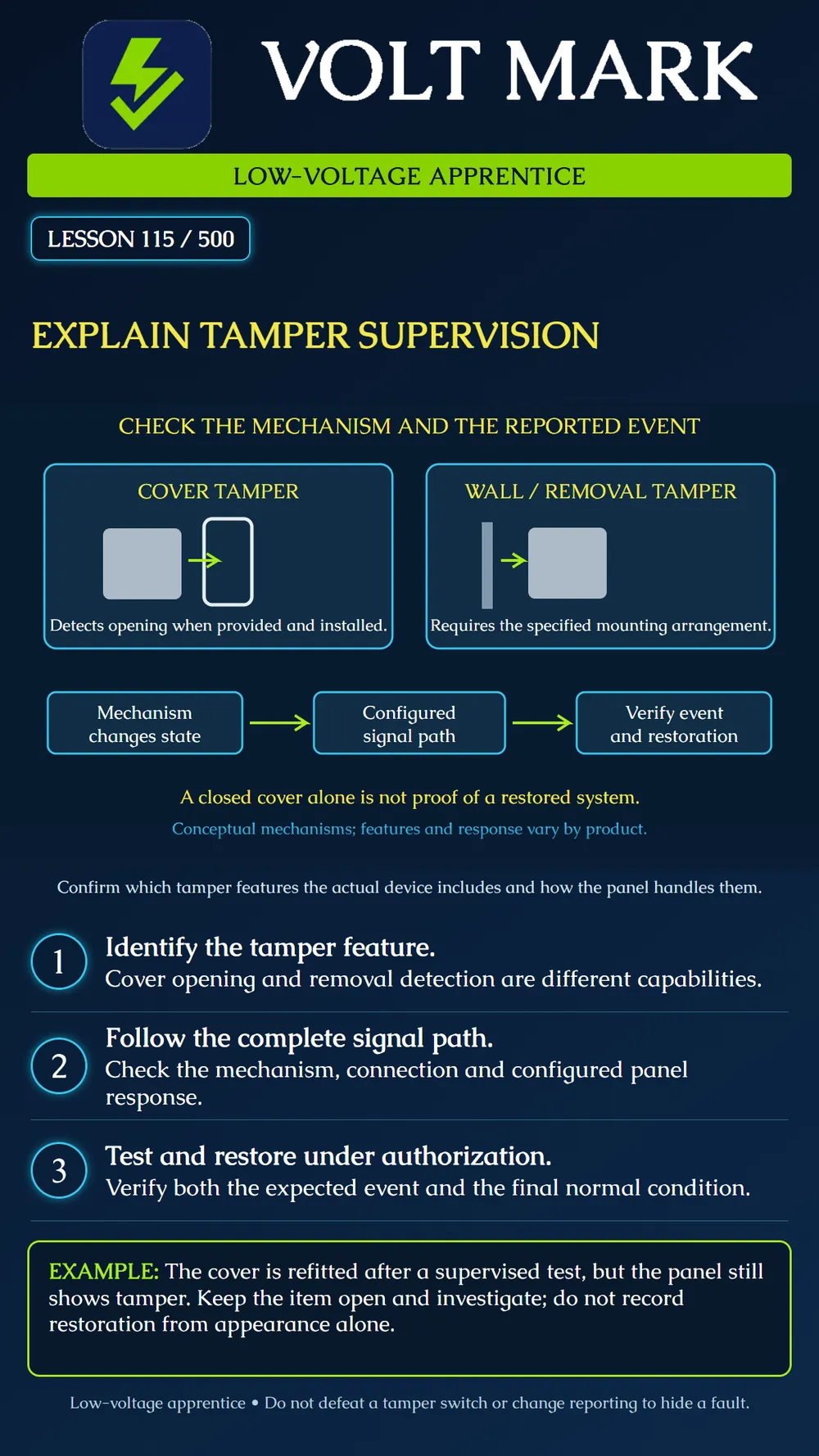
Explain device tamper detection and verify the complete path from a physical condition to a reported event and restoration.
A tamper feature monitors a condition associated with interference or access to equipment. A cover mechanism may detect enclosure opening. A wall or removal mechanism may detect separation from the mounting arrangement. These capabilities are not identical, and not every device includes both. Use the exact model instructions to identify what is monitored and how it must be installed.
Bosch's RADION PIR reference material describes cover and wall tamper signaling separately from wireless supervisory transmissions and battery reporting. Its RADION TriTech data sheet likewise describes signaling when the device is removed from its base or mounting surface. These are bounded product examples; a tamper feature on another device may work differently.
The physical mechanism is only the start of the signal path. A wired device may provide a tamper contact for an approved circuit, while a wireless device may transmit a tamper status. The compatible panel must receive and interpret the condition according to its configuration. A local switch movement alone is not proof of panel receipt or monitoring-center receipt.
Keep tamper supervision distinct from other checks. A wireless supervision message relates to communication monitoring; it is not itself proof that a cover switch operates. A low-battery event is different again. The panel's terminology, timing, audible behavior and reporting depend on the documented system. Do not assume tamper disappears simply because a partition is disarmed.
A trainee completes an authorized cover-opening test and replaces the cover. The panel continues to display a tamper condition. The trainee initially records "restored" because the enclosure looks closed. The instructor corrects the record: physical reassembly was observed, but system restoration remains unresolved. The next step is to follow the approved troubleshooting procedure and verify the final indication. This is a fictional example, not an actual field result.
Use an instructor-prepared training assembly. Obtain the exact device and panel instructions. Identify the supported cover and removal features without assuming a generic drawing matches the device. Ask the instructor to define the test method, expected indication and evidence required.
Before initiating a tamper, the responsible person must arrange the authorized service or monitoring test status. Disarming is not a substitute for that process. Do not remove a production device from a wall, pull on its wiring or alter a breakaway mounting feature as an improvised exercise.
Trace the documented signal path. Record the device identifier and the receiving zone or point. If a wired tamper contact is used, identify its role on the approved drawing. If wireless status is used, identify the enrolled device. Do not invent terminal assignments, resistor values or event labels.
Have the instructor perform or supervise the prescribed test. Record the exact physical condition and time, the local observation, and the panel indication. Document remote receipt separately if that check is part of the authorized plan. A feature that was not tested remains NOT TESTED.
Restore the mounting and cover exactly as instructed. Confirm the panel's required restoration state and complete any documented acknowledgment or reset process through the authorized person. Retain any active indication for investigation. Do not tape a switch down, bridge its circuit or suppress reporting to produce a normal display.
Close the exercise by confirming the approved configuration, enclosure condition and monitoring status. Record unresolved items, their owner and the required retest. Test evidence should show both the initiated condition and its restoration.
Device / model / manual revision: Supported cover and removal features: Required mounting arrangement: Panel point / signal path / configured response: Authorized test method and service status: Physical condition / time: Local observation / panel event: Remote receipt, if required: Restoration observation and final status: Open issue / owner / retest / closeout:
Answer: No. Confirm the actual feature set.
Answer: No. These are distinct checks.
Answer: No. Verify the required final indication and closeout.
Researched 2026-09-30 using primary manufacturer indexed material: Bosch RADION Transmitter Reference Guide, RFPR-12 PIR section: https://cdn.commerce.boschsecurity.com/public/documents/RADION_Special_enUS_19054651531.pdf Bosch RADION TriTech data sheet, cover and wall tamper: https://boschsecurityq.blob.core.windows.net/public/documents/RADION_TriTech_Data_sheet_enUS_11161300619.pdf Diagram, practice, scenario and record form are original teaching material. No universal response, timer, remote reporting or feature guarantee is made.
Free study material for low-voltage apprentices. This is a national foundation course: requirements differ by state and by local jurisdiction, and a practice that is common in one place is not a rule everywhere. Nothing here is a licence, a certification, or authority to work unsupervised, and completing it does not count as apprenticeship hours or continuing-education credit. Check the codes adopted where you are working, the licensing authority for that work, and your employer's safety programme. VoltMark is not affiliated with, endorsed by, or sponsored by NFPA, OSHA, NICET, BICSI, FOA, or any state or local licensing authority.

Electrician licensing exam prep: practice questions, timed exam simulations, and step-by-step help finding every answer in the NEC.