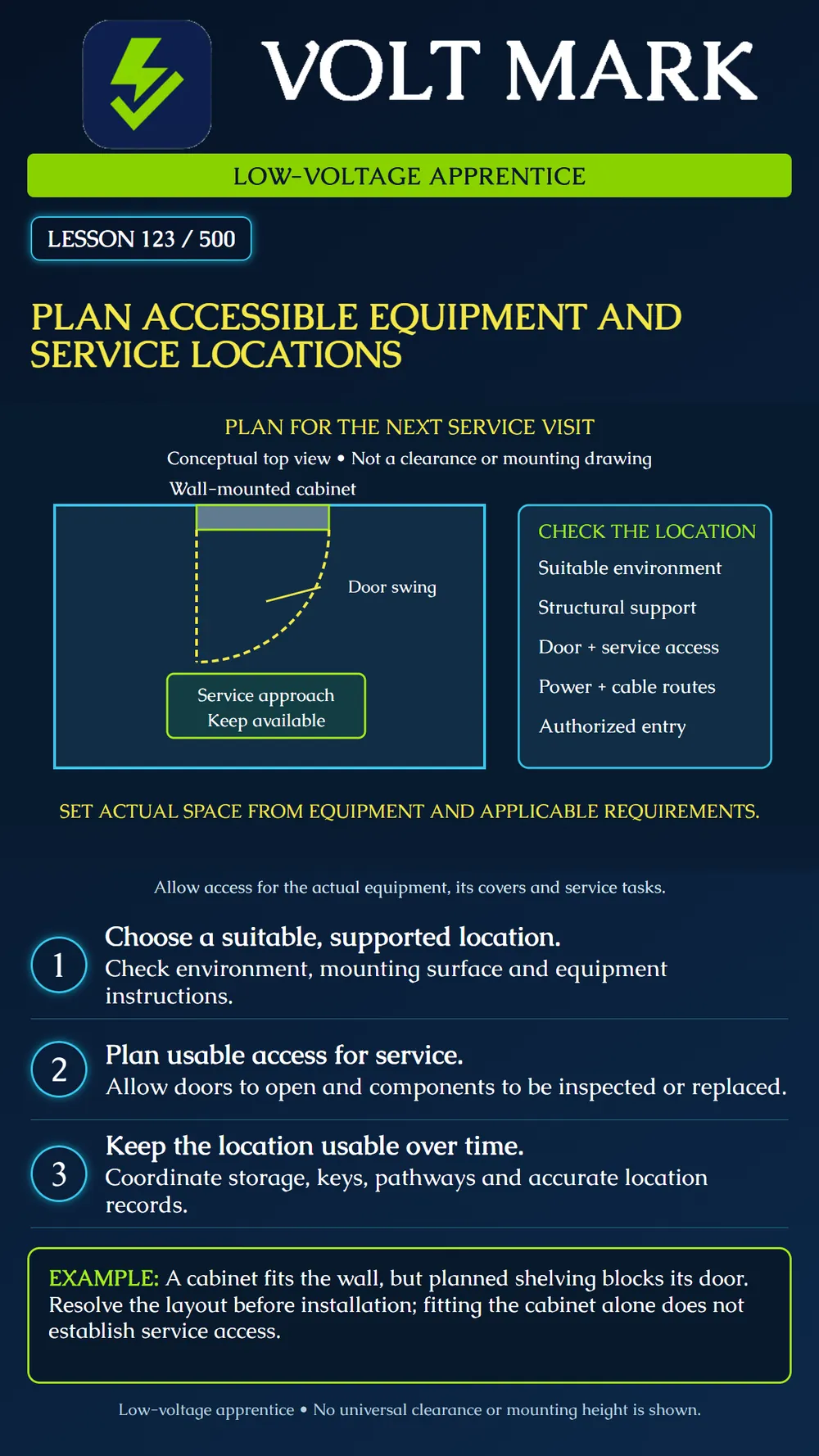
Evaluate proposed intrusion equipment locations for their environment, mounting support and practical access throughout installation and service.
A cabinet can fit on a wall and still be difficult to inspect or maintain. Plan the location around the actual equipment and the work people must perform there. Include opening the cover, reading identification, inspecting connections and replacing permitted components under the applicable service procedure.
Start with the selected equipment instructions. As a specific example, DSC's PowerSeries Pro enclosure guidance calls for a dry location near the required power and communications connections. It also requires mounting support suitable for the enclosure and its contents rather than relying on drywall alone. These instructions belong to that equipment; do not turn one enclosure's fastener or loading specifications into rules for every low-voltage cabinet.
Different equipment serves different users. The cited DSC keypad guidance places that keypad where it can be reached from designated entry and exit points in a dry, secure location. A control cabinet's authorized service access and a user's keypad access are separate design considerations. Resolve the actual locations through the approved project design and applicable requirements.
Review the environment, wall construction, service approach and nearby activities. Check whether future storage, equipment or furniture could obstruct access. Record uncertain conditions instead of approving them from appearance. If wall construction is unknown, obtain the information needed for the mounting design before selecting attachment hardware.
The poster is a top-view teaching sketch. The shallow rectangle against the wall represents a cabinet. Its dashed yellow arc indicates a door-opening concept; the actual hinge, opening angle and door dimensions depend on the selected enclosure. The green area represents an approach for service. Its drawn size is not a prescribed clearance.
The sketch contains no dimensional scale. It does not establish compliance, an installation height or a complete working-space arrangement. Determine actual space using equipment instructions, the tasks involved and applicable project and jurisdiction requirements. Review any nearby electrical equipment separately with the responsible qualified person.
First, identify what will occupy the cabinet and what must be removed during service. Check the model's enclosure dimensions and cover arrangement. Consider the access needed to inspect labels and perform the specified maintenance. Do not assume opening the door a few inches is enough.
Next, review the route to the equipment. A locked room can protect equipment, but authorized service personnel still need a defined access process. Record the responsible contact and approved key or access arrangement in the appropriate controlled records. Keep passwords and alarm credentials out of general equipment-location notes.
Coordinate cable and power routes with the responsible trades. Show the proposed routes and unresolved constraints on the plan. Proximity to an outlet does not establish that its supply is suitable or that all electrical work is within an apprentice's authorization. The project team must resolve the actual supply arrangement.
Finally, consider how the room will be used after handover. Mark the agreed equipment location and access area on the coordination drawing. Confirm that the site's planned storage layout preserves the required access. Changes to shelving should trigger review rather than quietly turning a service area into storage.
A proposed cabinet fits between two shelves. On the arrangement drawing, the left shelf extends into the cabinet door's opening path. The correct action is to resolve the conflict before mounting. Do not mark the location accepted solely because the cabinet width fits. Record the revised arrangement and who approved it. No specific shelf spacing is implied by this example.
On a training plan, mark a cabinet and a keypad as separate items. For each, list the people who need access and the normal tasks performed there. Review the selected equipment manual with your supervisor. Identify one mounting question, one environmental question and one service-access question. Use a cardboard outline or measured drawing where authorized; do not open energized equipment to perform this planning exercise.
Equipment tag/model; room and wall; drawing revision; environmental suitability; mounting-support reference; cover/door access; service approach; power and cable-route coordination; authorized access process; storage conflict; unresolved issue and owner; approval and date.
Primary manufacturer sources checked September 30, 2026: DSC / Johnson Controls, PowerSeries Pro Reference Manual 1.3.1, Mounting the enclosure: https://docs.johnsoncontrols.com/dsc/r/DSC/en-US/PowerSeries-Pro-Reference-Manual/1.3.1/Installation/Alarm-controller-installation/Mounting-the-enclosure DSC / Johnson Controls, PowerSeries Pro keypad installation instructions, Mount the Keypad: https://docs.johnsoncontrols.com/dsc/r/DSC/en-US/HS2LCDWF-V-PRO-HS2LCD-RF-PROx-HS3LCDWF-V-PRO-HS3LCD-RF-PROx-Installation-Instructions/Mount-the-Keypad Manufacturer examples are bounded to those products. The conceptual sketch and coordination exercise are original teaching material, not an engineered layout or jurisdiction-specific compliance determination.
Free study material for low-voltage apprentices. This is a national foundation course: requirements differ by state and by local jurisdiction, and a practice that is common in one place is not a rule everywhere. Nothing here is a licence, a certification, or authority to work unsupervised, and completing it does not count as apprenticeship hours or continuing-education credit. Check the codes adopted where you are working, the licensing authority for that work, and your employer's safety programme. VoltMark is not affiliated with, endorsed by, or sponsored by NFPA, OSHA, NICET, BICSI, FOA, or any state or local licensing authority.

Electrician licensing exam prep: practice questions, timed exam simulations, and step-by-step help finding every answer in the NEC.