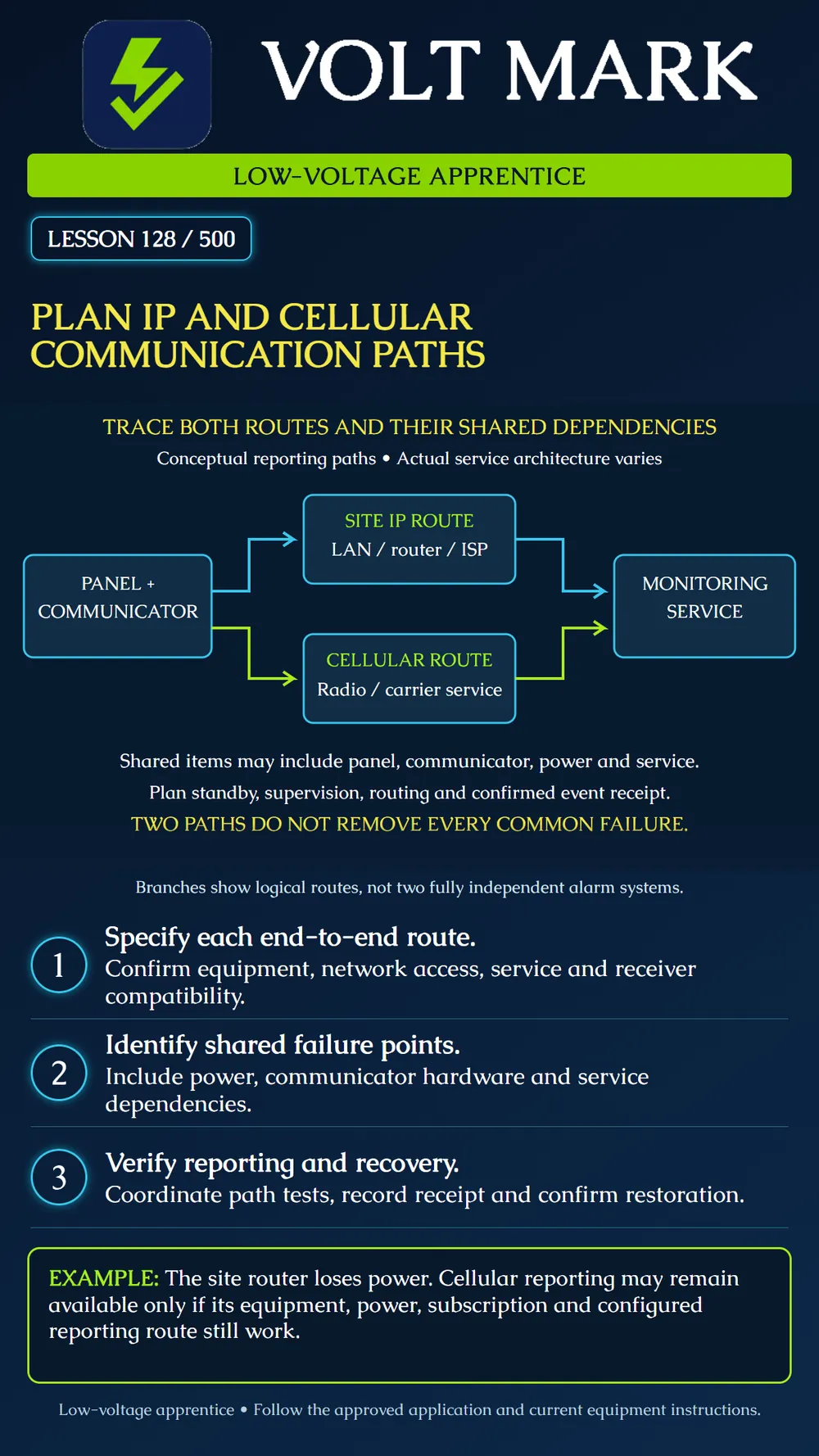
Draw the intended alarm-reporting routes, identify their dependencies and define the evidence needed to verify each required path.
A reporting path connects the alarm equipment to the intended receiving service. Trace the entire route rather than stopping at an Ethernet connector or cellular signal indicator. The plan must match the panel, communicator, network arrangement, service account and receiver support.
The poster shows a conceptual panel and communicator with two branches. One uses a site's LAN, router and internet service. The other uses a cellular radio and carrier service. Both lead to the monitoring service. Intermediate service infrastructure is simplified. Cellular service may itself use IP technology; the diagram distinguishes the site's internet route from the cellular access route, not mutually exclusive data protocols.
A manufacturer example is Resideo's LTEM-P family, which describes cellular paired with Ethernet or optional Wi-Fi for dual-path communication. Those alternatives do not mean every interface can be treated as an additional independent route. Verify the exact model and supported configuration. DSC's documentation also distinguishes communications routing and receiver supervision settings. Follow the actual system's instructions rather than applying another model's menu choices.
Identify the network equipment between communicator and service. Record which organization manages it and what connectivity requirements must be resolved. Coordinate approved addressing and network access with the responsible network administrator. Do not assume a link indicator proves that an event reached the intended receiver.
Consider the power available to every required local network component. Backing up the alarm panel alone does not supply the site's router, switch or internet termination equipment. Record which dependencies have verified standby arrangements and which remain unresolved. No universal standby duration is specified by this lesson.
Confirm the correct communicator, service activation and installation requirements for the site. Verify radio performance using the equipment procedure at the intended installed location. A carrier name or nearby phone signal does not establish the alarm communicator's performance. An antenna and a registered account serve different purposes; neither should be assumed from the other.
Document who owns the service relationship and who handles failures or changes. Equipment support, carrier arrangements and service availability can change. This lesson makes no claim that a particular carrier or technology is available at every site.
The two branches may share the alarm controller, communicator, enclosure, local power and receiving-service infrastructure. Drawing two lines does not eliminate these common dependencies. Identify the actual shared elements so the responsible designer can evaluate the application.
A training arrangement has a site-router route and a cellular route. The router loses power. That removes a component of the site route. Cellular reporting may remain possible if its own equipment and service are operational and the reporting configuration supports the required behavior.
Do not record successful backup operation merely because the cellular indicator remains on. The exercise needs evidence of the required event reaching the correct account through the intended route. Likewise, do not assume the communicator sends simultaneously on both branches. Primary/backup selection, retries, routing and supervision are model- and configuration-dependent.
With the instructor and responsible service personnel, define the permitted tests and expected observations. Identify which training event will be used, how its route will be confirmed and where receipt will be checked. Distinguish an event-delivery test from a supervision or path-failure indication test.
Coordinate any intentional path interruption in advance. Use only the approved training method and avoid disrupting unrelated network users. Record expected and observed event identity, route evidence, receipt time and system indication. Confirm recovery and the final restored state after the exercise. A timestamp alone does not establish a universal acceptable delivery interval; acceptance criteria come from the approved application.
Panel/communicator models; diagram revision; route A and B components; network/service owner; account/receiver reference in controlled records; power dependencies; configured routing; supervision requirements; unresolved prerequisites; test authorization; observed receipt evidence; restoration result. Keep service passwords and other secrets outside ordinary lesson worksheets.
Checked September 30, 2026: Resideo, LTEM-P Advanced Modular Communicator: https://www.resideo.com/us/en/pro/solutions/security/ltem-p-communicator/ DSC / Johnson Controls, Panel/Receiver Communication Paths: https://docs.johnsoncontrols.com/dsc/r/DSC/en-US/PowerSeries-Pro-Reference-Manual/1.3.1/Programming/Programming-descriptions/Partition-Setup/300-Panel/Receiver-Communication-Paths DSC / Johnson Controls, System Toggle Options: https://docs.johnsoncontrols.com/dsc/r/DSC/en-US/PowerSeries-Pro-Reference-Manual/1.3.1/Programming/Programming-descriptions/Communicator-Programming/851-Alternate-Communicator-Programming/System-Options/005-System-Toggle-Options Product references support the distinction between supported routes, routing choices and supervision. Diagram and failure exercise are original conceptual material, not a universal architecture or approval determination.
Free study material for low-voltage apprentices. This is a national foundation course: requirements differ by state and by local jurisdiction, and a practice that is common in one place is not a rule everywhere. Nothing here is a licence, a certification, or authority to work unsupervised, and completing it does not count as apprenticeship hours or continuing-education credit. Check the codes adopted where you are working, the licensing authority for that work, and your employer's safety programme. VoltMark is not affiliated with, endorsed by, or sponsored by NFPA, OSHA, NICET, BICSI, FOA, or any state or local licensing authority.
Electrician licensing exam prep: practice questions, timed exam simulations, and step-by-step help finding every answer in the NEC.