Prepare a traceable mapping between a system event and its monitoring record, then distinguish expected mappings from verified received information.
A monitoring record needs to identify the right account, event and source. A message reaching a receiver is only part of that task. Its decoded fields and site description must also agree with the intended installation.
Keep the account reference, partition or area, event meaning and source identifier separate. Depending on the event, a source field can refer to a zone, user or other system component. A user number is not a zone number, and neither is a secret access code. Use the selected reporting format's documentation to interpret each field.
The cited DSC SIA example includes an account with the transmission and distinguishes a new event, area, burglary event and zone. Its reporting tables distinguish zone and user identifiers. This illustrates why a worksheet must preserve the meaning of each field instead of copying a number without context. It does not establish the exact message layout or screen labels used by every receiver.
Begin with the approved zone list, panel configuration and monitoring-provider account information. Confirm the intended reporting format and receiver destination through the responsible parties. Use controlled project records for actual account identifiers. Keep credentials and verification passphrases out of general training worksheets.
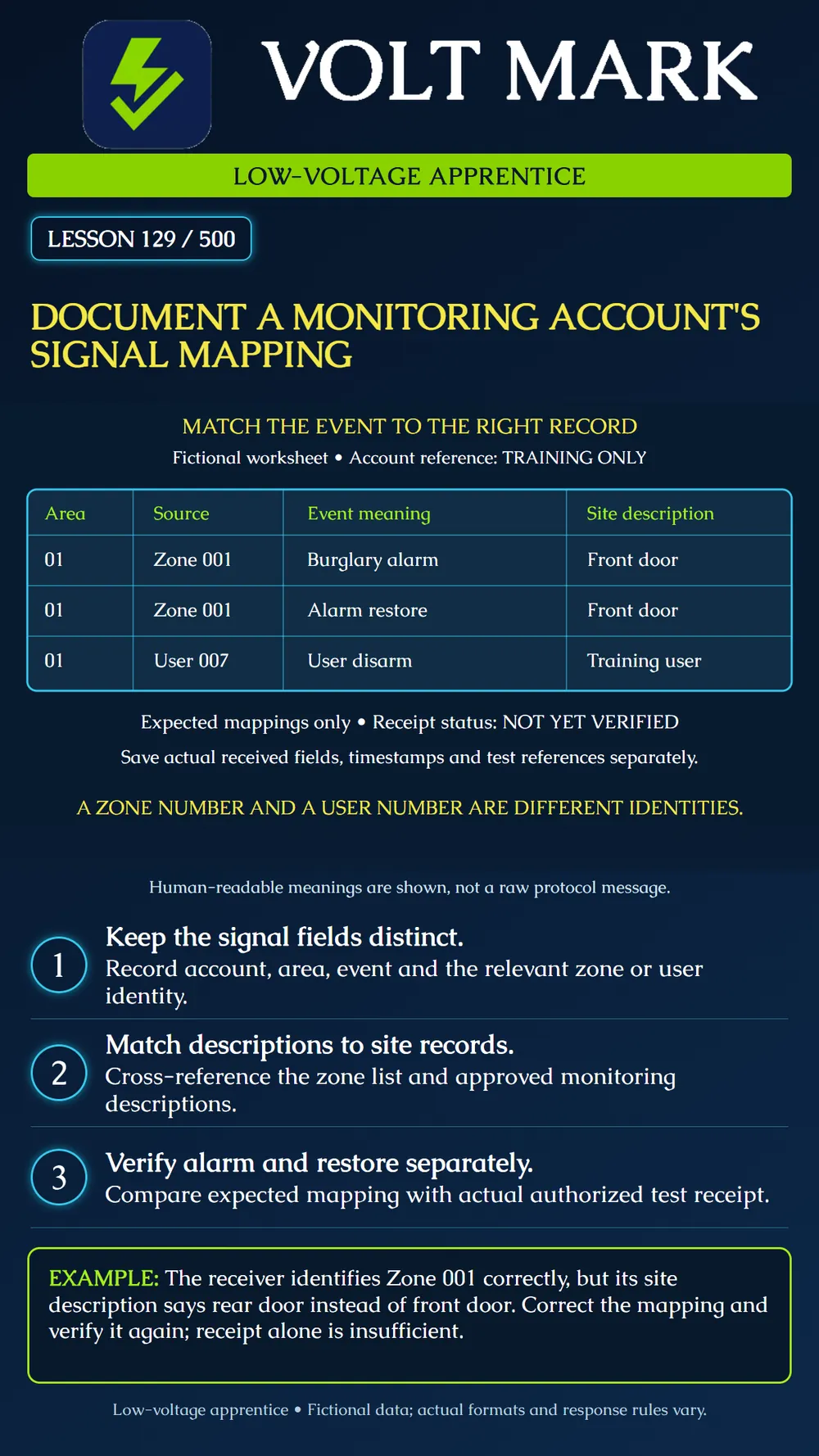
The poster uses TRAINING ONLY as a placeholder account reference. It is not an account number to enter into equipment. Area 01 | Zone 001 | Burglary alarm | Front door Area 01 | Zone 001 | Alarm restore | Front door Area 01 | User 007 | User disarm | Training user
These are human-readable expected meanings, not literal protocol strings. The three rows do not claim that any test signal has been received. Each begins with receipt verification pending.
The first two rows refer to the same zone but different event meanings. The third identifies a user-related operation. User 007 is a fictional record identifier, not a PIN. Whether that operation is reported and what the receiving system calls it depend on the actual configuration and service.
A zone label on the local keypad may not be the description in the monitoring provider's database. Compare them through the approved process rather than assuming a label change updates every destination.
For example, the provider receives Zone 001 but its database describes that zone as the rear door. The project zone list identifies Zone 001 as the front door. Delivery occurred, yet the mapping is wrong. Resolve the discrepancy with the responsible parties, record the change and verify the intended description again.
A restore should remain distinct from the original alarm and from a user's disarming action. Do not use those terms interchangeably. The cited DSC restore option also shows that restore transmission timing can depend on configuration. Do not assume every system reports a restore immediately when a contact closes.
Use separate worksheet columns. Expected information comes from the approved design and provider setup. Observed information comes from an authorized test and the actual receiving record. Leave an observed field pending if you do not have evidence.
For each permitted test, identify the physical source, intended event and expected account/area/source fields. Coordinate with the provider before generating signals. Capture the received event description, source fields, timestamp with time reference and provider test reference. Compare them with the expected row. Verify the restore where required and document its actual meaning.
Provider receipt does not itself prove that a dispatch, notification or other response occurred. Response rules belong in the approved service arrangement and should be checked separately. This lesson does not authorize live alarm activation or changes to dispatch handling.
Use the three fictional rows and a simulated receiver printout supplied by the instructor. Introduce one wrong description, one missing restore and one user/zone mix-up. Identify each discrepancy. Mark missing evidence pending rather than inventing a successful result. Write who must resolve each issue and what evidence will close it.
Account reference; panel and provider; format/version; event meaning; partition/area; source type and number; field-device tag or approved user reference; expected site description; actual received fields; event and receipt timestamps; test authorization/reference; restore result; discrepancy owner; correction and retest date.
Checked September 30, 2026: DSC / Johnson Controls, SIA Format - Level 2: https://docs.johnsoncontrols.com/dsc/r/DSC/en-US/PowerSeries-Pro-Reference-Manual/1.3.1/Reporting-codes/SIA-Format-Level-2-Hard-Coded DSC / Johnson Controls, Restore On Bell Timeout: https://docs.johnsoncontrols.com/dsc/r/DSC/en-US/PowerSeries-Pro-Reference-Manual/1.3.1/Programming/Programming-descriptions/System-Communications/380-Communicator-Option-1/2-Restore-On-Bell-Timeout Manufacturer references support bounded field distinctions and configuration-dependent restore behavior. The table, mismatch scenario and practice activity are original fictional material.
Free study material for low-voltage apprentices. This is a national foundation course: requirements differ by state and by local jurisdiction, and a practice that is common in one place is not a rule everywhere. Nothing here is a licence, a certification, or authority to work unsupervised, and completing it does not count as apprenticeship hours or continuing-education credit. Check the codes adopted where you are working, the licensing authority for that work, and your employer's safety programme. VoltMark is not affiliated with, endorsed by, or sponsored by NFPA, OSHA, NICET, BICSI, FOA, or any state or local licensing authority.

Electrician licensing exam prep: practice questions, timed exam simulations, and step-by-step help finding every answer in the NEC.