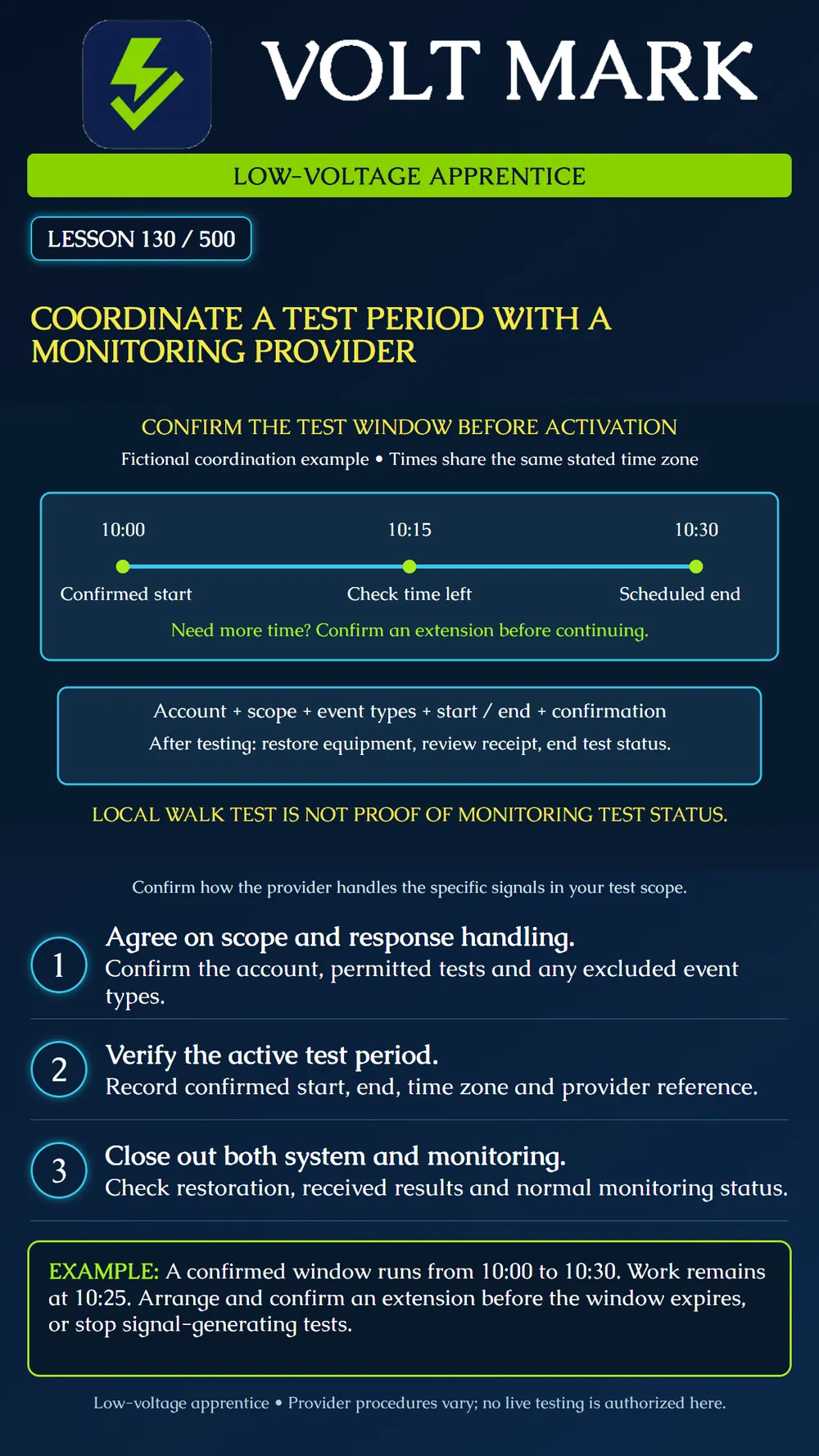
Plan and document an authorized monitoring test period with a confirmed scope, timing, received results and return to normal monitoring.
Coordinate before generating test signals. Confirm the correct site and account through the provider's approved process, identify the authorized requester and describe the work. Agree on which signals and areas are included, how those signals will be handled, and when the test period begins and ends.
A local device test, a panel walk test and a monitoring-account test period serve different purposes. Do not assume that entering a panel menu changes the monitoring provider's response status. Verify the applicable procedure for the actual system and service.
Alarm.com's published customer procedure is one example: authorized logins can request a monitoring-station test duration, and that account automatically leaves test mode when the selected period ends. ADT's published Luna panel guidance separately describes panel sensor verification and a complete sensor signal test involving central monitoring receipt. These examples show why the exact test function and its duration matter; they are not instructions for every product.
List the planned device or event checks and the affected account or areas. Ask how the provider will handle the specific signals. Include any event categories that require separate arrangements. Do not assume a generic test-status confirmation covers every emergency, panic or other event type.
Confirm whether the selected mode allows the signals needed for a receipt test to reach the provider. A mode that prevents transmission cannot by itself prove successful receipt. Similarly, a provider's temporary handling change does not necessarily silence local sounders. Coordinate local impacts with the responsible site representative and occupants as applicable.
Record the provider confirmation reference, start, scheduled end and time zone. Protect authentication secrets; a general test worksheet should not contain the passphrase used to verify the account. Use the approved service channel rather than relying on an unverified contact.
The poster shows a confirmed 10:00 to 10:30 period using one stated time zone. It lasts 30 minutes. At 10:15, 15 minutes remain. At 10:25, five minutes remain. Those numbers describe the fictional schedule, not a recommended duration for all work.
The learner checks progress before the end. If more time is needed, the authorized person requests and obtains confirmation of an extension. A request is not confirmation. If no extension is confirmed, stop signal-generating tests before the current window expires and coordinate the next step. Do not assume an open app screen or ongoing work keeps a timed status active.
Follow the approved test sequence and record what was actually generated. Compare each required received signal with the expected account, source and event meaning. Include required restorations. Record timestamps and the provider's evidence or test reference.
A test period is permission and coordination for particular work, not a pass result. A signal not found in the receiver history remains unresolved. Investigate through the agreed process rather than repeatedly generating unplanned alarms.
Return devices and equipment to the intended condition using the approved procedure. Review active troubles, bypasses and unresolved issues with the responsible person. Do not hide a failed test or remove evidence merely to make the status appear normal.
Finish the provider's end-test process and confirm normal monitoring status. Automatic expiry, where supported, does not replace checking the actual final condition. Document equipment restoration and monitoring restoration separately. Confirm the planned final armed or disarmed state with the site representative.
If a defect prevents full restoration, notify the responsible owner and service personnel through the agreed process and document the remaining condition and next action. Do not sign off that the system is fully restored when it is not.
Use a simulated provider conversation and worksheet. One learner requests a test period; another supplies a confirmation that accidentally lists the wrong end time. Find and correct the mismatch before beginning the simulated test. Later introduce an incomplete signal list. Mark the missing receipt pending and plan the follow-up without inventing a pass.
Site/account reference; authorized requester; provider channel/reference; approved scope and exclusions; signal handling agreed; confirmed start/end/time zone; extension confirmation if needed; test events and receipts; device restoration; outstanding issues; confirmed end of test status; final monitoring/system state; responsible handover contact.
Checked September 30, 2026: Alarm.com, Put a system in test mode with the monitoring station: https://answers.alarm.com/Customer/Website_and_App/System_Management/System_Usage/Put_a_system_in_test_mode_with_the_monitoring_station ADT, Luna Simple Touchscreen Panel, System/Sensor Tests: https://help.adt.com/article/Luna-Simple-Touchscreen-Panel-Simple-1 The workflow and timed example are original instructional material. Provider-specific features are bounded examples, not universal response suppression or testing permissions.
Free study material for low-voltage apprentices. This is a national foundation course: requirements differ by state and by local jurisdiction, and a practice that is common in one place is not a rule everywhere. Nothing here is a licence, a certification, or authority to work unsupervised, and completing it does not count as apprenticeship hours or continuing-education credit. Check the codes adopted where you are working, the licensing authority for that work, and your employer's safety programme. VoltMark is not affiliated with, endorsed by, or sponsored by NFPA, OSHA, NICET, BICSI, FOA, or any state or local licensing authority.

Electrician licensing exam prep: practice questions, timed exam simulations, and step-by-step help finding every answer in the NEC.