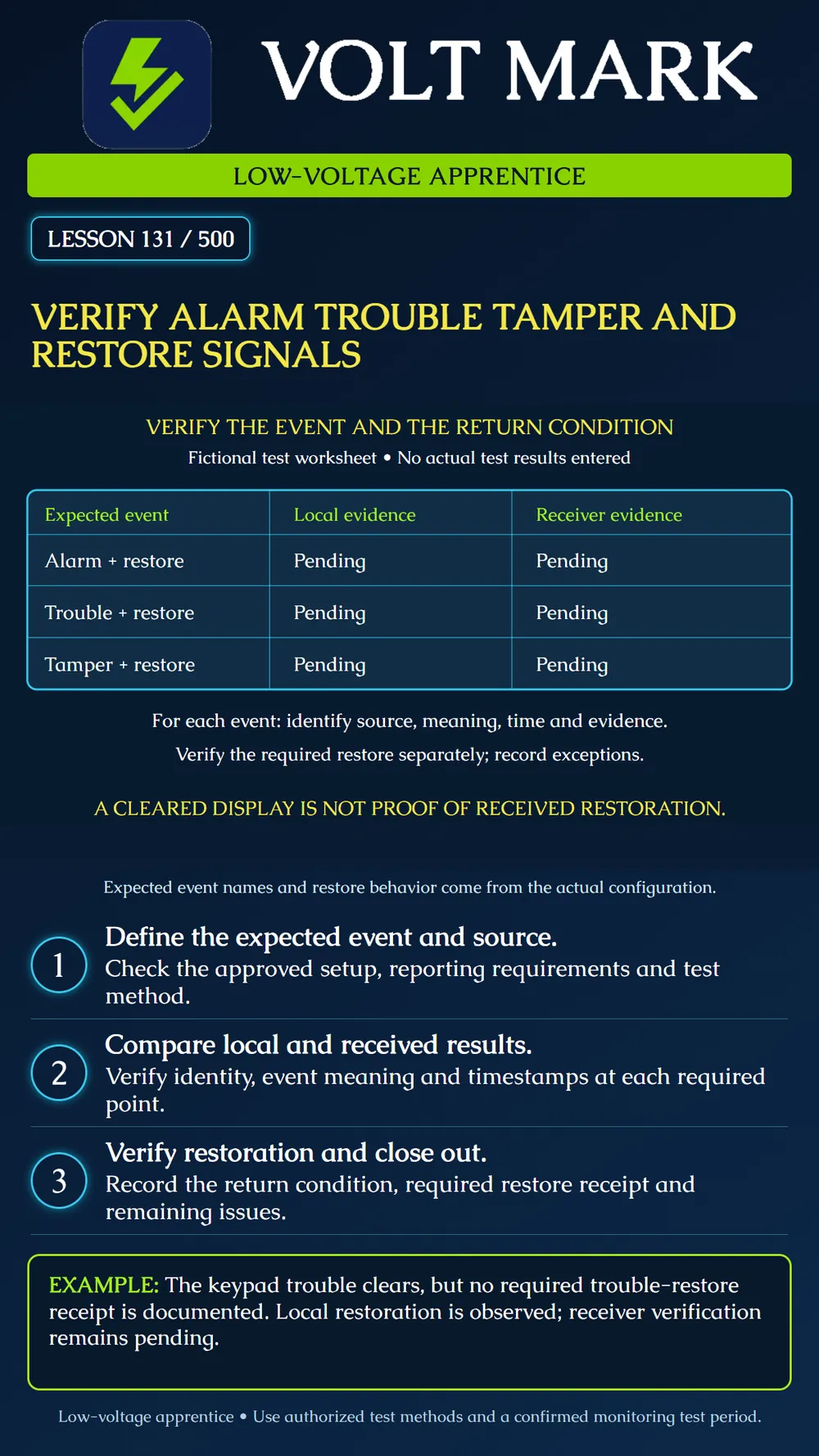
Verify intended alarm, trouble, tamper and restoration behavior using separate local and receiving-system evidence.
Start by defining what the selected system should report for each approved test. An alarm, trouble and tamper are different event meanings. Their classification, indication and reporting depend on the equipment, input arrangement and programming. A physical action does not have one universal event name across every product.
Generally, an alarm represents a configured alarm condition, a trouble identifies a system or operational problem, and a tamper concerns monitored interference such as an enclosure condition. These are learning categories, not a substitute for the actual event definitions. Check the selected model's manual and approved configuration.
DSC's cited reporting tables list zone alarms, zone restores, tamper/restores and fault/restores separately. They also identify some equipment tampers separately from zone events. This illustrates why the record needs both event meaning and source identity. Do not label every received trouble as a zone alarm or assume every source number represents a field zone.
Use the coordinated test-period process from Lesson 130. Identify the account, areas and event types included, and confirm the provider's handling. Define each expected result and a manufacturer-supported test method with the instructor. Do not improvise fault conditions by cutting cables, shorting powered terminals or disconnecting essential site equipment.
Record the current baseline before the test: relevant system state, existing troubles and any approved bypasses or test settings. An old unresolved condition can otherwise be mistaken for the new test result. Set the expected observation points and acceptance criteria from the approved application.
Observe the local indication or event record and identify its source. Then compare the corresponding received information where reporting is required. Include account, partition or area, source type/number, event meaning and time reference. A local indication alone does not prove successful remote receipt. Conversely, a receiver event with the wrong description or identity is not a complete pass.
The poster's table is a blank fictional planning matrix. Every local and receiver cell is pending. Each row groups an event with its restore for illustration; in a working test record, give each transition its own observations and timestamps. The diagram contains no actual passed tests.
An instructor supplies a simulated log with a trouble event and a later local cleared indication. The receiving log contains the trouble but no required restore. Record the trouble receipt as observed and the restore receipt as pending. Do not mark the whole row passed because the keypad now appears normal.
Resolve whether the expected restore should have been transmitted under the actual configuration and test conditions. Check the approved reporting requirement, timing and event definition before deciding whether the missing record is a failure or an incomplete observation. Document the determination and supporting evidence.
A restore reports a transition according to the system's defined logic. It is not automatically equivalent to disarming, silencing a sounder, acknowledging an event or physically correcting every possible problem. Verify the real equipment condition as well as required reporting.
The cited DSC restore option demonstrates configuration-dependent transmission timing and conditions. Therefore, this lesson provides no universal number of seconds within which every restore must appear. Record the configured behavior and evaluate the actual result against it.
After the permitted exercise, confirm the intended final system state. Review outstanding troubles, bypasses and temporary settings. End the provider's test period through the approved process and confirm the monitoring state. If a condition remains unresolved, report and document it rather than recording full restoration.
Use an instructor-prepared simulated set containing an alarm/restore pair, a tamper event with the wrong source identity, and a trouble event with missing restore evidence. Link each observation to the expected test case. Separate identity mismatches from absent evidence. Write the next verification step for each unresolved item. Do not use this paper exercise as authorization to activate a live alarm.
Test case; authorization/reference; equipment/model and configuration; expected event/source; approved stimulus; local observation/time; received account/area/source/event/time; expected restoration condition; local restore evidence; received restore evidence; acceptance criteria; discrepancy and owner; retest result; final state. Store actual account data under the project's access controls and omit secret credentials.
Checked September 30, 2026: DSC / Johnson Controls, PowerSeries Pro, SIA Format - Level 2 and reporting table: https://docs.johnsoncontrols.com/dsc/r/DSC/en-US/PowerSeries-Pro-Reference-Manual/1.3.1/Reporting-codes/SIA-Format-Level-2-Hard-Coded DSC / Johnson Controls, Restore On Bell Timeout: https://docs.johnsoncontrols.com/dsc/r/DSC/en-US/PowerSeries-Pro-Reference-Manual/1.3.1/Programming/Programming-descriptions/System-Communications/380-Communicator-Option-1/2-Restore-On-Bell-Timeout The matrix and simulated log activity are original teaching material. No physical tests or monitoring-provider actions were performed for this lesson.
Free study material for low-voltage apprentices. This is a national foundation course: requirements differ by state and by local jurisdiction, and a practice that is common in one place is not a rule everywhere. Nothing here is a licence, a certification, or authority to work unsupervised, and completing it does not count as apprenticeship hours or continuing-education credit. Check the codes adopted where you are working, the licensing authority for that work, and your employer's safety programme. VoltMark is not affiliated with, endorsed by, or sponsored by NFPA, OSHA, NICET, BICSI, FOA, or any state or local licensing authority.
Electrician licensing exam prep: practice questions, timed exam simulations, and step-by-step help finding every answer in the NEC.