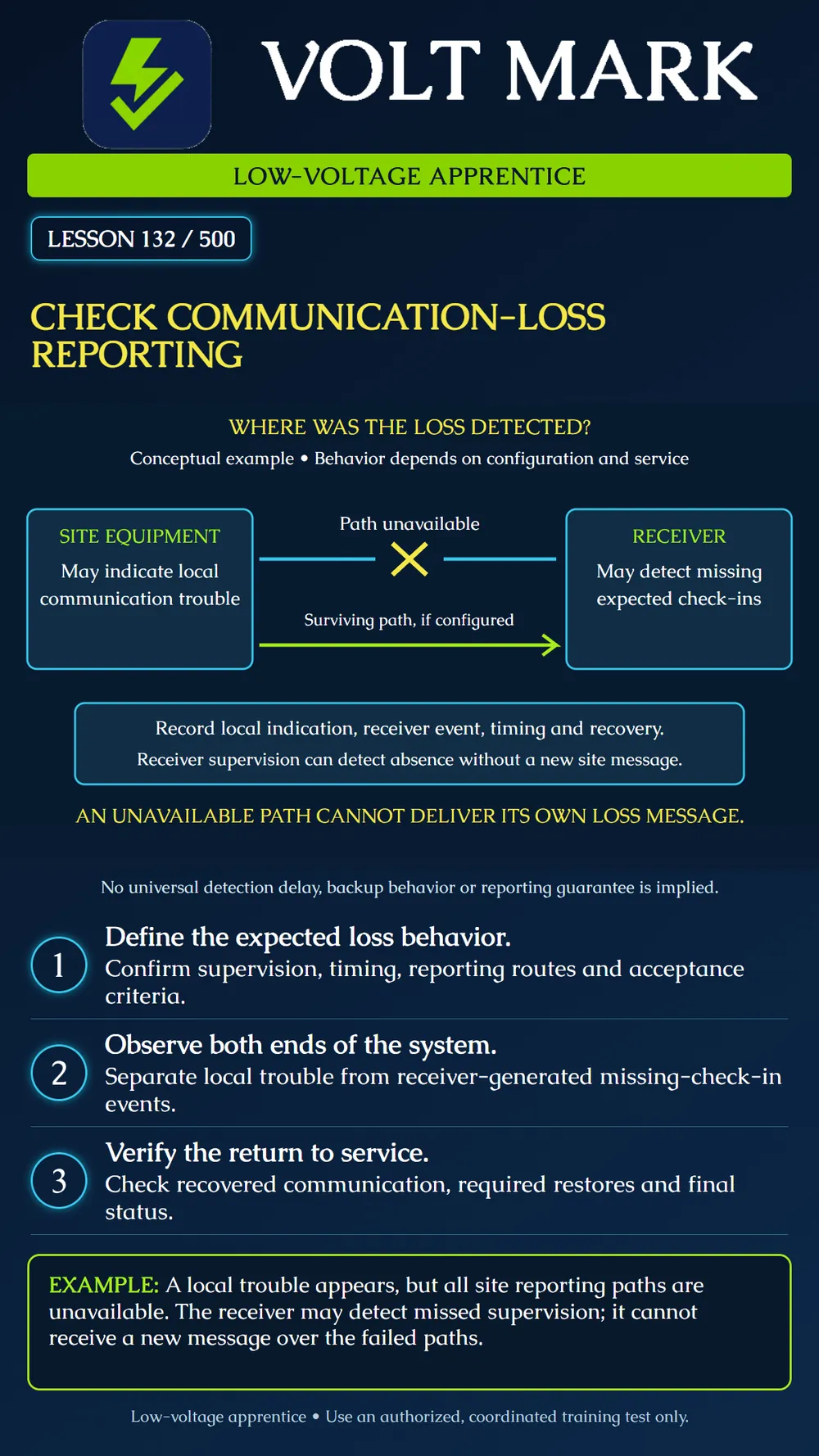
Distinguish local communication trouble, reporting through a surviving path and receiver-side detection of missed supervision, then document recovery.
Communication loss can be observed at different points. Site equipment may detect a local link problem or a failure to obtain the expected response. A receiver may detect that expected check-ins have stopped arriving. These observations are related, but they are not the same event or necessarily simultaneous.
A completely unavailable path cannot carry a newly transmitted message about its own failure. A working alternative may carry that message if the equipment and configuration support it. Separately, a receiver can detect the absence of expected communication using its configured supervision rules. Identify which mechanism produced the recorded event.
The cited DMP communication guide distinguishes check-in supervision, receiver fail timing and a communication-trouble message sent through a backup method when configured. DSC's documentation describes heartbeat supervision and path-related options. These manufacturer examples support the distinction between local detection, alternate reporting and receiver supervision; their settings must not be mixed into a universal procedure.
Before a training exercise, document the actual panel, communicator, receiver arrangement and enabled supervision. Establish the approved timing expectations and evidence needed at each end. A check-in interval alone does not necessarily equal the complete time until a missing-panel event, operator notification or other response.
Coordinate the test scope with the instructor, site representative and monitoring provider as appropriate. Confirm the test period and handling of the specific communication events. Obtain an approved method that does not interrupt unrelated users or equipment. Do not improvise by disconnecting production network infrastructure or disabling all protection.
The upper line on the poster represents an unavailable reporting path. The lower line represents a surviving route only if it exists, is operational and is configured for the required reporting. It is not a promise that every system has automatic backup.
Case A: One path fails and the remaining route works. Record the local indication, any event received through the surviving route and the receiver's supervision state. Confirm which route carried the event using the available approved evidence. The existence of a second connector does not establish success.
Case B: All site reporting paths are unavailable. A new site-generated message cannot traverse those failed paths. A supervised receiver may instead create an event because expected communication is missing. Label that evidence as receiver-generated rather than pretending it was transmitted by the panel.
The diagram shows these mechanisms conceptually. It contains no actual test results, device-specific delay values or instructions for interrupting a live system.
Record when the approved test condition starts, including the time reference. Observe the local equipment's exact indication and event identity. Ask for the receiving-system evidence through the agreed process. Record whether the event originated at the site or was generated by receiver supervision, if established.
Compare observed timing with the approved expectations. Do not mark a result passed merely because a trouble eventually appears. If an expected event is absent, document the missing evidence and investigate the configuration, observation window and actual test scope with the responsible person.
The meanings of link loss, failure to communicate, receiver supervision failure and missing check-in depend on the product. Preserve the actual event description in the record instead of renaming every condition communication failure and losing useful detail.
Restore the test condition using the approved procedure. Verify that communication actually resumes; a plugged-in cable alone is not sufficient evidence. Check required restore or recovery reporting, local status and receiver status separately. Some products use specific recovery logic, so follow the current instructions.
Return temporary settings and monitoring status to the agreed final condition. Document any unresolved trouble and hand it over to the responsible person. Do not record normal service if confirmation is missing.
Use simulated logs from the instructor. One log shows local trouble followed by a backup-route report. Another shows no received panel message but a receiver-generated missing-check-in event. Identify the different evidence paths. Add a recovery row for each and mark any absent evidence pending. No live network interruption is required for this exercise.
Test authorization; equipment and software; reporting routes; supervision configuration reference; approved detection/notification expectations; interruption method; start time; local event/time; received or receiver-generated event/time; route evidence; restored communication evidence; required restore receipt; final local/receiver states; unresolved issue and owner.
Checked September 30, 2026: DMP, Communication guide LT-2815, check-in/fail-time and communication-trouble discussion: https://assets.dmp.com/assets/LT-2815.pdf DSC / Johnson Controls, PowerSeries Pro, System Toggle Options: https://docs.johnsoncontrols.com/dsc/r/DSC/en-US/PowerSeries-Pro-Reference-Manual/1.3.1/Programming/Programming-descriptions/Communicator-Programming/851-Alternate-Communicator-Programming/System-Options/005-System-Toggle-Options The diagram and cases are original instructional examples. No universal timeout, live interruption or successful monitoring test is claimed.
Free study material for low-voltage apprentices. This is a national foundation course: requirements differ by state and by local jurisdiction, and a practice that is common in one place is not a rule everywhere. Nothing here is a licence, a certification, or authority to work unsupervised, and completing it does not count as apprenticeship hours or continuing-education credit. Check the codes adopted where you are working, the licensing authority for that work, and your employer's safety programme. VoltMark is not affiliated with, endorsed by, or sponsored by NFPA, OSHA, NICET, BICSI, FOA, or any state or local licensing authority.

Electrician licensing exam prep: practice questions, timed exam simulations, and step-by-step help finding every answer in the NEC.