Use event history to form and investigate evidence-based hypotheses while preserving required protection.
Begin by establishing what happened. The report of a nuisance alarm is a starting description, not proof that the detector malfunctioned or that no genuine event occurred. Follow the site's response process for any unresolved real alarm before treating it as a maintenance problem.
Preserve the relevant records using authorized access. Keep the original event export or observations intact and work from a copy for analysis. Include events before and after the alarm, such as arming, disarming, trouble, tamper and restoration, when available. A short alarm-only extract may hide important context.
DSC's PowerSeries Pro documentation describes a timestamped event buffer containing event descriptions and relevant identifiers, with finite capacity before rollover. This illustrates two practical points: record identity and timing carefully, and preserve available history before older entries are replaced. Actual capacity and export options depend on the model.
Verify how timestamps should be interpreted. Check date, time zone, clock accuracy and any known changes. A panel event time and a monitoring receipt time may differ. Do not silently rewrite the original times to make them agree. Record any known offset and how it was determined.
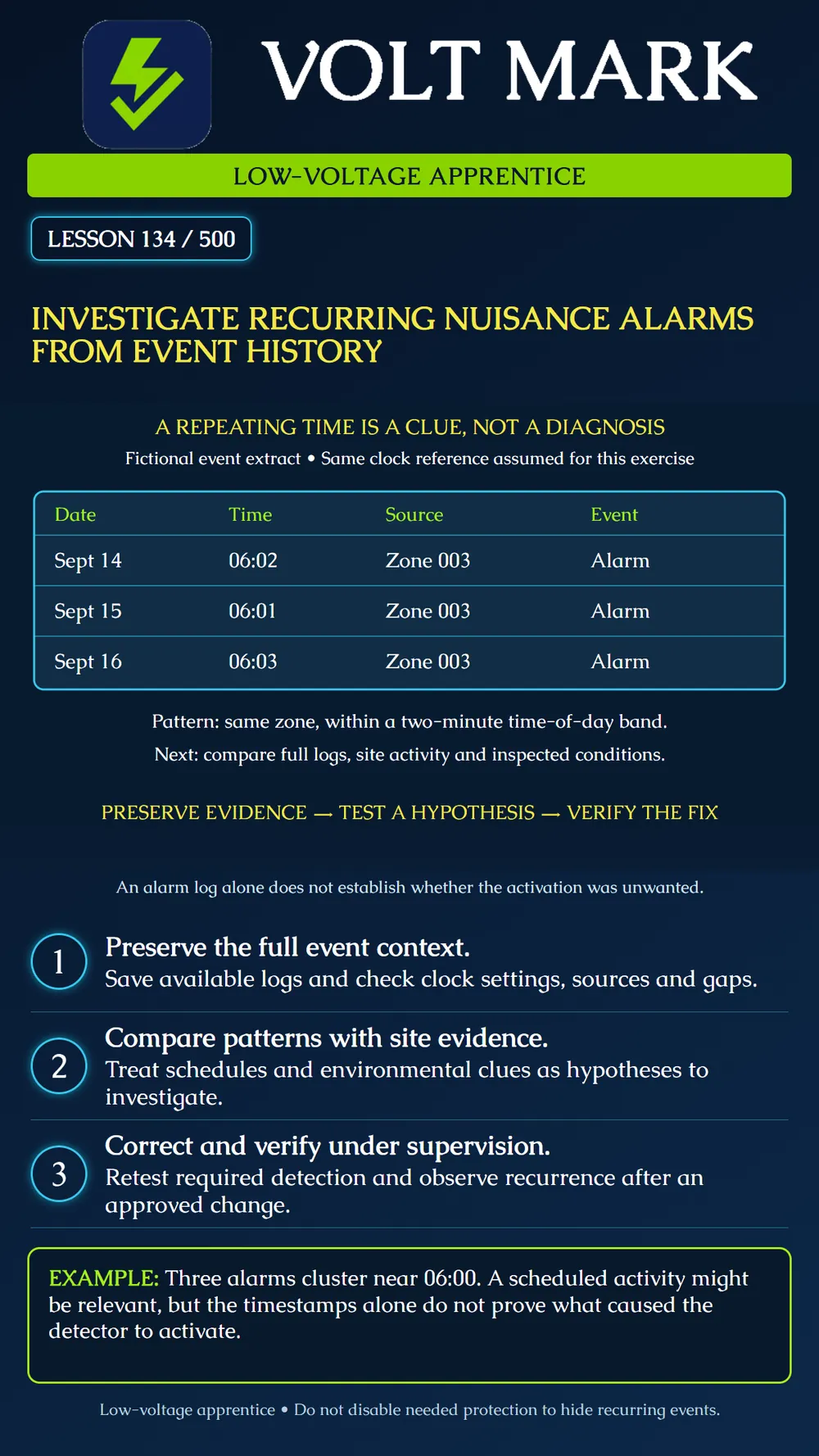
The poster contains three invented alarm rows: September 14, 06:02, Zone 003. September 15, 06:01, Zone 003. September 16, 06:03, Zone 003.
For this exercise only, the dates and times are assumed to use a consistent clock reference. The earliest time of day is 06:01 and the latest 06:03, a two-minute band. That calculation compares time of day across three different dates; the events did not all occur within two elapsed minutes.
The repeated zone and time suggest a question worth investigating. They do not identify a cause. The sample has no accompanying activity records, inspection findings or full event sequences. It cannot establish that heating, staff activity, sunlight, an animal or wiring caused any of the activations.
Confirm which physical device currently corresponds to Zone 003 and whether that mapping changed during the period. Compare the complete records with authorized site information: operating schedules, deliveries, cleaning, room-layout changes and maintenance work. Mark reported information as reported, with its source.
Inspect the relevant installation under qualified supervision. Use the selected detector's instructions to evaluate mounting, environment, field of view, connections and settings as applicable. An observation may support or weaken a hypothesis without proving it. Keep alternative explanations open until the evidence resolves them.
Plan a controlled, approved check with a predicted result. For example, if a particular site activity appears relevant, define what should be observed during that activity and what evidence would distinguish it from another cause. Coordinate any alarm-producing test with the responsible parties. Do not simulate hazardous conditions or alter live protection casually.
When an evidence-supported correction is approved, record what changed, why and who authorized it. Avoid changing several unrelated settings at once unless the approved repair requires it; otherwise it becomes difficult to determine what affected the result.
Verify required detection and associated reporting after the change. A quieter event log alone does not prove a successful repair if detection has been reduced or disabled. Set an appropriate follow-up observation period with the responsible person and record whether comparable operating conditions actually occurred. No recurrence during a period without the suspected trigger is limited evidence.
If the cause remains unknown, state that clearly and retain the open issue. Do not replace uncertainty with a convenient diagnosis. Preserve any temporary measures and their authorization so the system can be returned to the approved state.
Using the fictional three-row extract, write one supported fact, two possible hypotheses and the missing evidence needed to evaluate them. Then review an instructor-supplied full log. Identify whether it changes your interpretation. Prepare a proposed verification plan without changing any live settings.
Reported concern; source logs and collection time; clock reference/offset; device mapping; full event sequence; observed pattern; site evidence; hypotheses; planned discriminating checks; authorization; findings; approved correction; required detection/reporting retest; follow-up conditions/results; unresolved items.
Checked September 30, 2026: DSC / Johnson Controls, PowerSeries Pro, Viewing the event buffer: https://docs.johnsoncontrols.com/dsc/r/DSC/en-US/PowerSeries-Pro-Reference-Manual/1.3.1/Configuration/Testing-the-system/Viewing-the-event-buffer Source supports the product-specific event-history fields and rollover concept. The dataset, inference limits and investigation exercise are original teaching material. No real site diagnosis or repair is claimed.
Free study material for low-voltage apprentices. This is a national foundation course: requirements differ by state and by local jurisdiction, and a practice that is common in one place is not a rule everywhere. Nothing here is a licence, a certification, or authority to work unsupervised, and completing it does not count as apprenticeship hours or continuing-education credit. Check the codes adopted where you are working, the licensing authority for that work, and your employer's safety programme. VoltMark is not affiliated with, endorsed by, or sponsored by NFPA, OSHA, NICET, BICSI, FOA, or any state or local licensing authority.

Electrician licensing exam prep: practice questions, timed exam simulations, and step-by-step help finding every answer in the NEC.