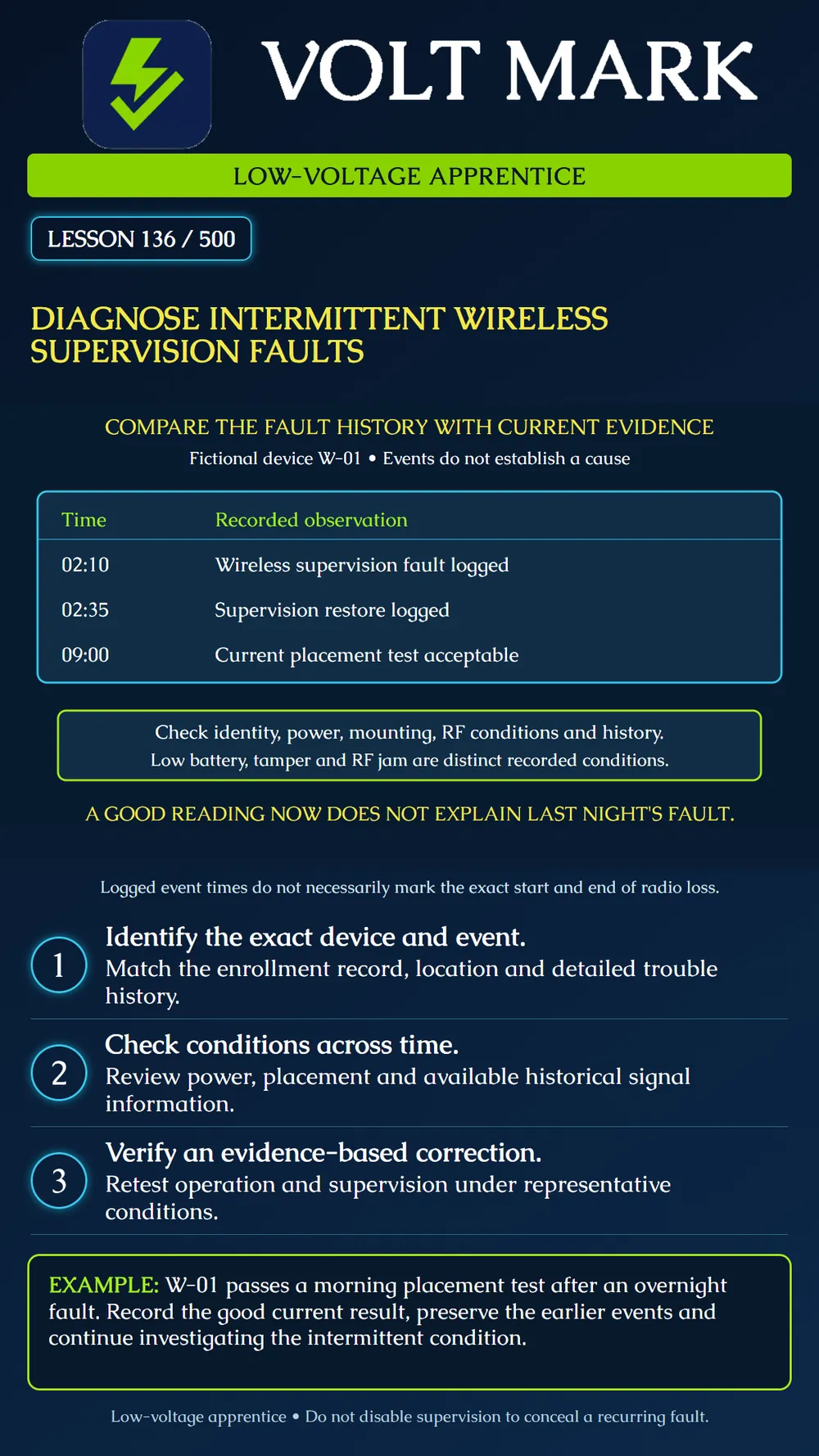
Investigate recurring wireless supervision faults using device identity, time-based evidence and supervised verification.
A wireless supervision fault indicates that the system's expected communication condition was not satisfied under its configured rules. It does not, by itself, identify the physical cause. Do not automatically diagnose a dead battery, interference or a defective detector from that label alone.
First identify the exact recorded event and device. Compare the physical model and identifier with the enrollment and location records. Confirm the device is present. Preserve the event history, including restoration and related conditions, before making changes.
DSC's cited troubleshooting guidance treats device low battery, device tamper and RF delinquency as distinct conditions, and directs investigation toward device presence, faults and current plus historical signal information. These are bounded manufacturer examples. The actual supervision interval, event name and clearing behavior depend on the selected system and configuration.
For fictional device W-01, the worksheet contains: 02:10 - supervision fault logged. 02:35 - supervision restore logged. 09:00 - current placement test acceptable.
The first two logged timestamps are 25 minutes apart. That does not prove that radio communication was absent for exactly 25 minutes. Supervision rules and recovery processing can separate event timestamps from the actual communication interruption. The history contains no measurements of that interruption.
The acceptable morning placement test is useful evidence about that test. It does not erase the overnight fault or establish its cause. Keep both observations in the record. No real device was tested to create this example.
Use the current equipment instructions to review battery type, installation, contacts and any applicable device diagnostics. Have the responsible technician perform authorized checks. An absent low-battery record alone is not a complete battery-health assessment; understand what the system monitors and when it logs the event.
Record battery replacement or device handling as changes, including the approved part and date. Close and secure the equipment as instructed, then verify applicable tamper and operating conditions. A battery replacement is an action, not proof that the intermittent fault was resolved.
Review the installed position and any changes since successful commissioning. Record relevant doors, storage, equipment and mounting conditions. Inspect the receiver or repeater arrangement where applicable. Use the manufacturer's placement test at the intended installed location and document its actual result.
Compare current and historical diagnostic information when available. Note which time period a displayed value represents. Do not treat one acceptable sample as a complete record of overnight conditions. If the problem affects multiple devices, investigate shared conditions without assuming they must all have the same cause.
An RF-jam indication is a specific system observation, not automatic proof of intentional interference. Preserve the exact wording and investigate through the approved technical process. Do not create interference as a troubleshooting experiment or disable supervision to hide the indication.
Write a proposed cause and the evidence needed to support it. Plan an authorized check with the supervisor. Keep variables controlled where practical, and record every change. A change in placement, battery, enrollment and settings all at once can make it difficult to determine what mattered.
If relocation is approved, reassess the device's intended detection coverage and physical application as well as communication quality. A location with better radio results may not provide the required detection. Use compatible equipment and manufacturer-supported remedies.
After an approved correction, verify device operation, correct system identity, relevant tamper/restoration behavior and supervision according to the test plan. Confirm any required reporting separately. Define a follow-up interval and representative conditions with the responsible person; this lesson provides no universal fault-free duration.
If the fault does not recur during observation, report that specific result and its limits. If the cause remains uncertain or conditions were not reproduced, retain the open issue. Do not declare a permanent repair from one quiet test period.
Use the fictional three-row history. List what it proves and what it does not. Add a separate low-battery event to one version of the exercise and a receiver-power event to another. Explain how each changes the next investigation step without treating either as conclusive.
Device tag/model/identifier; receiver or repeater; configuration reference; exact fault/restore history; clock reference; current and historical diagnostic windows; power and mounting observations; site changes; hypothesis; approved action; retest evidence; follow-up conditions; remaining uncertainty and owner.
Checked September 30, 2026: DSC / Johnson Controls, PowerSeries Pro, Trouble summary: https://docs.johnsoncontrols.com/dsc/r/DSC/en-US/PowerSeries-Pro-Reference-Manual/1.3.1/Troubleshooting/2-Trouble-summary DSC / Johnson Controls, System supervision features: https://docs.johnsoncontrols.com/dsc/r/DSC/en-US/PowerSeries-Pro-Reference-Manual/1.3.1/Introduction/Features/System-supervision-features The timeline, hypotheses and follow-up exercise are original instructional material. No universal timeout, real diagnosis or successful repair is claimed.
Free study material for low-voltage apprentices. This is a national foundation course: requirements differ by state and by local jurisdiction, and a practice that is common in one place is not a rule everywhere. Nothing here is a licence, a certification, or authority to work unsupervised, and completing it does not count as apprenticeship hours or continuing-education credit. Check the codes adopted where you are working, the licensing authority for that work, and your employer's safety programme. VoltMark is not affiliated with, endorsed by, or sponsored by NFPA, OSHA, NICET, BICSI, FOA, or any state or local licensing authority.

Electrician licensing exam prep: practice questions, timed exam simulations, and step-by-step help finding every answer in the NEC.