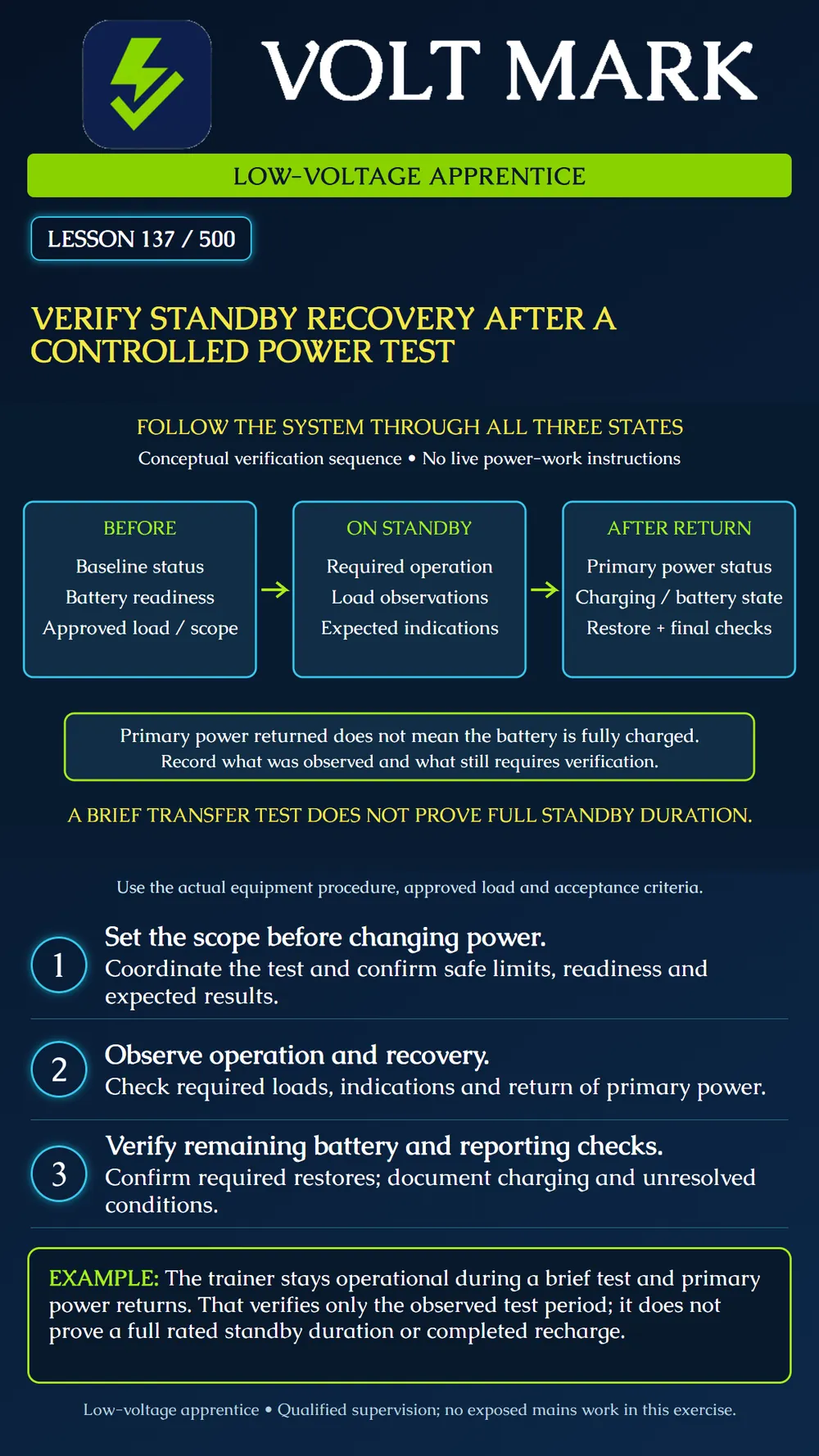
Document operation and recovery during an authorized standby-power test without confusing a brief functional check with full battery-capacity or endurance verification.
Plan three stages: the baseline before testing, operation on standby and recovery after primary power returns. Success in one stage does not establish every result in the next. A lit keypad, for example, does not prove that every required device and communication component remained operational.
Use the selected equipment's procedure with qualified supervision. Define the approved test method, load, duration, stop conditions and acceptance criteria. Coordinate effects on monitoring and occupants. This lesson provides no procedure for exposing or disconnecting mains conductors. Only the responsible qualified person performs power-source operations within their authorization.
Record the equipment and battery information needed for the approved test. Check existing status and unresolved troubles before starting. Confirm the standby source is ready using the manufacturer's criteria. Do not start from a known abnormal condition and later treat it as an unexpected test result.
Altronix's cited supervised power-supply guidance discusses battery checks under load. DSC's documentation distinguishes AC trouble/restore, battery trouble and power-unit failure, and provides configurable AC reporting delay. These examples show why observations must identify the source, load condition and expected indication rather than simply state power good.
Do not copy a voltage threshold, duration or recharge assumption from one model to another. Battery type, capacity, load, charger and installation requirements differ. The approved test plan should cite the actual equipment documentation.
Observe the required functions and record when the approved test condition begins. Check the relevant loads and system indications using the permitted procedure. If measurement is part of the plan, record the test point, units, instrument and load condition. Do not improvise energized probing or resistance measurements.
Consider the complete intended system. A standby-powered panel does not automatically keep independently supplied network equipment or remote modules operating. Record which equipment is within the test scope and which dependencies require separate verification.
Follow the approved stop criteria. A short functional exercise is not permission to discharge the battery to cutoff. If required operation fails or an abnormal condition appears, follow the supervisor's recovery plan and document the actual result.
Verify that the intended source has returned and the equipment is operating correctly. Inspect the relevant status and any required power-restoration reporting. A physical reconnection alone is not evidence that the correct supply is present or that every function recovered.
Check the charging and battery condition using the equipment procedure. Returning primary power does not instantly replace the energy used during the test. A low-battery condition may require further investigation or charging time under the applicable instructions. Do not assume that waiting a generic interval guarantees recovery.
Record required local and receiver evidence separately. Reporting delays or configuration can affect when events appear. A cleared local indicator is not proof of remote receipt. Confirm the final operating state and end the coordinated monitoring test period through the approved process.
An instructor's trainer remains operational during a brief authorized transfer check. Primary power is restored and its status indication returns. The learner records those observations as evidence of the functions observed over that test period.
The learner does not write full standby capacity verified or fully recharged unless the required separate evidence exists. A brief run and a normal-looking display cannot establish a full endurance requirement. The duration, load and acceptance method for any capacity or endurance assessment must be explicitly defined and approved.
An unresolved battery indication remains an open item. Assign it to the responsible technician and document follow-up criteria. Do not conceal it by disabling supervision, acknowledging away the evidence or replacing the finding with passed.
Use a paper record with three columns matching the poster. The instructor supplies baseline, standby and recovery observations, plus a missing recharge result. Identify which claims are supported and which remain pending. Prepare a closeout note that describes the verified behavior without claiming full endurance.
Test authorization; equipment and battery details; procedure revision; baseline state; scope and required loads; approved duration/stop criteria; start/end times; measured values with load conditions; operation observed; primary-power return evidence; charging/battery follow-up; local and received restores; final system/monitoring state; unresolved items and owner.
Checked September 30, 2026: Altronix, SMP3PM/SMP5PM supervised power supply/charger instructions: https://altronix.com/library/pdf/installation_instructions/SMP3_5PM.pdf DSC / Johnson Controls, PowerSeries Pro, Panel Events 1: https://docs.johnsoncontrols.com/dsc/r/DSC/en-US/PowerSeries-Pro-Reference-Manual/1.3.1/Programming/Programming-descriptions/Reporting/308-Event-Reporting/301-Panel-Events-1 DSC / Johnson Controls, AC Failure Communication Delay: https://docs.johnsoncontrols.com/dsc/r/DSC/en-US/PowerSeries-Pro-Reference-Manual/1.3.1/Programming/Programming-descriptions/System-Communications/377-Communication-Variables/002-Communication-Delays/AC-Failure-Communication-Delay-minutes-or-hours The three-stage diagram and fictional case are original instructional material. No live power test or measured endurance result is claimed.
Free study material for low-voltage apprentices. This is a national foundation course: requirements differ by state and by local jurisdiction, and a practice that is common in one place is not a rule everywhere. Nothing here is a licence, a certification, or authority to work unsupervised, and completing it does not count as apprenticeship hours or continuing-education credit. Check the codes adopted where you are working, the licensing authority for that work, and your employer's safety programme. VoltMark is not affiliated with, endorsed by, or sponsored by NFPA, OSHA, NICET, BICSI, FOA, or any state or local licensing authority.

Electrician licensing exam prep: practice questions, timed exam simulations, and step-by-step help finding every answer in the NEC.