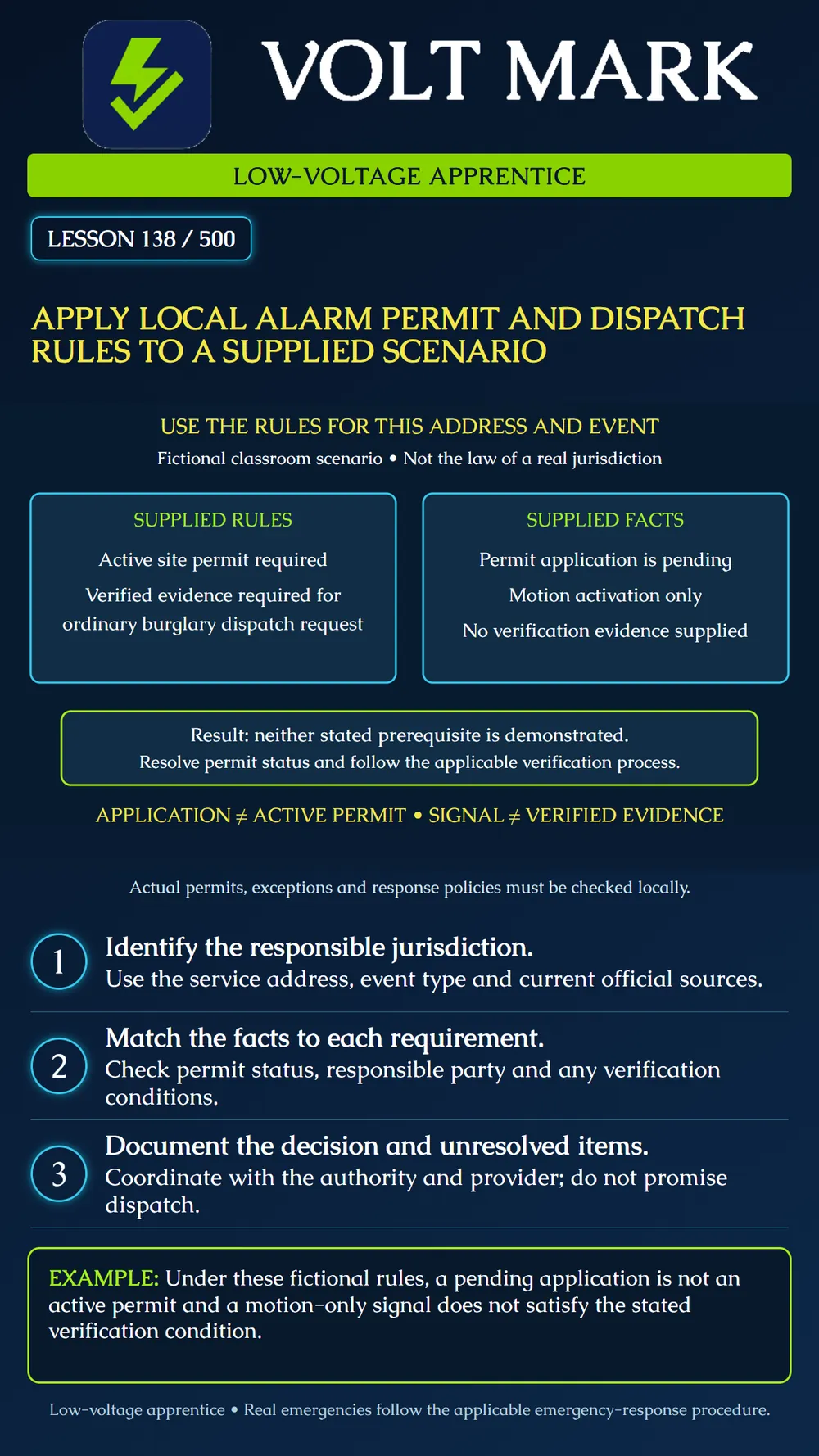
Identify the relevant jurisdiction and apply supplied requirements to documented facts without assuming a nationwide permit or dispatch rule.
Begin with the actual service address and the responsible authority. A mailing-city name alone may not establish which municipality, county or response agency has jurisdiction. Confirm the location and applicable authority before selecting a permit form or response policy.
Separate several questions: Is an alarm-user permit required? Does an alarm company need a license? Is an installation permit involved? What conditions govern an ordinary alarm dispatch request? These are different requirements. Satisfying one does not automatically satisfy the others.
Use current official sources. Record the document title, issuing authority, effective or revision date when available and the date checked. Resolve unclear scope or conflicting documents with the responsible authority and monitoring provider. Do not treat an old fee sheet or proposed ordinance as current law.
Seattle's official alarm-monitoring information states that the monitoring company is responsible for its system license rather than requiring homeowners or businesses to obtain an alarm permit. It also describes supporting-evidence requirements for alarm-company police calls beginning October 1, 2024. Houston's official permitting page separately provides an alarm application and fee process. These examples demonstrate variation; they are not complete guidance for either city's every event type or a substitute for an address-specific current check.
No fee amounts are taught here because the task is to find and apply the applicable requirements. Actual permit status and response decisions must be confirmed through the relevant process. Having a permit does not guarantee a particular response time or dispatch outcome.
For the classroom scenario only, assume:
These are invented exercise rules, not a quotation or summary of a named jurisdiction's law.
The site has submitted an application, but no issued active permit is documented. The current event is a motion activation. No supporting verification evidence has been supplied. The exercise concerns an ordinary burglary request, not an immediate eyewitness report of an emergency.
Rule A is not demonstrated by the pending application. Record the permit status as pending or unverified, identify the responsible party and resolve issuance through the designated authority. Do not fill in an invented permit number or mark the system permitted solely because a fee was submitted.
Rule B is not demonstrated by the motion-only signal. Follow the scenario's required verification process through the responsible provider and authority. Do not manufacture evidence or reclassify the event to evade a condition.
The conclusion is limited: neither stated prerequisite is demonstrated by the supplied facts. It is not a nationwide instruction to deny emergency assistance. Actual emergencies follow the applicable emergency-response procedure and the responsible agency's directions.
Create a requirement-to-evidence record. For each requirement, cite the source or supplied rule, identify the relevant fact and state whether evidence supports compliance, contradicts it or is missing. Give unresolved items an owner and next action.
Keep permit records linked to the correct address, responsible party and system where required. Check renewal, transfer, cancellation and change-of-ownership rules using current local sources rather than assumptions. Confirm how the provider receives updated information.
An apprentice can gather records and identify missing information, but should not invent legal interpretations or promise dispatch. Escalate ambiguous applications through the responsible project, provider or authority contact.
Apply the fictional rules to three variations:
Service address; jurisdiction/response agency; event type; official source and date; permit/license category; responsible applicant; status and evidence; verification requirement; exceptions reviewed; provider coordination; unresolved question; responsible contact; determination and review date. Do not include account passwords or verification passphrases.
Checked September 30, 2026: City of Seattle, Alarm System Monitoring: https://seattle.gov/business-regulations/alarm-system-monitoring Official-page text was available in indexed search results; direct retrieval returned HTTP 403. Only the limited published points above are used, and they require reconfirmation for actual work. City of Houston, Burglar and Panic Alarms Permitting: https://www.houstontx.gov/ara/rp/burglarandpanicalarms.html Directly retrieved page links a January 2026 revised application and the current fee schedule. Older Houston redlines and historical fee documents were not used as current rules. The poster and supplied scenario are fictional instructional material. No claim of nationwide legal coverage, actual permit approval or response authorization is made.
Free study material for low-voltage apprentices. This is a national foundation course: requirements differ by state and by local jurisdiction, and a practice that is common in one place is not a rule everywhere. Nothing here is a licence, a certification, or authority to work unsupervised, and completing it does not count as apprenticeship hours or continuing-education credit. Check the codes adopted where you are working, the licensing authority for that work, and your employer's safety programme. VoltMark is not affiliated with, endorsed by, or sponsored by NFPA, OSHA, NICET, BICSI, FOA, or any state or local licensing authority.

Electrician licensing exam prep: practice questions, timed exam simulations, and step-by-step help finding every answer in the NEC.