Assemble a traceable handover package that separates tested performance, unfinished work and authorized acceptance. Produce a record another authorized technician can use without reconstructing the installation from memory.
An intrusion installation needs more than a list of equipment and a statement that everything worked. The acceptance record should tell the reviewer what was in scope, what was tested, what evidence supports each result and what remains unresolved. The service record should help the next authorized technician understand the installed system and its documented condition.
Begin with identity and scope. Identify the site using the project's approved identifier, the panel and relevant installed devices, document revision, visit date and responsible personnel. Identify the drawings and zone list used during the test. A result associated with an obsolete zone label can send a future technician to the wrong opening. Distinguish the latest approved design from changes observed in the field and changes awaiting approval.
For each test, record its purpose, affected device or function, expected response and actual observation. Link the observation to a time, observer and supporting evidence. Use the applicable test plan, manufacturer instructions and project requirements to define acceptance criteria; do not invent a universal checklist or interval. Record approved exceptions explicitly.
Manufacturer context: the PowerSeries Pro reference manual describes timestamped event-buffer records with event descriptions and associated identifiers. That makes a relevant event record one useful piece of evidence. It does not establish that a separate receiver obtained the event, that every detector covers its intended area, or that an authorized reviewer accepted the installation. Use the evidence appropriate to each claim.
A handover package also needs a clear final-condition statement. Document unresolved troubles, authorized bypasses or other temporary conditions, with the responsible person's instructions and next action. Do not erase a deficiency simply because it was discussed. Do not present a temporary arrangement as the permanent design. Record restoration from the coordinated test condition according to the project procedure; never infer it from the end of a visit.
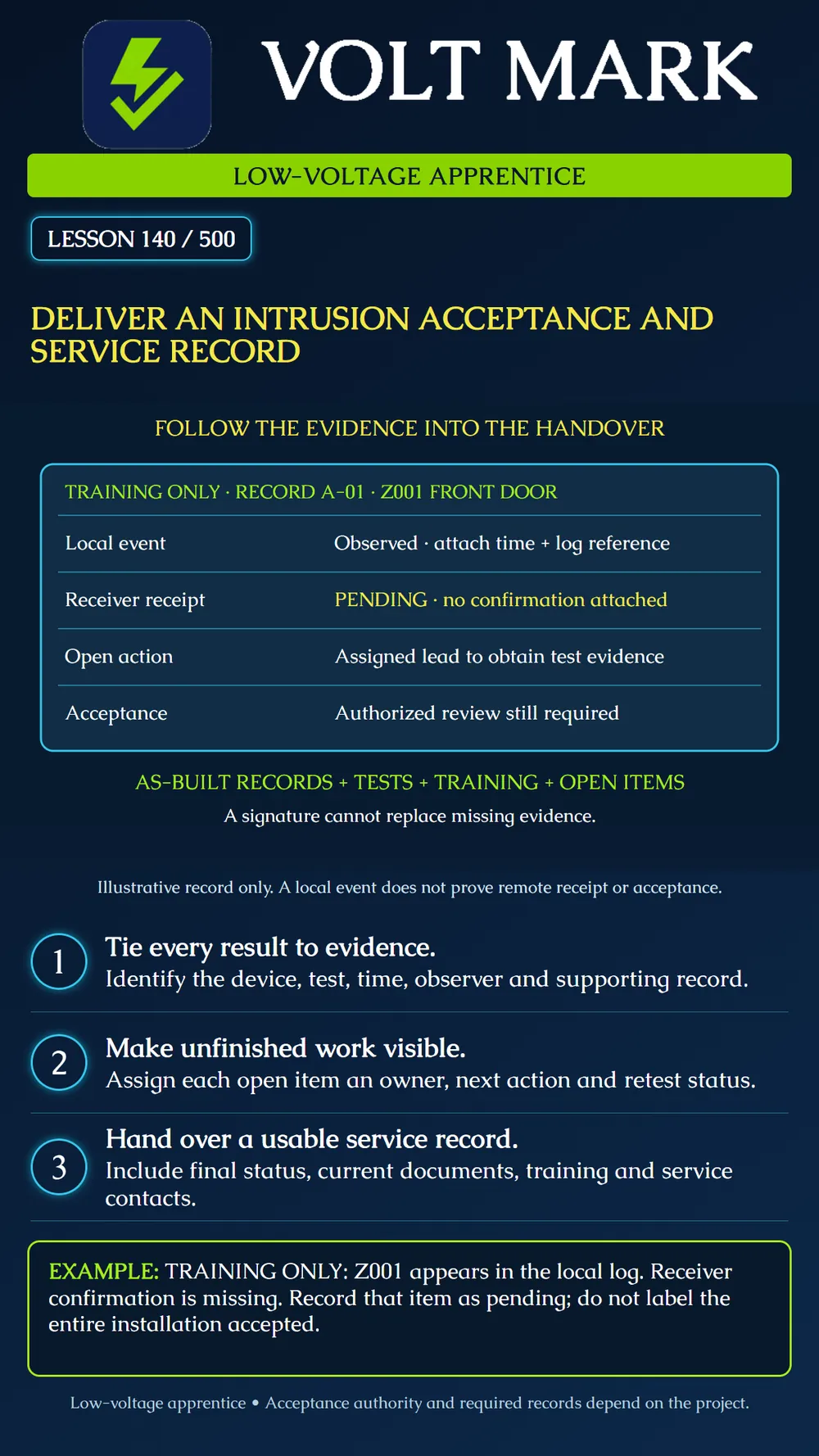
The training worksheet identifies Z001 as the front-door contact. A local event-log extract contains the expected event, but the receiver confirmation field is blank. A trainee has checked the overall box marked accepted.
Correct the worksheet without altering the underlying evidence. Keep the local observation and its reference. Change the receiver item to pending evidence, assign the next action to the designated lead and leave final acceptance for the authorized reviewer. No real test was performed in this lesson. Record A-01 and its status are fictional instructional examples.
A later receiver record might resolve the missing evidence. The reviewer still needs to check that its account, device or zone identification, event and time correspond to the intended test. A document from another test is not a substitute merely because it contains the same zone number.
Use the project's required form. An apprentice's draft package can organize:
Do not place passwords, installer codes, private user codes or sensitive recovery material in a general handover packet. Reference the approved protected transfer process where such information must be provided.
Use a fictional packet with three records: one complete test result, one result missing receiver evidence and one untested device. Match each record to the drawing and zone list. Explain why complete, pending and not tested are different conditions. Draft an open-item entry for each unresolved matter. Have the supervisor trace one claimed result back to its evidence without relying on your verbal explanation.
For a later service visit, retain the previous baseline and add a dated change record. State the reported symptom, actual findings, authorized work, relevant post-work checks and remaining limitations. Separate customer reports from your observations. Preserve document revision history so a later reader can understand which configuration each test describes.
Site / project reference: Equipment / zone / function: Drawing and test-plan revision: Expected response: Actual response and evidence reference: Observer / date / time / time basis: Status: complete / pending / not tested / failed, as defined by project: Open item / owner / next action / target date: Retest record: Final system condition: Training and documents delivered: Authorized reviewer / disposition / date:
Does a local log prove receiver receipt? No; obtain the corresponding receiver evidence. Can a blank test field be treated as a pass? No; determine and record its actual status. Who authorizes acceptance? The party designated by the project and applicable requirements. Does this lesson certify an installation? No. It teaches preparation of a reviewable record.
Primary source checked September 30, 2026: Johnson Controls / DSC, PowerSeries Pro Reference Manual 1.3.1, Viewing the event buffer: https://docs.johnsoncontrols.com/dsc/r/DSC/en-US/PowerSeries-Pro-Reference-Manual/1.3.1/Configuration/Testing-the-system/Viewing-the-event-buffer Source supports the bounded description of local event records. The record layout, scenario and practice exercise are original teaching examples, not a manufacturer form or a nationwide legal acceptance standard.
Free study material for low-voltage apprentices. This is a national foundation course: requirements differ by state and by local jurisdiction, and a practice that is common in one place is not a rule everywhere. Nothing here is a licence, a certification, or authority to work unsupervised, and completing it does not count as apprenticeship hours or continuing-education credit. Check the codes adopted where you are working, the licensing authority for that work, and your employer's safety programme. VoltMark is not affiliated with, endorsed by, or sponsored by NFPA, OSHA, NICET, BICSI, FOA, or any state or local licensing authority.

Electrician licensing exam prep: practice questions, timed exam simulations, and step-by-step help finding every answer in the NEC.