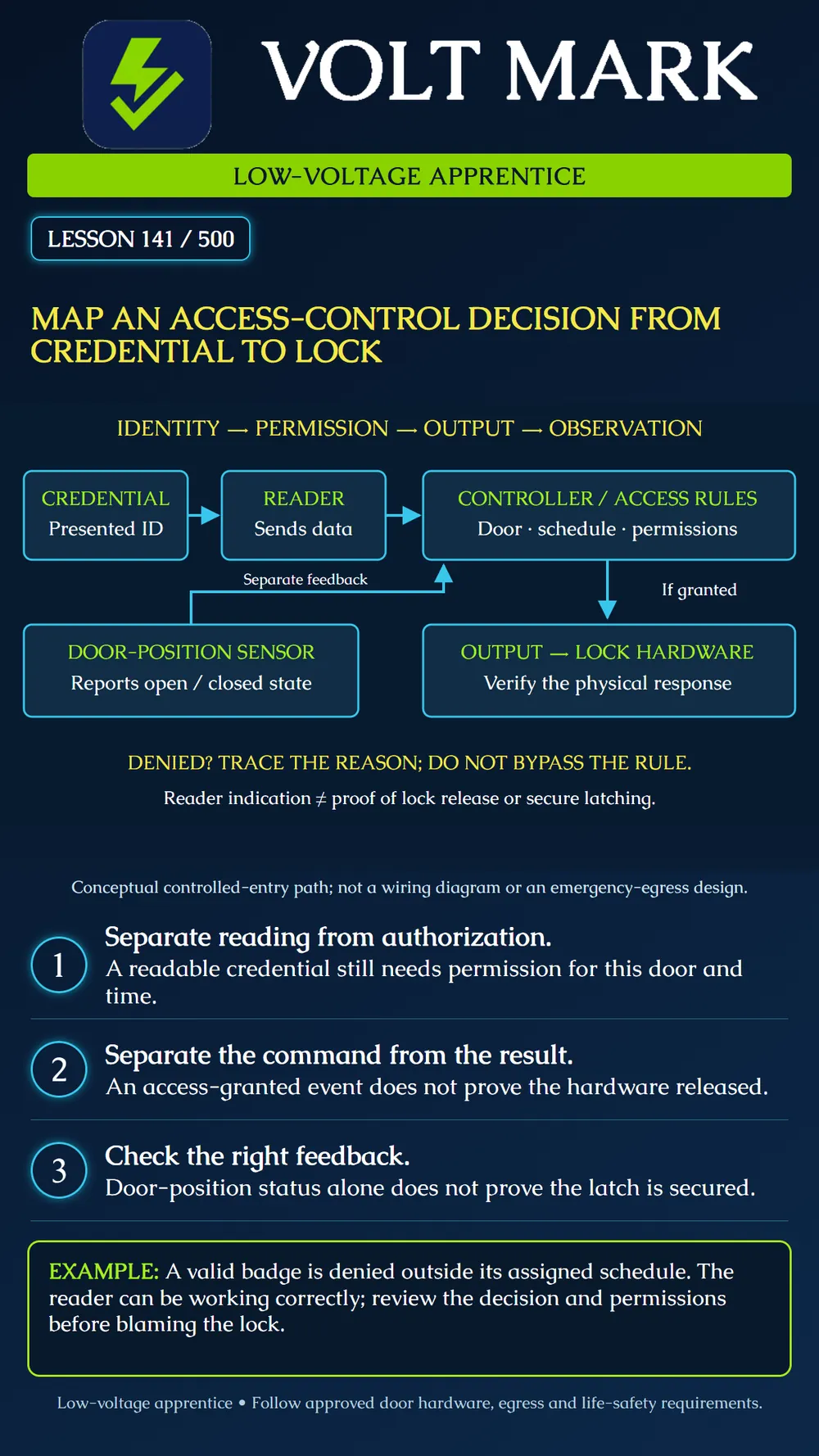
Trace a conceptual controlled-entry transaction and distinguish credential reading, authorization, output operation and physical feedback.
Start with a person presenting an assigned credential. Depending on the installed system, that credential might be a card or another supported form of identification. The reader obtains information and communicates with the access-control system. Reading the credential is one stage; permission to enter is another.
In the illustrated controller-based arrangement, the controller or access-control logic evaluates whether the credential has permission for this opening at this time under the configured rules. A recognized credential can still be denied. It may lack permission for that door, fall outside its schedule or be subject to another configured restriction. The diagram is a conceptual teaching model; products differ, and some devices combine functions.
When the decision grants entry, the configured output acts on the approved lock arrangement. Do not equate an electronic decision with a successful physical result. A record saying access granted does not, by itself, establish that the installed hardware released. Mechanical binding, an output problem or another fault can prevent the expected response. Diagnose with the authorized procedure rather than repeatedly changing permissions.
The door-position sensor is a separate feedback path. Its input describes the state it is installed and configured to sense, commonly door open or closed. A closed indication does not independently prove that a latch or locking mechanism is engaged. If the design includes other monitoring, interpret each input according to its actual function and installation instructions.
The illustration deliberately separates these ideas. The upper path carries credential information to the decision. The downward path represents a granted command to the hardware. The return path represents door-position feedback. These arrows are functional relationships, not conductor assignments, power connections or terminal instructions.
Axis describes readers transmitting credential information to a controller in its OSDP white paper. Its access-control service documentation describes determining where and when credential holders receive access. The A1601 manual provides distinct verification functions for readers, locks and door monitors. Together these support teaching the stages separately; they do not establish a universal topology or a complete commissioning test for every product.
A fictional trainee presents an assigned training badge at a demonstration door. The reader registers the presentation, and the controller records denial outside the assigned schedule. The trainee proposes replacing the lock.
Explain why that conclusion is premature. In this scenario there was no granted command to release the lock. First compare the intended training permissions with the recorded decision and the approved schedule. The assigned administrator determines whether an authorized configuration correction is needed. An apprentice does not expand access rights simply to make a demonstration succeed.
In a second fictional observation, access is granted but the hardware does not release. The investigation now needs to distinguish the command, the configured output and the physical response. This is not permission to short a relay, apply external power or defeat the lock. Use the manufacturer's instructions and the supervisor's authorized test plan.
Use a tabletop trainer or an explicitly approved demonstration opening. Draw five labeled blocks: credential, reader, controller or decision function, lock output and hardware, and door-position input. Identify which functions are combined in the actual training equipment. Have the supervisor confirm the map.
Observe a permitted presentation and a planned denied presentation under the training procedure. Record what was actually observed at each stage. If you cannot observe a stage, mark it not observed instead of inventing a result. Compare the relevant time and door identifier in the records. Avoid exposing real credential identifiers in a shared lesson worksheet.
For an observation of door closure, state only what the evidence supports. If you observed the position input return to closed, write that. Do not upgrade it to verified locking unless the authorized test actually established that separate condition.
This is an entry-decision lesson, not an emergency-egress design. Required exit operation and life-safety interfaces must follow the approved design and applicable requirements. Do not infer fail-safe or fail-secure behavior from the diagram, a reader light or a granted event. Do not alter an occupied building's door hardware or egress operation for classroom practice.
Training opening and equipment: Credential reference, protected as required: Intended permission and schedule: Reader observation: Decision and event reference: Output observation: Physical hardware response: Door-position observation: Unobserved stages / unresolved issue: Supervisor review:
Can a correctly read badge be denied? Yes, recognition does not establish permission. Does a granted event prove release? No, verify the actual hardware response. Does a closed input prove secure latching? Not by itself. Where should a trainee begin with an outside-schedule denial? Compare the intended authorization with the recorded rule decision under supervision. Are the diagram arrows wiring instructions? No.
Primary sources checked September 30, 2026: Axis, OSDP protocol in access control: https://whitepapers.axis.com/download/wp_osdp_protocol_in_access_control_t10227329_2506.pdf Axis, Access control service: https://www.developer.axis.com/vapix/physical-access-control/access-control-service/ Axis, AXIS A1601 Network Door Controller manual, hardware connection verification: https://help.axis.com/en-us/axis-a1601 Bounded manufacturer facts are paraphrased; scenario, diagram and worksheet are original instruction. No live test, installation approval or compliance certification is claimed.
Free study material for low-voltage apprentices. This is a national foundation course: requirements differ by state and by local jurisdiction, and a practice that is common in one place is not a rule everywhere. Nothing here is a licence, a certification, or authority to work unsupervised, and completing it does not count as apprenticeship hours or continuing-education credit. Check the codes adopted where you are working, the licensing authority for that work, and your employer's safety programme. VoltMark is not affiliated with, endorsed by, or sponsored by NFPA, OSHA, NICET, BICSI, FOA, or any state or local licensing authority.

Electrician licensing exam prep: practice questions, timed exam simulations, and step-by-step help finding every answer in the NEC.