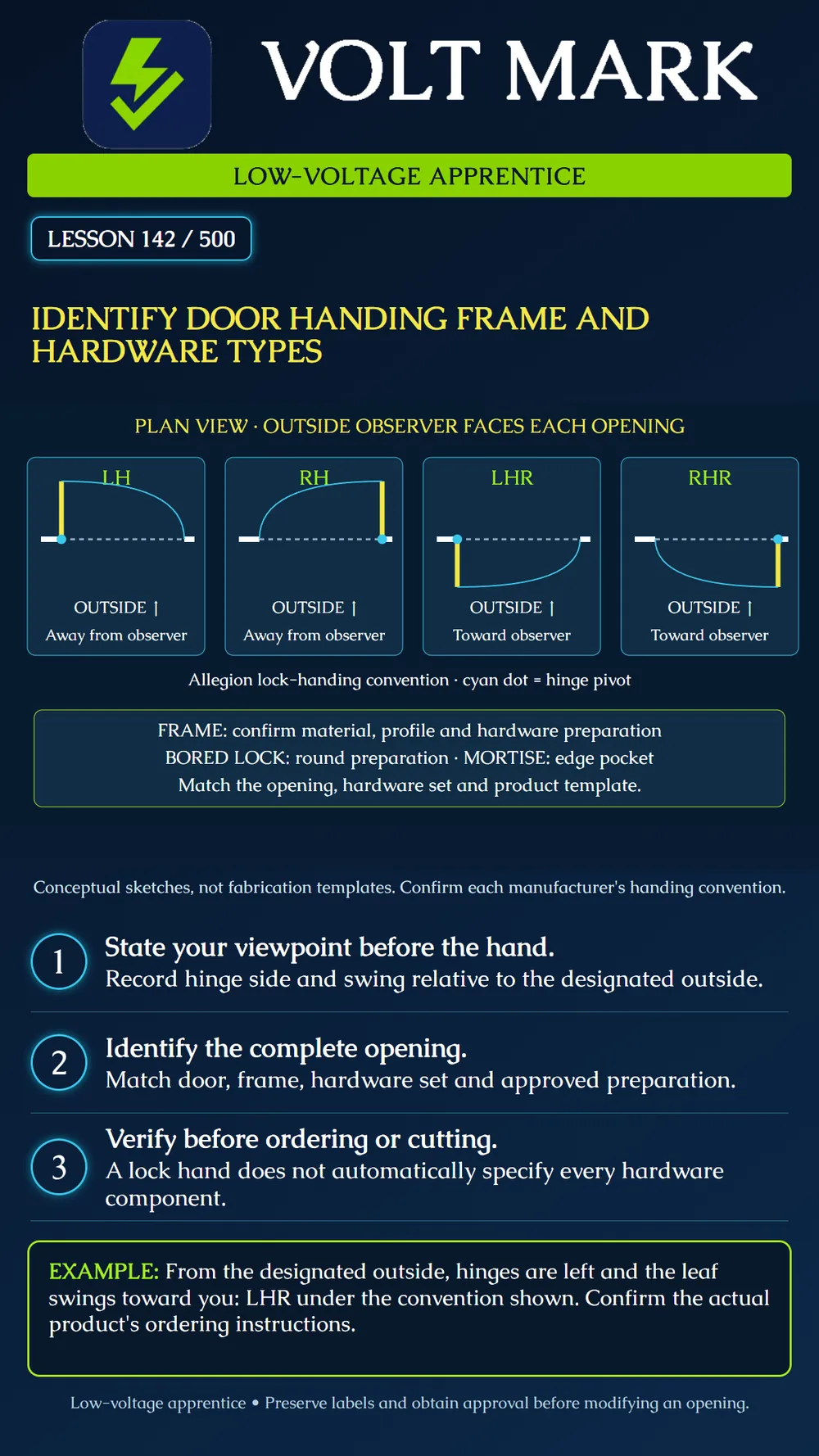
Describe a surveyed opening with an explicit viewpoint, identify basic hardware preparation types, and connect the observation to the approved hardware schedule.
This lesson uses Allegion's published lock-handing convention: face the opening from its designated outside. Left or right follows the hinge location. Swing away is standard; swing toward the observer is reverse. The four abbreviations are LH, RH, LHR and RHR. The poster shows plan views, with the outside observer below each opening. Cyan dots identify pivots; yellow lines show open leaves and dashed lines the closed position.
Do not choose a viewpoint just because you happen to be standing in a corridor. Identify the designated outside on the project information. Record the viewpoint in the survey sketch. Product-specific ordering instructions govern the actual item. Door, frame, closer and lock terminology must not be assumed interchangeable.
Treat the frame and door as separate identified components. Record their documented material and construction, rather than guessing from paint or surface appearance. Common frame descriptions include hollow metal, aluminum and wood; confirm the actual product and profile. Identify the hinge side, strike area, head and existing preparation. Record relevant labels without covering or damaging them.
A bored lock uses round prepared holes; a mortise lock has its case in a prepared edge pocket. These descriptions distinguish broad types, not interchangeable products. The Steel Door Institute provides different preparation details for different hardware configurations and calls for checking manufacturer specifications. A matching lever appearance does not establish matching preparation. Dimensions, reinforcement, strike relationship and product templates still matter.
For access-control planning, also identify the scheduled electrified hardware and any power-transfer arrangement. A reader beside an opening does not tell you whether the opening uses an electric strike, an electrified lock or another approved arrangement. Use the hardware set and model documentation. Do not infer voltage, current, power-loss behavior or egress function from appearance.
A training opening is labeled D-142. The approved drawing identifies the corridor as the outside. Facing the leaf from that side, the hinges are on the left and the leaf opens toward the observer. Under the convention illustrated, the lock hand is LHR.
The trainee's first note reads only "left door." Improve it: identify D-142, label the corridor viewpoint, sketch hinge and swing, and record LHR under the named convention. Next compare the frame and lock preparation with the approved hardware set. A correct hand alone is insufficient to release an order.
Suppose the field frame preparation does not match the submitted hardware template. Document the discrepancy and seek direction from the responsible project lead. Do not enlarge a cutout or change hardware simply to make the parts fit. The training record should distinguish an observed mismatch from an approved revision.
On approved sample hardware or a training opening, draw the opening in plan view. Mark outside, pivot and swing. Write the hand using the selected manufacturer's instructions. Have a second person identify the same hand from your drawing without a verbal explanation.
Then identify the frame from documentation and label the observed hardware family. Compare the opening identifier, hardware-set number and template revision. Mark information not yet verified as unknown. No destructive investigation is needed for this exercise.
Opening identifier: Designated outside and drawing reference: Hinge side / direction relative to observer: Hand / manufacturer's convention: Door and frame material, construction and label references: Hardware set / model / preparation template: Observed mismatch or unknown: Responsible reviewer / disposition:
Why state the viewpoint? Left, right and toward depend on where the observer stands. What is LHR in the illustrated convention? Hinges left and swing toward the outside observer. Does knowing the lock hand prove a closer's order designation? No; confirm that product's instructions. Does a mortise lock fit a bored-lock preparation automatically? No. What follows a mismatch? Document and obtain the authorized resolution before modification.
Checked September 30, 2026: Allegion, What is lock handing? https://kc.allegion.com/kb/article/what-is-lock-handing/ Steel Door Institute, ANSI/SDI A250.14-2025, Hardware Preparation in Steel Doors & Steel Frames: https://steeldoor.org/ansi-250-14/ Manufacturer convention and bounded preparation definitions support this lesson. The survey scenario and worksheet are original instructional examples. This is not a fabrication template, product approval or nationwide installation prescription.
Free study material for low-voltage apprentices. This is a national foundation course: requirements differ by state and by local jurisdiction, and a practice that is common in one place is not a rule everywhere. Nothing here is a licence, a certification, or authority to work unsupervised, and completing it does not count as apprenticeship hours or continuing-education credit. Check the codes adopted where you are working, the licensing authority for that work, and your employer's safety programme. VoltMark is not affiliated with, endorsed by, or sponsored by NFPA, OSHA, NICET, BICSI, FOA, or any state or local licensing authority.

Electrician licensing exam prep: practice questions, timed exam simulations, and step-by-step help finding every answer in the NEC.