Explain why an access decision for entry is separate from the required exit operation. Identify when an opening needs specialist review because its locking arrangement affects egress.
Entry authorization asks whether a person may enter a controlled area. Egress describes leaving an area along the required route. These functions share an opening but need not use the same release process.
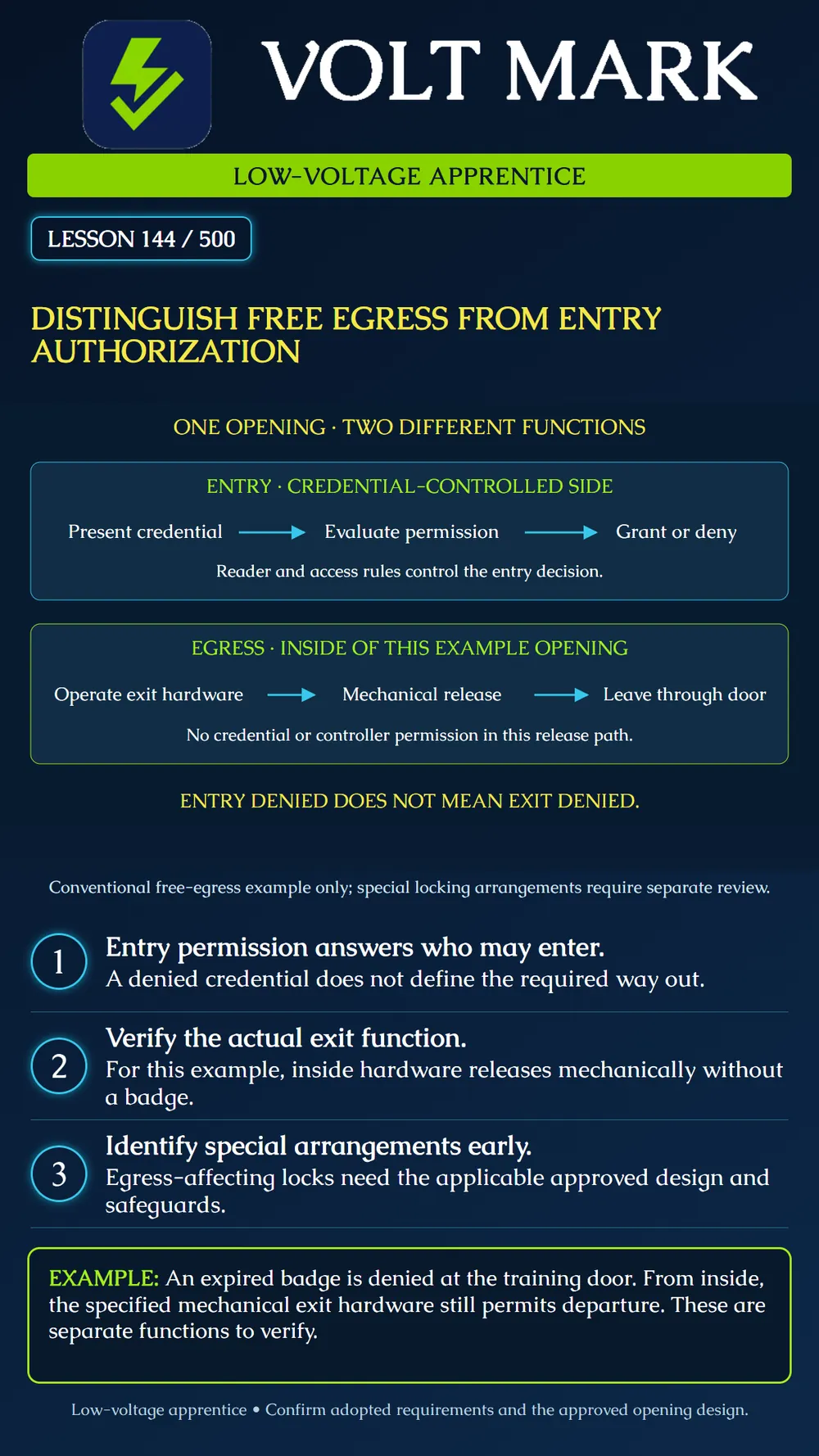
The poster illustrates a conventional arrangement with credential-controlled entry and mechanically available egress. On the entry side, the system evaluates a credential and grants or denies access. On the inside, operation of the specified exit hardware mechanically releases the opening without needing a credential or a controller's permission. This is a functional teaching example, not a wiring plan or a claim about every electrified door.
An entry reader's status does not establish the exit function. A red indication might correctly show that a badge lacks entry permission. That observation alone says nothing about whether the required inside operation works. Similarly, a green light does not prove that either the latch or the complete opening operates as intended.
A request-to-exit signal may provide useful information to an access system. Its exact function depends on the design. Do not assume a software input is the same thing as the physical means of releasing a door. In the conventional mechanical example, the occupant's release path is not conditional on a credential decision. Identify the actual hardware and sequence before describing what a signal does.
OSHA's federal workplace exit-route rule, 29 CFR 1910.36(d), addresses opening exit-route doors from inside without keys, tools or special knowledge and addresses devices whose failure could restrict emergency use. It also contains a narrow provision for specified institutional facilities with stated safeguards. This workplace rule is not a substitute for reviewing all building, fire and accessibility requirements applicable to a particular opening.
Allegion's electrified-hardware guidance distinguishes normal arrangements providing mechanical free egress from special locking arrangements that can affect egress. It directs readers to adopted codes and recognizes jurisdictional variations. Do not treat a general classroom example as approval for a delayed, controlled or electrically released egress design.
On an approved tabletop trainer, badge T-144 has expired. The reader transaction is denied. The trainer is configured with an inside mechanical release, and the supervisor demonstrates that operation independently of the denied transaction.
Write two observations: the planned expired credential was denied entry, and the inside hardware performed the demonstrated mechanical release. Do not combine them into a statement that the opening meets every code requirement. The exercise did not evaluate every design condition, force requirement, accessibility feature or emergency interface.
Now consider a different proposed arrangement where the occupant must present a valid credential to release the only exit. Do not copy the first example's approval language onto that arrangement. Flag the changed exit function to the responsible designer or supervisor and obtain the applicable review. An apprentice does not invent an exception based on a request to improve security.
Use a trainer or an opening explicitly approved for the exercise. Identify the entry side, inside exit hardware and approved operating description. Draw two paths: entry decision and actual exit release. Name the component performing each action. If a request-to-exit device is present, identify its documented function separately.
Observe the permitted demonstration and record only the functions actually checked. Do not interrupt building power, disconnect fire interfaces, disable a release device or alter an occupied exit for this classroom exercise. Any required failure-mode or interface testing belongs in the coordinated authorized test plan.
Compare the drawing with the installed hardware documentation. If the release depends on an electrical signal, or includes an intentional delay, flag that distinction. It changes the design review and verification needed; it is not a minor software preference.
Opening / drawing and hardware-set reference: Entry authentication method: Inside hardware and documented release operation: Controller role in the exit release, if any: Request-to-exit function, if present: Special locking arrangement identified or unresolved: Observed demonstration / untested conditions: Responsible reviewer / required follow-up:
Does a denied badge establish that people cannot leave? No. In the illustrated example, must the controller authorize mechanical exit release? No. Can an entry reader alone identify the egress arrangement? No; identify actual hardware and operation. Is every electrically controlled door a special egress locking arrangement? No. Can this poster approve a delayed-egress installation nationwide? No; the applicable design conditions and adopted requirements need review.
Primary sources checked September 30, 2026: OSHA, 29 CFR1910.36, especially subsection(d): https://www.osha.gov/laws-regs/regulations/standardnumber/1910/1910.36 Allegion / Lori Greene, Electrified Hardware and Special Locking Arrangements: https://idighardware.com/sla/ The conceptual diagram, trainer scenario and worksheet are original instructional material. No real opening was tested or approved. No specific model-code edition is asserted to apply throughout the United States.
Free study material for low-voltage apprentices. This is a national foundation course: requirements differ by state and by local jurisdiction, and a practice that is common in one place is not a rule everywhere. Nothing here is a licence, a certification, or authority to work unsupervised, and completing it does not count as apprenticeship hours or continuing-education credit. Check the codes adopted where you are working, the licensing authority for that work, and your employer's safety programme. VoltMark is not affiliated with, endorsed by, or sponsored by NFPA, OSHA, NICET, BICSI, FOA, or any state or local licensing authority.

Electrician licensing exam prep: practice questions, timed exam simulations, and step-by-step help finding every answer in the NEC.