Identify where electrical control acts in two hardware families and determine what product information is needed before installation or testing.
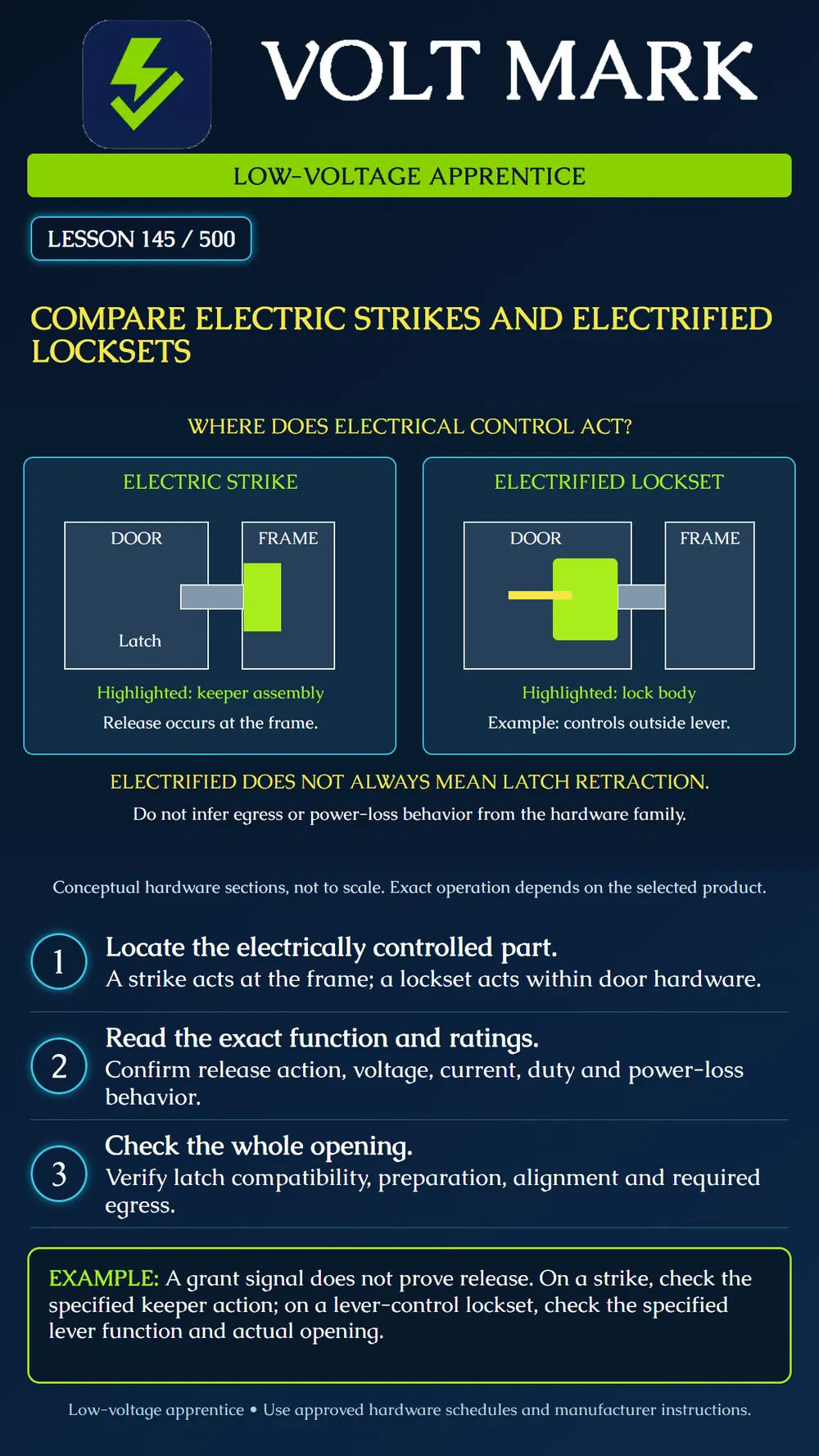
An electric strike and an electrified lockset can both participate in controlled entry, but they are different devices. The diagram highlights their general locations. It is not a fabrication section, wiring diagram or depiction of a particular model.
An electric strike is installed at the frame and provides a controlled receiving or release mechanism for compatible door hardware. In a common keeper-release arrangement, the strike permits the latch to pass when released. Do not assume the strike retracts the lock's latch into the door. Specific designs differ: HES describes its 8000/8300 arrangement using internal ramps, which illustrates why the actual operating instructions matter.
An electrified lockset locates the electrically controlled function in the door hardware. A lever-control example changes whether the outside lever can operate the lock. That is different from a motorized latch-retraction function. Schlage offers multiple mortise and cylindrical electrified functions; the family name alone does not tell you which operation is installed. Some functions affect more than the outside lever, making exact identification essential.
Compare the complete opening, not just the two electrical devices. The strike must be compatible with the latch and other applicable hardware. The lockset must match the door preparation and its approved function. In both cases, alignment, mechanical operation and required egress remain important. A controller event saying access granted is not physical proof that the opening released.
Read the scheduled model and function designation. Use the matching manufacturer instructions to confirm electrical supply requirements, current characteristics, duty, wiring and permitted configuration. Do not apply a guessed voltage because another device from the same manufacturer used it.
Identify the power-loss behavior separately from the inside exit operation. Terms describing an electrically controlled side do not by themselves prove the behavior of the complete opening. The prior lesson distinguished entry authorization from required egress. Carry that distinction into the hardware comparison.
For a wired door-mounted device, identify the approved means of transferring power or signals to the moving leaf where required. Do not invent a cable route or drill through the door based on this conceptual graphic. Some products use different power arrangements; their documentation controls.
Two training samples are labeled A and B. Sample A has an electric strike in a frame fixture and a compatible mechanical latch on the door fixture. Sample B uses a documented outside-lever-control electrified lockset in a door fixture. The training supervisor supplies the approved operating instructions for both.
For A, describe the strike's specified release action and observe the fixture's physical response under the authorized demonstration. For B, describe the specified lever behavior and observe it. A click or indicator alone is not the final observation. Do not state that B retracts its latch automatically if its function only enables lever operation.
Neither demonstration establishes every installation requirement. Record the sample identity, configured function and observed action. If documentation is missing, leave the electrical operation untested and obtain it through the supervisor.
The controller reports access granted but a door remains closed. Begin by identifying the installed hardware and expected function. A strike issue and a lever-control issue may require different observations. Separate the command, electrical output, hardware action and mechanical opening. Do not overcome a failed test by forcing the door, bypassing the lock or changing safety-related functions.
Ask whether the evidence shows failure to release or merely that no one attempted to open the door. A released door need not swing open by itself. Avoid diagnosing a fault from an assumption about automatic movement.
Sample / opening: Hardware family and physical location: Manufacturer / exact model / function: Expected controlled action: Supply and current requirements from documentation: Approved power-transfer arrangement if applicable: Power-loss behavior from documentation: Inside exit operation from documentation: Observed authorized demonstration: Unresolved compatibility or operation question:
Where is the electric strike in the conceptual example? At the frame. Does every electrified lock retract the latch automatically? No. Does a grant event prove the mechanism released? No. Does a strike necessarily make a door swing open? No. Can a product family name alone establish egress and power-loss behavior? No; confirm the exact function and complete opening.
Primary manufacturer sources checked September 30, 2026: HES, 5000 Series Electric Strike: https://www.hesinnovations.com/en/products/electric-strikes/5000-series HES, 8000/8300 Series product description: https://www.hesinnovations.com/adobe/assets/urn%3Aaaid%3Aaem%3A06ca381d-c032-4bc4-9a32-7e6a1b6c06d7/original/as/AADSS1058540.pdf Schlage, Electrified Locks & Locksets: https://commercial.schlage.com/en/products/electrified-locks.html Schlage, L-Series Electrified Lock Instructions: https://commercial.schlage.com/content/dam/allegion-us-2/web-files/schlage/installation-documents/Schlage_L-Series_Electrified_Lock_Instructions_110539.pdf Sources establish bounded product distinctions; no specific product installation is prescribed. Diagram and exercises are original instructional material. No actual hardware test or project approval is claimed.
Free study material for low-voltage apprentices. This is a national foundation course: requirements differ by state and by local jurisdiction, and a practice that is common in one place is not a rule everywhere. Nothing here is a licence, a certification, or authority to work unsupervised, and completing it does not count as apprenticeship hours or continuing-education credit. Check the codes adopted where you are working, the licensing authority for that work, and your employer's safety programme. VoltMark is not affiliated with, endorsed by, or sponsored by NFPA, OSHA, NICET, BICSI, FOA, or any state or local licensing authority.

Electrician licensing exam prep: practice questions, timed exam simulations, and step-by-step help finding every answer in the NEC.