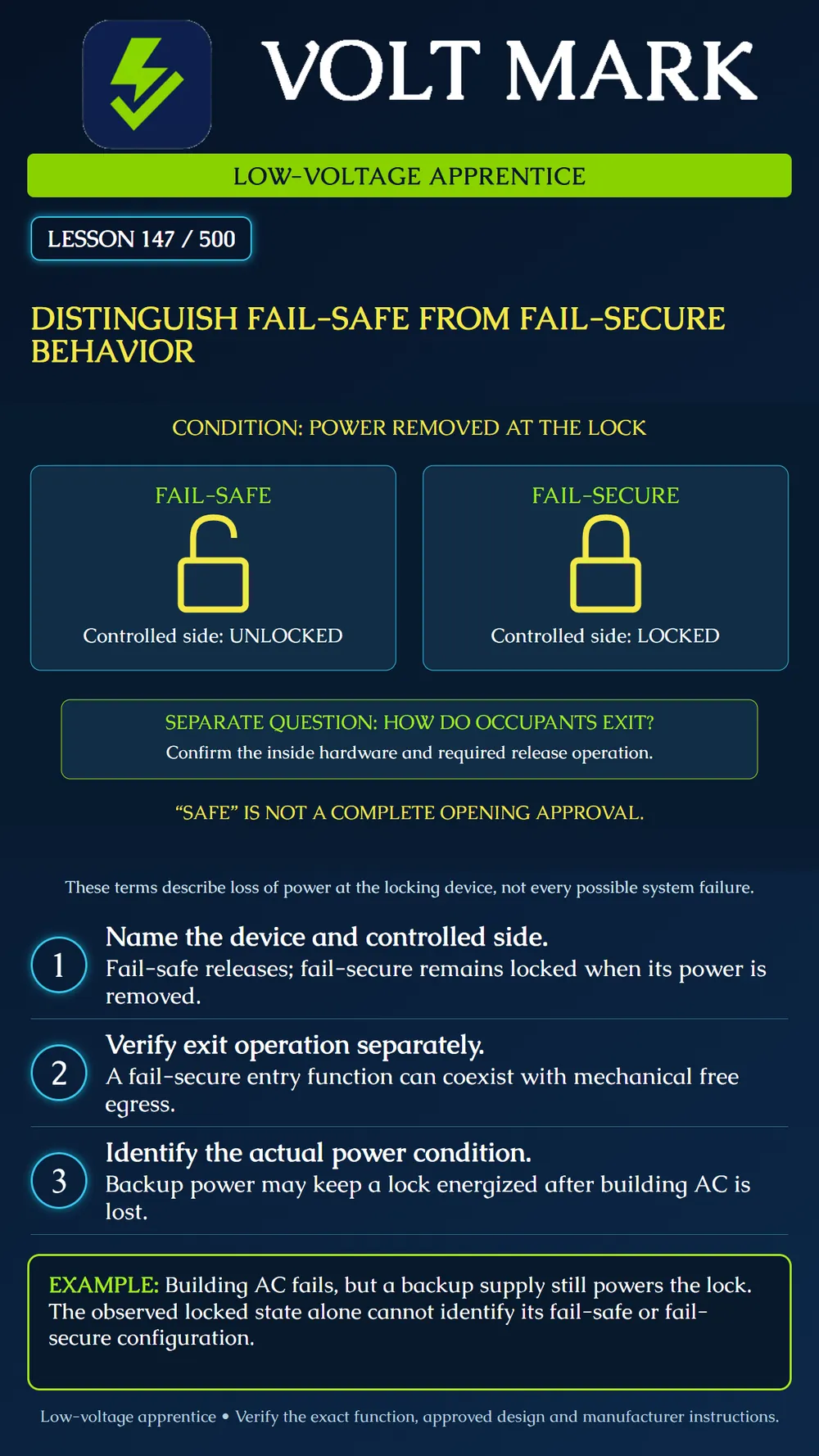
State the power-loss behavior of an identified locking function without confusing it with egress, a general equipment failure or loss of building AC.
For the locking functions addressed here, fail-safe means the electrically controlled side is unlocked when power to the locking device is removed. Fail-secure means that side remains locked without that power. Name the device, function and side when using either term.
These names do not describe every possible failure. A jammed mechanism, damaged door, misaligned latch or controller fault is not the same test condition as removing power from a specified device. Avoid the vague phrase "when the system fails" if the intended condition is loss of lock power.
Entry security and exit operation are separate questions. Manufacturer guidance explains that many fail-secure entry products still permit mechanical free egress. The word secure does not automatically mean people are trapped inside. Likewise, the word safe does not certify the complete opening or prove compliance with all required releases. Confirm the actual inside hardware and approved function.
Power architecture matters. Building AC can be absent while a battery-backed supply continues powering the device. A locked door during that event does not, by itself, identify a fail-secure function. Establish which power source and observation point the record refers to.
Do not infer a function from appearance or family name. The HES5000 product page, for example, describes a field-selectable fail-safe/fail-secure unit. That supports the need to verify configuration; it is not an instruction to convert a device. Changing a function can affect the approved opening design and requires authorized review.
Some products and systems have operating behaviors outside this introductory two-column comparison. Use the exact model and function documentation rather than forcing every electronic lock into an assumed pattern. Document what the manufacturer specifies and what the approved test actually observed.
A fictional record says, "AC off; door still locked; therefore fail-secure." The drawing shows a backup supply, but the record does not say whether the lock remained energized.
Correct the conclusion to unknown from the available evidence. The observation may simply show continued operation from backup power. Identify the missing evidence and refer the test plan to the supervisor. Do not disconnect a live building's backup source to settle a classroom question.
A second training record identifies a particular entry-side function as fail-secure and an independent inside mechanical release. Those facts can coexist. The learner should be able to describe both: entry remains secured on removal of lock power, while the documented inside hardware permits the required mechanical operation. Actual compliance still depends on the complete opening and applicable requirements.
Use manufacturer documentation and an isolated trainer approved for the exercise. Before any demonstration, record the model, function, configuration and expected de-energized behavior. Label the controlled side and separately identify the inside release.
Have the instructor demonstrate the approved condition and restoration sequence. Record the observed physical response, not just a relay click or software icon. Keep hands clear of moving hardware and follow the trainer's instructions. Do not alter occupied openings, defeat releases or change model settings for this exercise.
Classify each statement:
Opening / trainer identifier: Manufacturer / model / exact function: Controlled side: Configuration and approved document reference: Power condition and observation point: Expected response: Observed response and evidence: Inside egress function: Untested conditions / unresolved issue: Supervisor review and restoration record:
Does fail-safe mean every component will work during every failure? No. Does fail-secure necessarily prevent mechanical egress? No. Does building AC loss guarantee the lock is de-energized? No. Can two visually similar configurable devices behave differently? Yes. Does changing a selectable setting count as a routine classroom decision on an occupied opening? No; follow authorized design and testing procedures.
Primary manufacturer sources checked September 30, 2026: Allegion, Fail Secure vs. Fail Safe: Decoding Door Security Systems: https://us.allegion.com/en/resources/education/leading-the-industry/decoded/fail-safe-vs-fail-secure.html Allegion, What is the difference fail safe and fail secure? https://kc.allegion.com/kb/article/what-is-the-difference-fail-safe-and-fail-secure/ HES, 5000 Series Electric Strike: https://www.hesinnovations.com/en/products/electric-strikes/5000-series Definitions and configurability are bounded manufacturer facts. Diagram, fictional examples and exercises are original instructional material. No actual opening was tested, converted or approved.
Free study material for low-voltage apprentices. This is a national foundation course: requirements differ by state and by local jurisdiction, and a practice that is common in one place is not a rule everywhere. Nothing here is a licence, a certification, or authority to work unsupervised, and completing it does not count as apprenticeship hours or continuing-education credit. Check the codes adopted where you are working, the licensing authority for that work, and your employer's safety programme. VoltMark is not affiliated with, endorsed by, or sponsored by NFPA, OSHA, NICET, BICSI, FOA, or any state or local licensing authority.

Electrician licensing exam prep: practice questions, timed exam simulations, and step-by-step help finding every answer in the NEC.