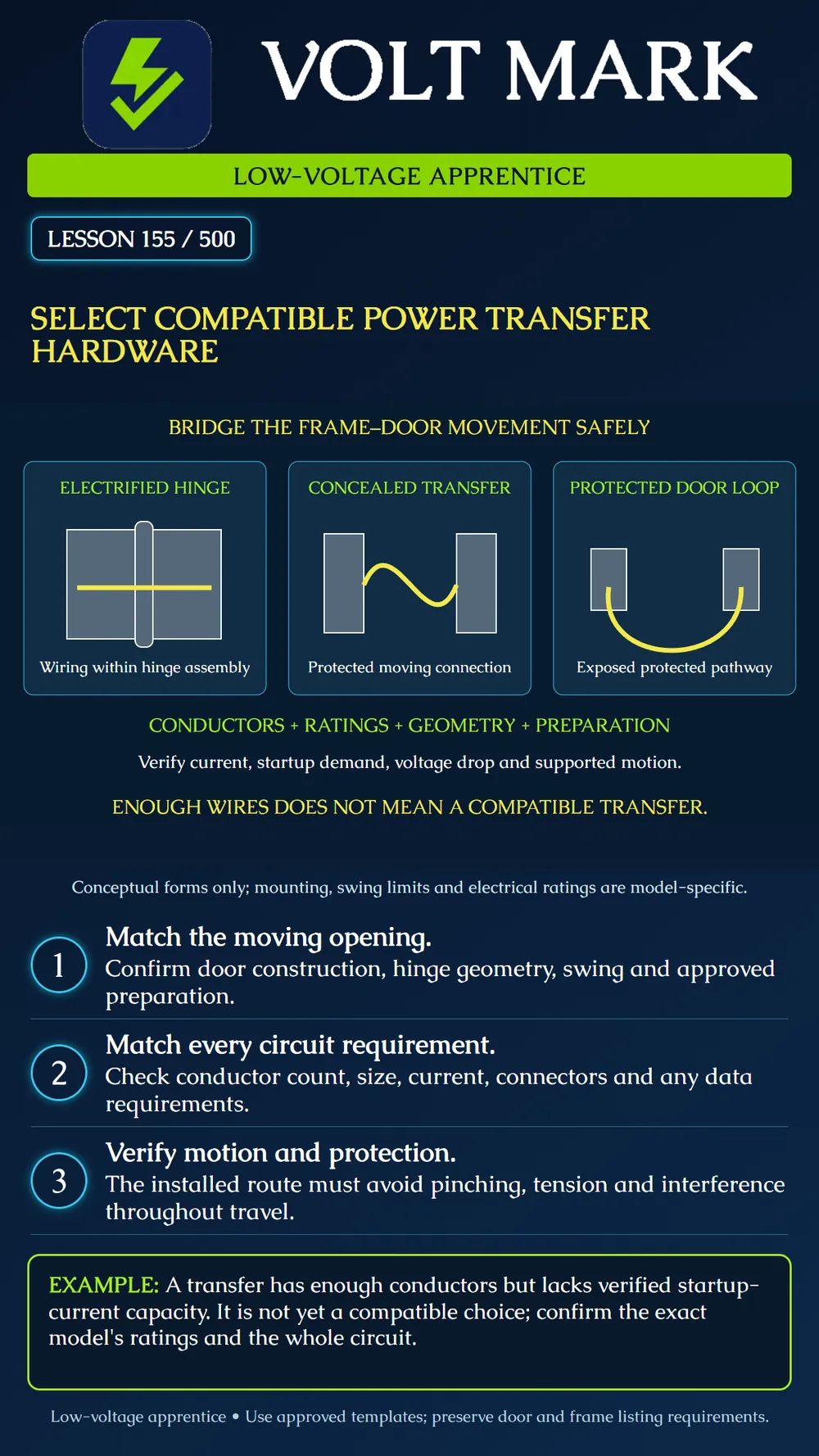
Identify a compatible method for carrying required circuits between the frame and moving door without treating conductor count as the only selection criterion.
Door-mounted electrical hardware may need a connection across a moving boundary. The transfer arrangement protects that connection while the opening operates. Examples include an electrified hinge, a concealed transfer assembly and a protected door loop. The poster shows conceptual forms rather than construction details.
Begin with the opening's approved hardware set. Identify the door and frame construction, hinge or pivot arrangement, required swing and preparation. The selected transfer must support that geometry. A device suitable for one hinge configuration is not automatically suitable for a swing-clear or pivoted opening.
Manufacturer documentation illustrates why exact selection matters. Von Duprin describes EPT products for transferring power from a frame to a swinging door, with different conductor configurations. Its guidance also identifies swing conditions. Securitron offers concealed transfer and electric-hinge products. These product families provide examples, not blanket permission to substitute one for another.
Next identify the circuits crossing into the leaf. Count the needed conductors, but also check conductor size, voltage and current ratings, connector suitability and any specified data requirements. More small conductors do not automatically provide the same power capability as fewer larger conductors. Do not parallel spare wires to increase current capacity unless the manufacturer and approved design explicitly support that arrangement.
The preceding lesson calculated startup and holding demand. Carry the relevant electrical conditions into the transfer review. A transfer may have enough circuits yet remain unsuitable for the load or transient duty. Evaluate the complete path, including connectors and wiring, rather than treating the transfer as an unlimited conductor.
Follow the exact product instructions for mounting and the permitted movement. A flexible assembly needs to accommodate the approved travel without stretching, pinching or obstructing hardware. The conceptual yellow lines are not bend-radius or slack instructions. Do not reproduce their shape as a field template.
A protected pathway may be supplied with conductors or may accommodate a specified cable arrangement, depending on the product. Confirm what is actually provided. Neither a metal sleeve nor a hinge-shaped enclosure establishes the electrical rating of conductors installed through it.
Preparation also matters. Use the approved templates and permissions for the opening. Do not drill, mortise or change a rated assembly from a generic classroom sketch. Confirm the door and frame listing requirements and manufacturer directions before modification.
A fictional opening requires power and monitoring circuits to reach door-mounted hardware. Candidate A has enough conductors, but its documented allowable motion does not match the scheduled opening. Candidate B matches the geometry, but the supplied documentation does not establish startup-current suitability.
Neither candidate is ready for approval. Record the specific mismatch for A and the missing rating evidence for B. The correct task is to obtain a compatible, documented selection, not choose whichever product is already on the truck.
In a second example, a proposed loop appears to reach both attachment points when the door is closed. That observation alone says nothing about full travel. Under the authorized test procedure, the installer must verify the intended movement and protection. Do not assume a longer loose cable is an acceptable correction.
Use unpowered samples and approved product documentation. Identify which components form the mechanical pathway and which carry electrical circuits. Compare each candidate against a supplied fictional opening schedule, conductor requirement and load profile.
Make a selection matrix with verified, incompatible and unresolved entries. An unresolved current rating is not a pass. Have the supervisor trace one mechanical and one electrical requirement back to the product documentation.
For an authorized installed demonstration, observe the approved travel and record any interference or strain. Functional continuity or load checks must use the specified safe procedure; do not probe or disconnect energized door hardware casually.
Opening / hardware set / revision: Door construction and hinge or pivot geometry: Required travel and approved preparation: Transfer model and documentation: Conductor count / sizes / circuit assignments: Voltage, steady current and startup requirements: Connector and data compatibility: Motion and protection review: Listing or modification requirements: Unresolved issue / reviewer / disposition:
Does conductor count alone prove compatibility? No. Can a hinge-specific swing limit be ignored if the cable seems long enough? No. Are all door loops supplied with the same conductors? No; check the exact product. Does an electrical transfer replace a structural hinge? Only a product designed and approved for that structural function can do so. Can the poster serve as a mounting template? No.
Primary manufacturer sources checked September30,2026: Von Duprin, Electrical Power Transfer: https://www.vonduprin.com/en/products/options-accessories/electrical-power-transfer.html Allegion, What is an EPT? https://kc.allegion.com/kb/article/what-is-an-ept/ Securitron, CEPT Concealed Electrical Power Transfer: https://www.securitron.com/content/dam/assa-abloy/americas/ems/securitron/document/AADSS1060832.pdf Securitron, EH Electric Hinge catalog: https://www.securitron.com/adobe/assets/urn%3Aaaid%3Aaem%3A182a8cac-b636-42ab-ade6-b644561a7c04/original/as/AADSS1207287.pdf Original conceptual art and exercises. No actual opening was modified or product combination approved.
Free study material for low-voltage apprentices. This is a national foundation course: requirements differ by state and by local jurisdiction, and a practice that is common in one place is not a rule everywhere. Nothing here is a licence, a certification, or authority to work unsupervised, and completing it does not count as apprenticeship hours or continuing-education credit. Check the codes adopted where you are working, the licensing authority for that work, and your employer's safety programme. VoltMark is not affiliated with, endorsed by, or sponsored by NFPA, OSHA, NICET, BICSI, FOA, or any state or local licensing authority.

Electrician licensing exam prep: practice questions, timed exam simulations, and step-by-step help finding every answer in the NEC.