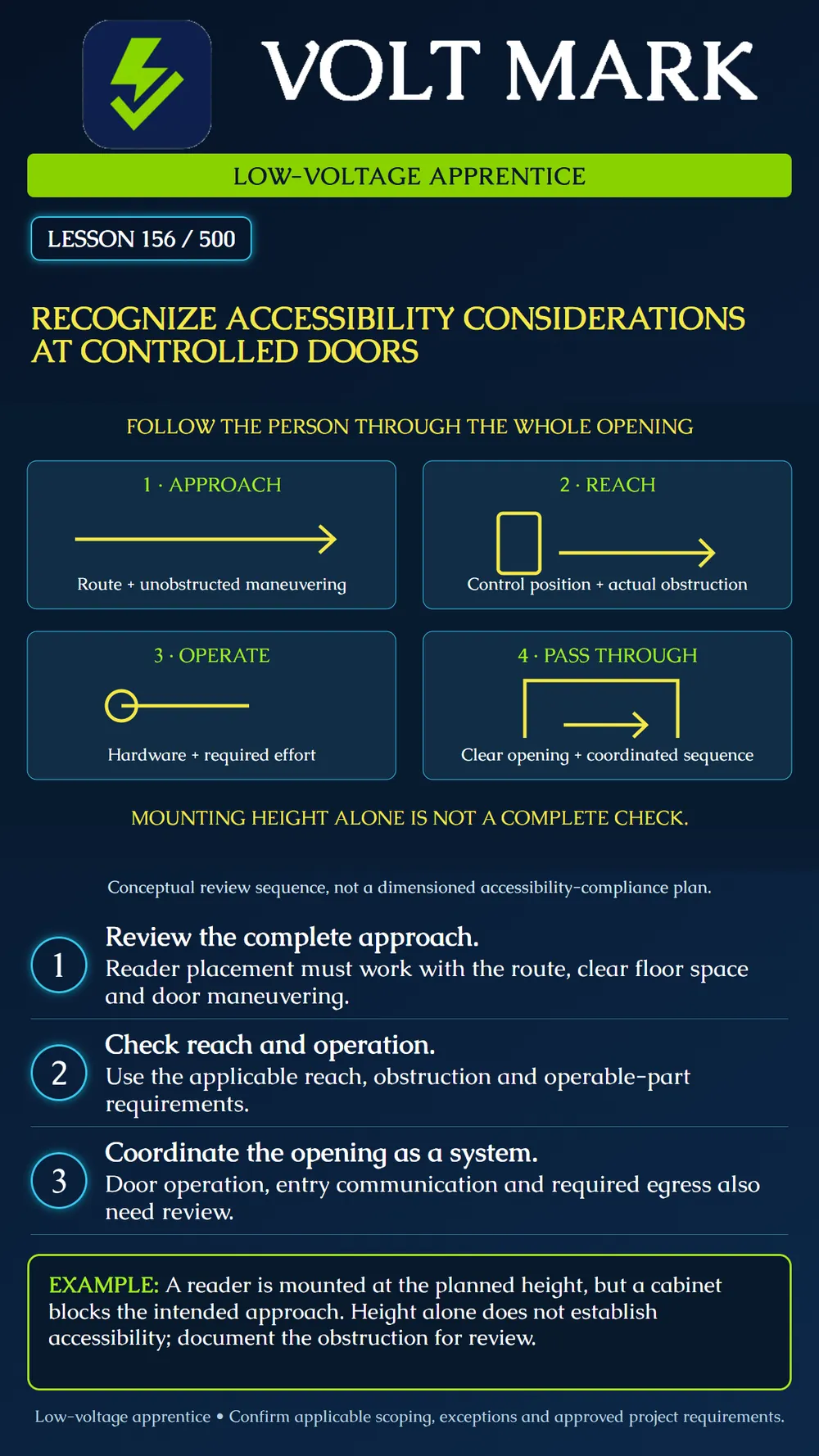
Recognize accessibility questions created by an access-control installation and document them for coordinated review of the entire opening.
A controlled door is part of a route people must use. A functioning credential reader does not establish that someone can approach it, operate it and pass through the door. Review the whole sequence rather than treating the reader as an isolated wall-mounted device.
The poster organizes four questions: approach, reach, operation and passage. It is a conceptual review aid. It supplies no dimensions and does not depict a compliant layout. Actual requirements depend on applicable scoping, approach conditions, opening configuration and permitted exceptions.
The U.S. Access Board's operable-parts guidance addresses clear floor space, reach and operation. Reach conditions differ with the direction of approach and intervening obstructions. A mounting-height measurement by itself does not resolve those questions. Use the applicable criteria and the approved layout.
The Board's entrance and door guidance addresses maneuvering clearances, door hardware and opening operation. Clearance requirements depend on approach and door conditions. Door-opening force and hardware operating force are different checks; exceptions matter. Where two-way entry communication is provided, its visual and audible signaling requirements also need attention. These are review topics, not a claim that the same numerical rule applies to every opening.
The fictional drawing locates a reader beside a training door. The mounting height matches the planned dimension, but a cabinet now occupies the intended approach area. A trainee records only the height and marks the reader accessible.
Correct the record. Note the observed cabinet location and the affected approach, with a sketch or authorized photograph. Ask the responsible designer to review the condition against the applicable criteria. Do not move the reader or furniture without coordination, and do not invent a clearance measurement from a photograph.
The point is not that every cabinet creates the same result. The observed condition must be evaluated against the actual approach and requirements. The apprentice's useful contribution is a precise record that lets the reviewer resolve the issue.
A demonstration user presents a credential successfully, but the complete interaction with the door has not been observed. The trainee writes "accessibility test passed."
Replace that with the narrower finding: the demonstrated credential transaction succeeded. The remaining review includes the physical route and opening operation under the approved procedure. A single user's successful attempt does not certify access for all users or prove every applicable requirement.
Identify the opening and the approved accessible-route information. Locate the reader, keypad, intercom or operator control on the current drawing. Record actual nearby obstructions and changes from the approved arrangement.
Ask which project criteria govern each measurement. Keep the source, unit, reference point and measured condition with the record. Separate a designer's required value from an actual field measurement. If a measurement has not been taken, leave it unverified.
Coordinate the credential-release sequence with the opening hardware. Do not change a closer, unlock timer or operator configuration merely to make one demonstration easier. Any proposed change must preserve the approved accessibility, egress, fire-door and security functions that apply.
Low-voltage work can introduce barriers through poorly coordinated reader locations, exposed hardware or changes to the use sequence. Recognizing those effects is part of the task even when another trade owns the door or adjacent construction.
Do not assume every user has a smartphone, the same reach or the same ability to manipulate a device. Record the organization's authorized credential and assistance arrangements as part of the usability discussion. These operational questions complement, rather than replace, the formal design review.
Use a supplied fictional floor plan and control-location drawing. Mark the intended approach and identify any objects that could affect it. Create separate lines for documented requirements, observed conditions and unanswered questions.
Have the supervisor review a sample measurement record. Explain why the source and condition matter. Do not quote a universal height or force value without its applicable scope. This exercise trains recognition and reporting, not independent code certification.
Opening / drawing / revision: Applicable accessibility criteria identified by responsible reviewer: Route and approach reference: Reader or control location: Observed obstructions and changes: Measurements with units and reference points: Hardware and interaction observations: Entry communication or operator coordination: Unverified conditions / responsible reviewer / disposition:
Does correct mounting height prove the whole installation accessible? No. Does a successful credential read prove the opening usable? No. Are door-opening force and hardware operating force the same measurement? No. Should a trainee adjust an approved closer or timer independently? No. What is a useful escalation? A specific observed condition with its location, references and unanswered review question.
Authoritative federal guidance checked September30,2026: U.S. Access Board, Chapter3: Operable Parts: https://www.access-board.gov/ada/guides/chapter-3-operable-parts/ U.S. Access Board, Chapter4: Entrances, Doors, and Gates: https://www.access-board.gov/ada/guides/chapter-4-entrances-doors-and-gates/ Source-derived principles are bounded summaries. The scenarios, review record and diagram are original instructional material. No nationwide project compliance determination or qualified inspection is claimed.
Free study material for low-voltage apprentices. This is a national foundation course: requirements differ by state and by local jurisdiction, and a practice that is common in one place is not a rule everywhere. Nothing here is a licence, a certification, or authority to work unsupervised, and completing it does not count as apprenticeship hours or continuing-education credit. Check the codes adopted where you are working, the licensing authority for that work, and your employer's safety programme. VoltMark is not affiliated with, endorsed by, or sponsored by NFPA, OSHA, NICET, BICSI, FOA, or any state or local licensing authority.

Electrician licensing exam prep: practice questions, timed exam simulations, and step-by-step help finding every answer in the NEC.