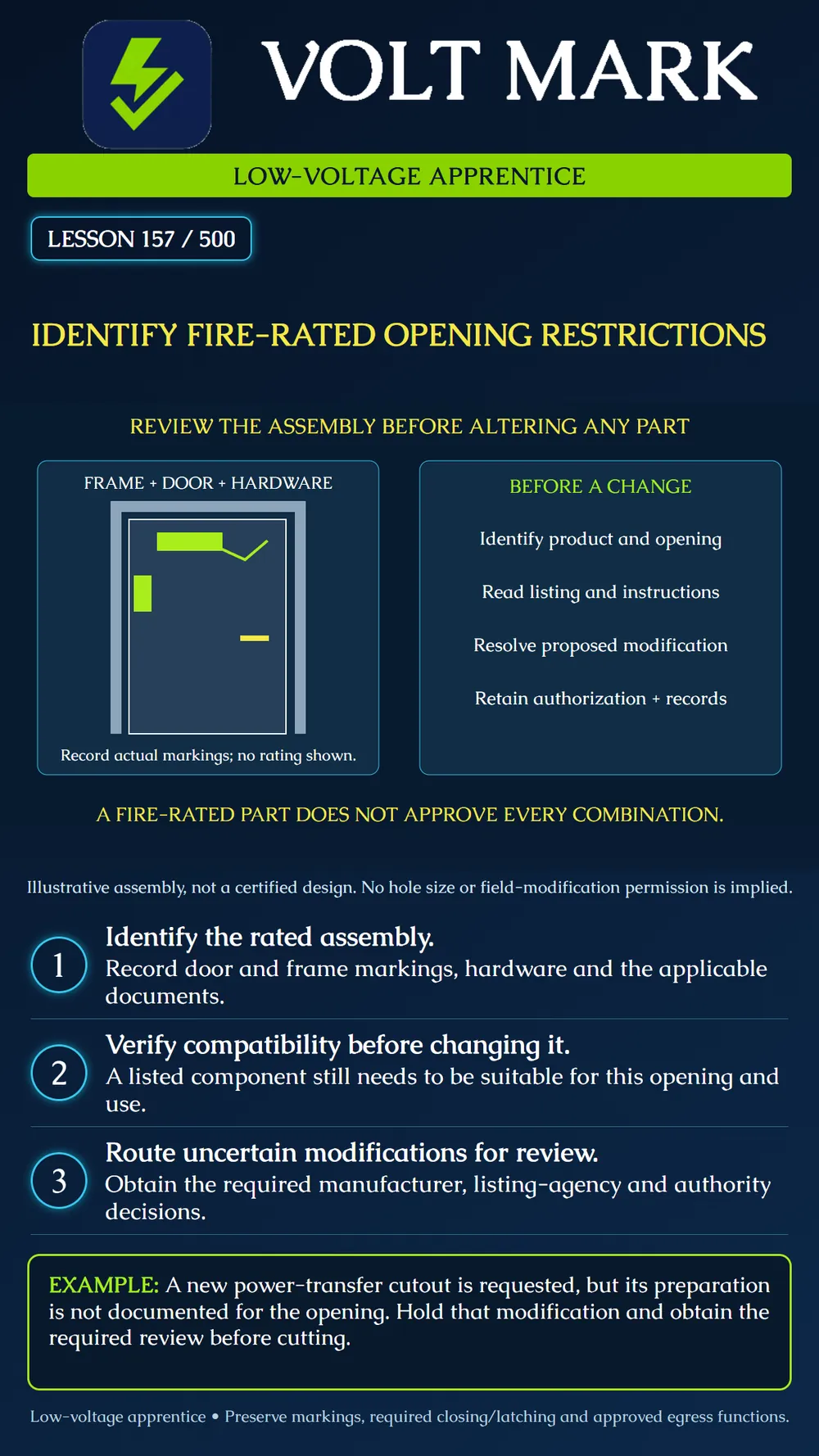
Recognize that low-voltage work can affect a fire-rated opening and identify the documentation and review needed before changing components or preparation.
A fire-rated opening is an assembly, not merely a door leaf with a label. Identify the door, frame and relevant hardware and accessories. Compare their documented use with the opening requirements before proposing access-control changes.
UL's application guide describes fire-door assemblies formed from doors, frames, glazing, hardware and accessories. It also distinguishes fire exit hardware from panic hardware intended only for non-rated exit doors. A familiar shape or a certification mark for a different purpose does not establish suitability.
Preserve actual markings and record their information accurately. The poster's small highlighted rectangle represents a place to look for identification; it is not a certification label, and no rating is depicted. Markings vary by product. Do not create replacement labels, transfer labels between openings or infer a rating from appearance.
Compatibility has to be established for the application. The Steel Door Institute explains that hardware use depends on the door being properly listed and labeled for that hardware application. Different brand names alone do not decide compatibility, and matching brands alone do not prove it.
A proposed cable passage, power-transfer preparation, strike replacement or other change may affect the assembly. Determine whether the specific work is permitted by the applicable instructions, listing conditions and adopted requirements. Do not import a general drilling allowance from an unrelated product or code edition.
UL distinguishes inspection from field evaluation. Its field-evaluation guidance addresses certain changes from original certification and modified assemblies. Which review is required depends on the actual change and applicable process; this lesson does not say every small task automatically requires the same evaluation.
If the documentation does not resolve a proposed alteration, hold that alteration and obtain the required direction through the responsible project lead, manufacturer, listing agency and authority having jurisdiction as applicable. Approval to work at the site is not automatically permission to make every field change.
A fictional access-control retrofit calls for a concealed power transfer. The proposed cutout is shown on a general hardware sketch, but the packet does not establish that preparation for the identified rated door and frame.
The trainee should record the opening identifier, actual marking information, proposed hardware model, cutout request and missing reference. The next step is documented review, not cutting first and asking later. Other authorized documentation work can continue while that alteration remains unresolved.
A second scenario presents a replacement exit device with a panic-hardware label but no established fire-exit suitability. Do not treat the label as approval for the rated opening. Obtain the applicable product evidence and approved selection. The scenario teaches recognition of a distinction, not a purchasing recommendation.
The opening's closing, latching and exit operation must remain consistent with its approved design. An access-control modification must not be accepted solely because a badge opens the door. Relevant post-work verification has to address the affected functions.
Do not wedge the opening open to avoid repeated credential use, remove a required closer or defeat a latch to simplify a demonstration. If the job requires a temporary impairment or work condition, follow the site's authorized procedure and responsibilities rather than inventing an arrangement.
Use a fictional packet containing an opening schedule, product instructions, marking photographs and a proposed change. Separate three columns: verified information, proposed work and unresolved authorization.
Have a second learner trace each conclusion to the supplied evidence. An illegible marking should remain unresolved, not become a guessed rating. A missing installation reference should remain a missing reference, not proof that a modification is forbidden or allowed.
Prepare a concise clarification request that identifies exactly what needs determination. Include the affected assembly and the proposed alteration. Avoid vague statements such as make it legal or the door looks rated.
Opening identifier / schedule revision: Door and frame marking references: Hardware and accessory models: Applicable listing and installation documentation: Proposed alteration: Documented permission or unresolved question: Required reviewer / decision / date: Work and post-work verification references: Remaining limitations:
Does a rated door leaf alone prove the complete opening acceptable? No. Are panic and fire exit hardware labels interchangeable? No. Can matching product brands prove compatibility? No. What follows an undocumented proposed cutout? Required review before the alteration. Can an apprentice fabricate a missing certification label? No.
Primary sources checked September30,2026: UL Solutions, Doors, Windows and Related Hardware Application Guide: https://www.ul.com/thecodeauthority/knowledge/ul-fire-rated-doors-guide UL Solutions, Fire Door Inspection and Field Evaluation Programs: https://www.ul.com/resources/ul-fire-door-inspection-and-field-evaluation-programs-what-are-differences Steel Door Institute, Frequently Asked Questions: https://steeldoor.org/faqs/ Bounded source summaries support identification and review principles. Diagram, scenarios and worksheet are original instruction. No inspection, field evaluation, code approval or physical modification was performed.
Free study material for low-voltage apprentices. This is a national foundation course: requirements differ by state and by local jurisdiction, and a practice that is common in one place is not a rule everywhere. Nothing here is a licence, a certification, or authority to work unsupervised, and completing it does not count as apprenticeship hours or continuing-education credit. Check the codes adopted where you are working, the licensing authority for that work, and your employer's safety programme. VoltMark is not affiliated with, endorsed by, or sponsored by NFPA, OSHA, NICET, BICSI, FOA, or any state or local licensing authority.

Electrician licensing exam prep: practice questions, timed exam simulations, and step-by-step help finding every answer in the NEC.