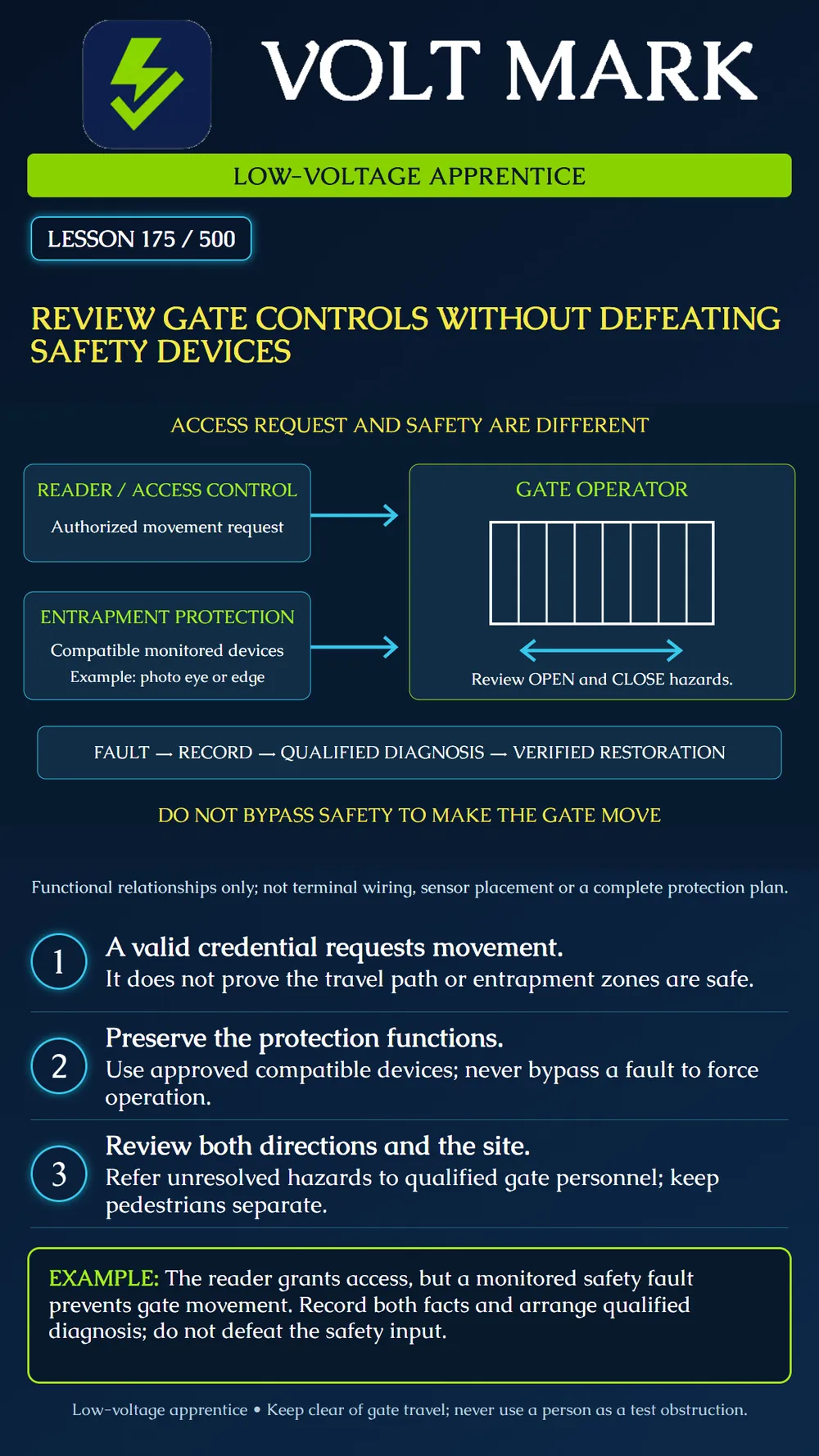
Distinguish access-command functions from entrapment-protection functions and prepare a useful gate-control review record without bypassing protective devices. This lesson is a desk-review and supervised observation exercise, not an operator commissioning or repair procedure.
A reader, intercom or access controller may request gate movement. The operator and its protective functions determine the response under the actual conditions. A successful credential transaction is not evidence that gate movement is safe. A low-voltage signal can initiate powerful mechanical motion; the control cable's voltage does not describe the physical hazard.
UL Solutions distinguishes gate-operator safety, including entrapment protection under UL 325, from access-control security functions addressed through UL 294. A credential reader is not a substitute for protection against a moving gate. Source: https://www.ul.com/thecodeauthority/knowledgecenter/securing-peace-mind-access-control-and-gate-operators
LiftMaster's safety guidance addresses entrapment protection in opening and closing directions, compatible system planning and separate pedestrian access. Its dated slide-gate examples are not a universal sensor-count rule for every operator or installation. Use the actual model, manual revision and assessed site conditions to establish the required protection. Source: https://www.liftmaster.com/about-liftmaster/safety
Start with gate ID, operator model, serial information where appropriate, manual revision, gate type, approved drawings and the responsible gate contractor. Record the purpose of each low-voltage input from its documentation, rather than from an assumed wire color. An open command, position indication, vehicle-detection function and monitored entrapment input have different jobs.
Verify the manufacturer's approved device compatibility through the correct documentation. Similar appearance or the same nominal supply voltage is insufficient evidence. A vehicle-detection device should not be credited as personnel entrapment protection without the required suitability and approved application. Do not substitute an ordinary relay contact for a monitored protective device.
From a safe observation position, record the documented travel areas, fixed objects and separate pedestrian route. Ask the qualified gate specialist to reconcile any unaddressed opening-side or closing-side hazard. Never stand in the path, reach through the gate to a control, or enter a pinch point to inspect a sensor. Equipment isolation, mechanical restraint and repair belong to the authorized task-specific procedure and competent personnel.
Gate G175 has a reader event log showing 'access granted.' The operator reports a protective-device fault and does not move. A requester says that the reader is broken because the gate did not open.
The apprentice records two separate facts: the access system accepted the test credential, and the operator reported a fault. The event does not prove whether the command reached the intended operator input, nor does the fault message by itself identify the failed component. Preserve the exact indication, time, model and associated observations for qualified diagnosis.
The wrong response is to remove the safety device from the configuration, bridge its input, move it away from its protection area or increase force to obtain movement. The useful response is to stop the functional exercise, keep the area managed under the site's procedure and arrange qualified investigation. A gate that moves after protection is defeated has not passed a safety test.
In a second paper scenario, a design shows one protection device at the vehicle opening but has no documented review of the gate's retreat area. Mark the review incomplete and refer it to the gate specialist. Do not infer that adding a random sensor fixes the entire installation.
Using an instructor-provided drawing and product manual, make a functional list with columns for device ID, purpose, documented input, compatibility evidence, direction or area served, and unresolved question. Use fictitious records. Identify which facts can be confirmed from documents and which require an authorized field evaluation.
For any operational demonstration, the qualified person selects the manufacturer's procedure, suitable test objects and controlled conditions. This lesson supplies no instructions to intentionally create entrapment, disconnect safety circuits or move the gate against a person. Do not improvise a body-part test or perform repeated resets to suppress a persistent fault.
A service record should distinguish the initial symptom, diagnosis, authorized correction, relevant functional/protective checks and the responsible person's restoration decision. Record the configuration and device references used. Moving once, clearing an indicator or receiving a remote 'success' message is not sufficient evidence that every required protective function works.
Include the gate and operator IDs; exact alarm or fault text; time and operating condition; access event reference; documented command destination; protective-device inventory and compatibility references; safe observations of damage or obstruction; both travel-direction concerns; pedestrian route; responsible service contact; and unresolved status. Do not declare compliance or authorize use outside your role.
Answer: No; authorization and motion safety are separate functions.
Answer: No.
Answer: No.
Answer: Both opening and closing, with the actual site and operator requirements.
Answer: No; qualified personnel must use the prescribed test method and suitable test objects.
Sources accessed October 1, 2026 UTC. Original teaching scenarios; no gate operated, safety input modified or field compliance established. Qualified gate-system technical and publication review remain pending. Actual adopted requirements, manufacturer instructions and approved site design govern installation and acceptance.
Free study material for low-voltage apprentices. This is a national foundation course: requirements differ by state and by local jurisdiction, and a practice that is common in one place is not a rule everywhere. Nothing here is a licence, a certification, or authority to work unsupervised, and completing it does not count as apprenticeship hours or continuing-education credit. Check the codes adopted where you are working, the licensing authority for that work, and your employer's safety programme. VoltMark is not affiliated with, endorsed by, or sponsored by NFPA, OSHA, NICET, BICSI, FOA, or any state or local licensing authority.

Electrician licensing exam prep: practice questions, timed exam simulations, and step-by-step help finding every answer in the NEC.