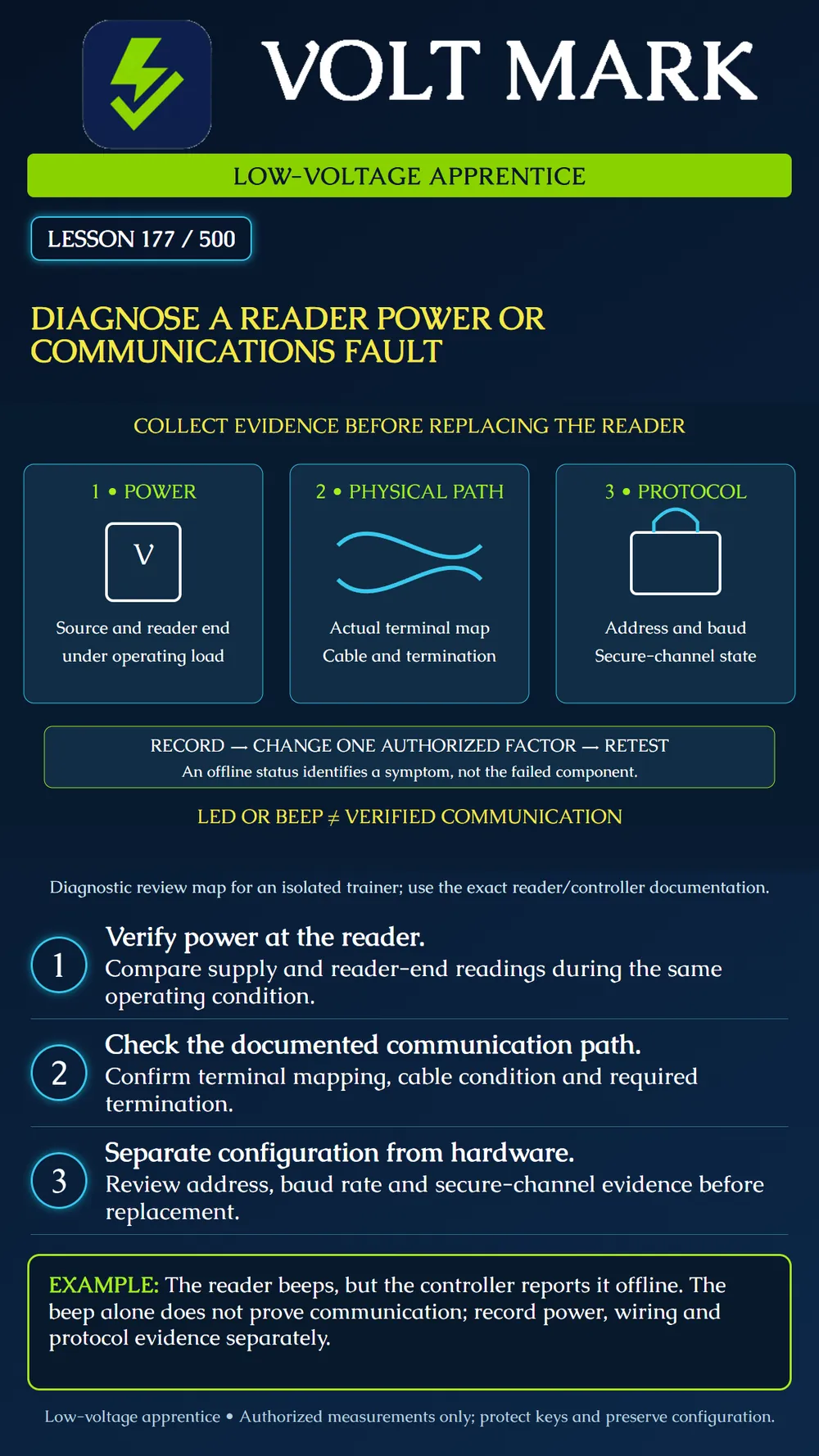
Separate evidence about reader power, the physical communication path and protocol configuration. Use an isolated supervised trainer to develop a defensible fault record before proposing a replacement.
Record the exact controller message, reader indication, time and operating condition. 'Offline' describes a reported state; it does not identify the failed component. A lit reader is not proof that its supply remains adequate during operation. A successful card beep is not proof that the controller received the credential.
SIA's April 2026 OSDP troubleshooting guidance specifically cautions that a reader beep or blinking LED does not establish valid OSDP communication. It recommends checking addressing, matching baud rates, secure-channel configuration, physical cabling and controlled combinations of known-good components, with findings documented for escalation. Use those concepts to separate fault categories; do not treat a reset or removal of encryption as the default repair. Source: https://www.securityindustry.org/2026/04/28/your-step-by-step-guide-to-osdp-system-troubleshooting/
The AXIS A4020-E manual gives a different A/B mapping for an A1001 than for other Axis controllers. It also identifies a model-specific termination switch whose Off position enables termination. These examples show why matching letters blindly or assuming 'On means terminated' can produce an error. Follow the actual reader/controller pair's instructions rather than universal wire colors or switch positions. Source: https://help.axis.com/en-us/axis-a4020-e
Identify the documented supply requirement, polarity, rated operating range and relevant load limits for the installed reader. Do not assume every reader uses the same voltage. Under the instructor's authorized measurement procedure, compare the supply-end condition with the reader-end condition while the reader is operating. Record the locations, measurement type, operating state and instrument used.
If the source remains suitable but the reader-end supply is outside the allowed range, investigate the supply path, connections and load with the supervisor. If both locations show a problem, investigate the source and its loading. These are diagnostic directions, not proof of one particular failed part.
Use a correctly rated instrument, correct function and proper lead connections. This lesson does not authorize work near exposed mains or an energized cabinet outside your qualifications. Do not apply resistance or continuity testing to an energized circuit; isolate the appropriate circuit and follow the equipment procedure before those tests. Avoid creating a short with probes or adding a second supply without an approved design.
With work performed under the appropriate isolation procedure, compare actual terminations with the documented mapping. Record visible damage, loose connections and cable identification without inferring hidden conditions. Review topology, termination and reference/shield treatment against the exact manufacturer's instructions. Do not move conductors at random until an offline indicator clears.
A basic continuity result does not by itself demonstrate reliable communications under operating conditions. Escalate for suitable cable or protocol analysis when the evidence requires it. Preserve the original symptoms and configuration before making an authorized change.
Record the reader's address, controller port association, communication speed and relevant firmware versions using protected configuration records. Compare the values with the intended design. For a multidrop arrangement, check the addressing plan rather than assigning an arbitrary new address.
Distinguish an established link from a verified secure session. A key-related error may require the authorized administrator's recovery process; it does not justify leaving the deployment in an insecure setup mode. Do not publish keys, reset devices casually or change encryption policy to hide the fault.
Case A: the reader works at rest but resets during an instructor-defined operating event. The learner records measurements and the event timing, then compares the reader-end result with the actual rating. 'It had power earlier' is insufficient evidence.
Case B: the power evidence is satisfactory, but the as-built termination differs from the manual for this exact controller/reader pair. Record the discrepancy. After the supervisor makes an authorized correction, repeat the same functional check and preserve before/after results.
Case C: the link is reported available, but secure-session establishment fails. Preserve the error and configuration references and involve the authorized administrator. Do not label the cable defective solely from that symptom.
Case D: a credential reaches the controller but is denied because the test user lacks access rights. That observation is different from a reader communication fault. Keep credential authorization outside the hardware-fault conclusion unless evidence connects them.
Use fictional credentials and an isolated trainer. Establish a baseline, state one hypothesis, make one authorized change and repeat the same observation. If using a known-good device, confirm its compatibility and provisioning before the instructor substitutes it. A successful short bench cable test does not automatically validate the full installed cable run.
Record the restored configuration, required secure-channel state and functional result. Keep unresolved symptoms open. If escalation is needed, provide model/version details, operating conditions, safe measurements, mapping references, error records and changes already attempted. Store sensitive trace files under the owner's access controls.
Free study material for low-voltage apprentices. This is a national foundation course: requirements differ by state and by local jurisdiction, and a practice that is common in one place is not a rule everywhere. Nothing here is a licence, a certification, or authority to work unsupervised, and completing it does not count as apprenticeship hours or continuing-education credit. Check the codes adopted where you are working, the licensing authority for that work, and your employer's safety programme. VoltMark is not affiliated with, endorsed by, or sponsored by NFPA, OSHA, NICET, BICSI, FOA, or any state or local licensing authority.

Electrician licensing exam prep: practice questions, timed exam simulations, and step-by-step help finding every answer in the NEC.