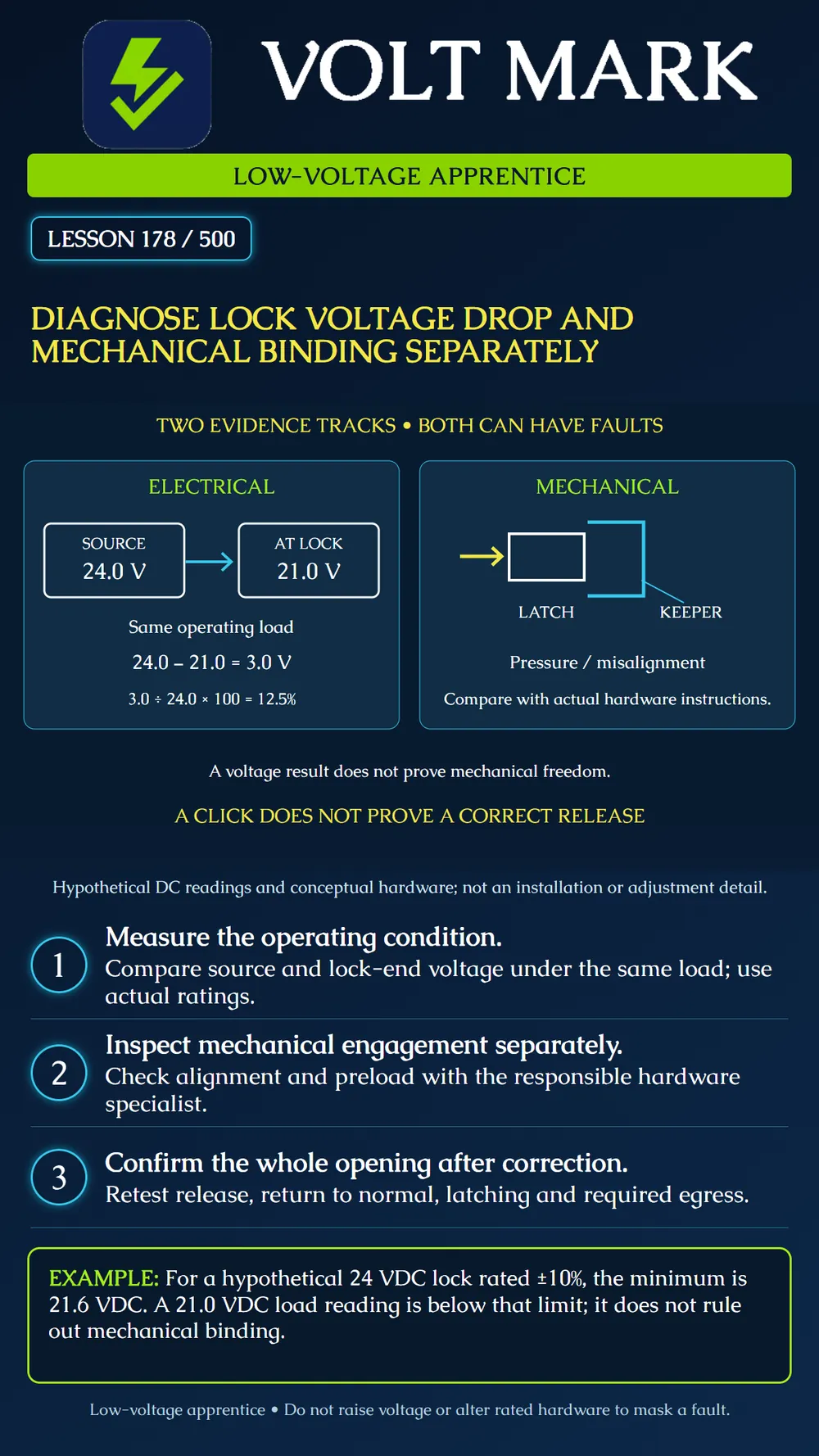
Distinguish electrical delivery problems from mechanical engagement problems, using measured evidence and the actual hardware instructions. Recognize that both can occur at the same opening.
Allegion's troubleshooting article for Von Duprin 6100/6200 strikes separates electrical and mechanical checks. It calls for voltage verification near the solenoid under load and identifies preload against the keeper as a possible interference with operation. Its voltage, wire-color, resistance and clearance details belong to those models and are not universal lock specifications. Source: https://kc.allegion.com/kb/article/why-won-t-my-von-duprin-6100-or-6200-series-electric-strike-lock-and-unlock-properly/
HES notes that smoke seals and door silencers can contribute to preload in its 5200 strike application. Its model-specific adjustment capability illustrates why the correct hardware instructions matter; it does not authorize removing seals or modifying a rated opening. Source: https://www.hesinnovations.com/en/support/technical-tips/tech-tip-1/5200-electric-strike
Before testing, identify the opening, hardware model, supply type, voltage configuration, fail mode and approved operating sequence. Determine whether the observed state is supposed to be powered or unpowered. Zero volts can be expected during some release sequences; it is not automatically a fault. A relay click only establishes that something actuated audibly, not that the correct voltage reached the load or that a latch released.
Use an isolated trainer and the instructor's authorized measurement procedure. Record source voltage and voltage at the lock's documented input under the same operating condition. A no-load reading can miss a problem that appears when current flows. Describe the state clearly: commanded release, normal secured state or another approved test condition.
Compare the lock-end reading with the actual manufacturer's operating limits and waveform requirements. DC and AC measurements are not interchangeable. Electronic drivers and transient conditions may require manufacturer-specific measurement methods beyond a simple steady reading.
Do not increase the supply above permitted ratings to compensate for a wiring problem. Investigate the source, circuit loading, conductors, connections and switching path according to the approved procedure. Never use resistance mode on an energized circuit or put a meter set for current directly across a supply. Work near mains or outside the apprentice's measurement authorization belongs to qualified personnel.
Assume a fictional steady DC trainer load whose permitted input is 24 VDC plus or minus 10 percent. This is a stated exercise rating, not a default for real locks. Lower limit = 24 × 0.90 = 21.6 VDC. Upper limit = 24 × 1.10 = 26.4 VDC. During a steady operating condition, source = 24.0 VDC and lock input = 21.0 VDC. Difference = 24.0 − 21.0 = 3.0 V. Difference as a percentage of the measured source = 3.0 / 24.0 × 100 = 12.5 percent. The 21.0 VDC reading is below this hypothetical device's 21.6 VDC minimum.
The result supports investigating electrical delivery. It does not identify which connection or component caused the loss, nor prove that mechanical binding is absent. The difference includes whatever supply-path elements lie between the measurement points; do not call all of it 'cable drop' without further evidence. A percentage alone is not a universal acceptance criterion.
Ask the responsible hardware specialist to assess alignment, latch engagement, preload and the opening's condition using the actual product instructions. Record when the symptom occurs: every cycle, only after the door closes, under a particular environmental condition or after a documented change.
A change in behavior when pressure is relieved under an authorized procedure is a diagnostic clue, not permission to grind a keeper, remove a seal or defeat latching. Do not force a closed door, hold an egress component disabled or make an unauthorized fire-door alteration. Mechanical service must preserve the approved assembly and required functions.
Case A: source voltage is suitable, lock-end voltage is below the documented minimum and release is unreliable. Investigate the electrical path while leaving mechanical condition as a separate question. Case B: documented electrical conditions are satisfactory, but the hardware specialist observes interfering latch pressure. Record the mechanical finding; do not replace the power supply merely because the symptom involves an electric strike. Case C: correcting electrical delivery improves operation, but the door still binds after closing. Keep the remaining defect open. Two faults can coexist. Case D: the lock acts opposite to the assumed sequence. Recheck the documented fail mode and control state before concluding either wiring loss or binding.
On paper, create separate electrical and mechanical evidence columns. For every conclusion, cite an observation and the applicable specification. Mark missing evidence as unverified. The instructor may supply fictional readings and photographs; no live opening needs to be altered for this exercise.
After an authorized correction, repeat relevant checks and verify the opening's complete approved behavior: release, return to normal, closing/latching and required egress. Record changes, before/after results, remaining issues and responsible review. A single successful cycle does not erase an intermittent symptom.
Free study material for low-voltage apprentices. This is a national foundation course: requirements differ by state and by local jurisdiction, and a practice that is common in one place is not a rule everywhere. Nothing here is a licence, a certification, or authority to work unsupervised, and completing it does not count as apprenticeship hours or continuing-education credit. Check the codes adopted where you are working, the licensing authority for that work, and your employer's safety programme. VoltMark is not affiliated with, endorsed by, or sponsored by NFPA, OSHA, NICET, BICSI, FOA, or any state or local licensing authority.

Electrician licensing exam prep: practice questions, timed exam simulations, and step-by-step help finding every answer in the NEC.