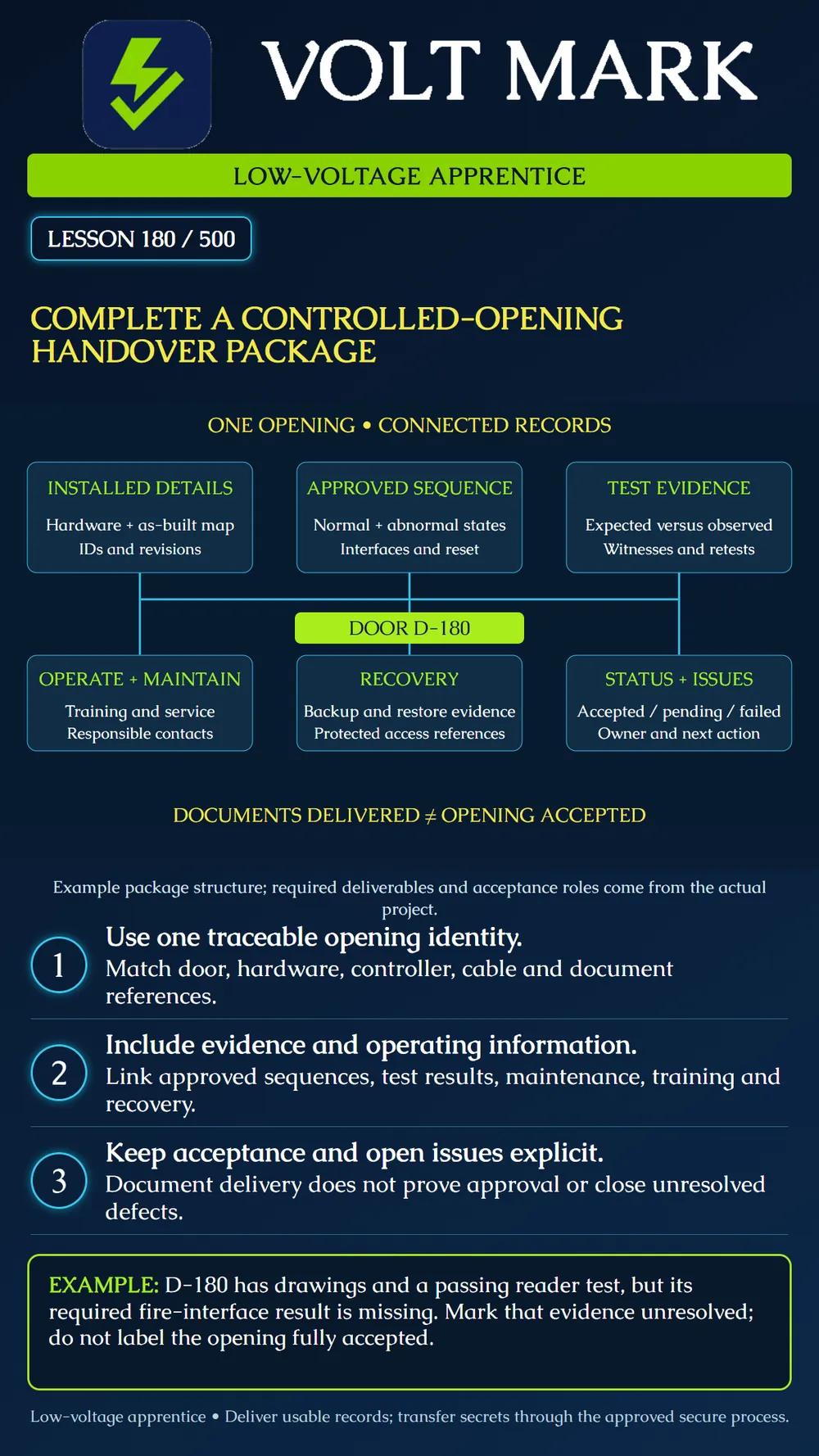
Assemble a traceable, usable package for a controlled opening that connects installed details, approved behavior, verification evidence and operating responsibilities. Keep missing evidence and acceptance status visible.
The WBDG Commissioning Committee describes project-specific documentation responsibilities and a systems manual that combines design records, operating information, training and verification evidence. It also treats the issues log as a record of problems and their resolution. This lesson adapts those broad commissioning concepts to a fictional controlled opening; the actual contract and project requirements determine mandatory deliverables and reviewers. Source: https://legacy.wbdg.org/building-commissioning/commissioning-documents
UCSF's 2026 integrated-testing bulletin links completion records to test plans, observed system responses and the resolution of discrepancies. That is a jurisdiction-specific implementation example, not a universal handover rule. Where a real opening has a required fire interface, include the applicable approved evidence rather than assuming an ordinary reader test covers it. Source: https://ehs.ucsf.edu/fire-prevention-design-bulletin-0003-integrated-fire-protection-and-life-safety-system-testing
Use the same opening ID in the schedule, drawings, device labels, controller mapping, test sheets and issue records. A technician should not need to guess whether 'front door,' 'Door 1' and 'Lobby East' mean the same opening. Where legacy names exist, provide a controlled cross-reference.
The poster's D-180 is fictitious. Its six boxes represent information groups linked by that identity; they are not separate approval signatures. A folder can contain every category and still lack a required result.
Identify the actual door, frame and hardware set, reader, controller/port, lock or release device, monitoring inputs, power source and interface references as applicable. Link approved product information and installation instructions. Provide the as-built cable and device mapping with the current revision, and distinguish verified installed facts from design intent or unverified notes.
Do not silently relabel an old design drawing as an as-built record. Resolve differences through the project's documentation process. Retain the history needed to explain approved changes.
Link the approved opening-specific sequence for normal entry, required egress, release and return to normal. Include applicable power-loss, network-loss, alarm-interface and other specified conditions. Avoid generic phrases such as 'works normally' when the intended behavior has multiple states.
Index the actual test records by opening and scenario. Each should identify the expected result, observed result, test conditions, date, responsible personnel and unresolved limitations. Preserve failures and associated retests. A passing credential transaction does not establish every lock, sensor, interface or mechanical function.
Provide instructions appropriate to the owner's roles: normal use, authorized administration, interpreting relevant indications, reporting faults and obtaining service. Link product maintenance information, warranty details and approved inspection/test arrangements. Do not invent a nationwide maintenance interval for all hardware.
Document training actually delivered, including audience roles, topics, materials, date and outstanding training needs. Attendance is evidence of attendance; it is not automatically a competency certification. Arrange remaining training through the responsible project team rather than marking it complete because a manual was emailed.
Link the backup record, recovery procedure and evidence of any demonstrated restoration. Identify the responsible system administrator and protected credential-transfer process. Include a reference to where authorized personnel obtain keys or credentials, not the secrets themselves in a broadly circulated handover.
Record the configuration version and recovery point. If recovery remains untested, say so. The packet should distinguish backup availability from demonstrated recovery, as discussed in Lesson 179.
A fictional D-180 package contains hardware schedule H-4, as-built drawing A-7 revision C, approved sequence S-9 and a passing reader test T-12. It also includes a backup record and an operating guide. The index calls the opening 'fully accepted.'
On review, the required fire-interface test record F-3 is absent, the power-supply label differs from the drawing and operator training has not occurred. The apprentice should identify these as three distinct gaps. Do not create a pass result, guess the supply identity or sign the training record.
Revise the handover index to show: F-3 pending with responsible test coordinator; power-source reference discrepancy awaiting verified reconciliation; and training pending with assigned owner. Preserve completed items and their evidence. Submit the package for the appropriate reviews with its actual status.
After the responsible team supplies a verified drawing correction, signed test evidence and completed training record, update the index using those references. Do not erase the original discrepancy history. Any final acceptance must still come from the authorized decision-maker.
Ask a second learner to find the opening's controller port, approved loss-of-power response, last relevant test and service contact using only the index. Broken links, conflicting versions and undefined abbreviations are defects in the handover even when the files exist. Verify access permissions using approved methods so intended recipients can open permitted documents without exposing restricted materials.
Free study material for low-voltage apprentices. This is a national foundation course: requirements differ by state and by local jurisdiction, and a practice that is common in one place is not a rule everywhere. Nothing here is a licence, a certification, or authority to work unsupervised, and completing it does not count as apprenticeship hours or continuing-education credit. Check the codes adopted where you are working, the licensing authority for that work, and your employer's safety programme. VoltMark is not affiliated with, endorsed by, or sponsored by NFPA, OSHA, NICET, BICSI, FOA, or any state or local licensing authority.

Electrician licensing exam prep: practice questions, timed exam simulations, and step-by-step help finding every answer in the NEC.