Turn a broad security request into specific, testable camera tasks before selecting equipment. Define what the footage must show, where it must show it and under which conditions.
'Watch the property' is a starting request, not a complete camera requirement. Ask what event matters and what decision the video must support. Seeing that activity occurred across a yard differs from examining a person at a doorway. A useful requirement names the target and desired evidence rather than only a camera count or resolution.
Axis's Quality with a Purpose guidance distinguishes scene overview from detailed information and emphasizes use case, environment and image usability. It also notes that video analytics have their own installation and testing requirements. Those principles support task-based planning; they do not promise an outcome from a particular camera specification. Source: https://whitepapers.axis.com/en-us/quality-with-a-purpose
Older planning material commonly uses detect, observe, recognize and identify (DORI). Axis's September 2026 paper explains that IEC 62676-4:2025 uses a revised set of operational categories and that human-viewed imagery, analytics and thermal applications do not share identical criteria. Record the project's selected framework and edition when using a numeric design target. Do not mix category names or thresholds from different editions without explanation.
The same paper describes pixel density as a planning aid rather than a guarantee. Lighting, optics, compression and display conditions also affect usable results. This introductory lesson therefore assigns no universal pixels-per-foot threshold. Source: https://whitepapers.axis.com/en-us/pixel-density-based-on-iec-62676-4-2025
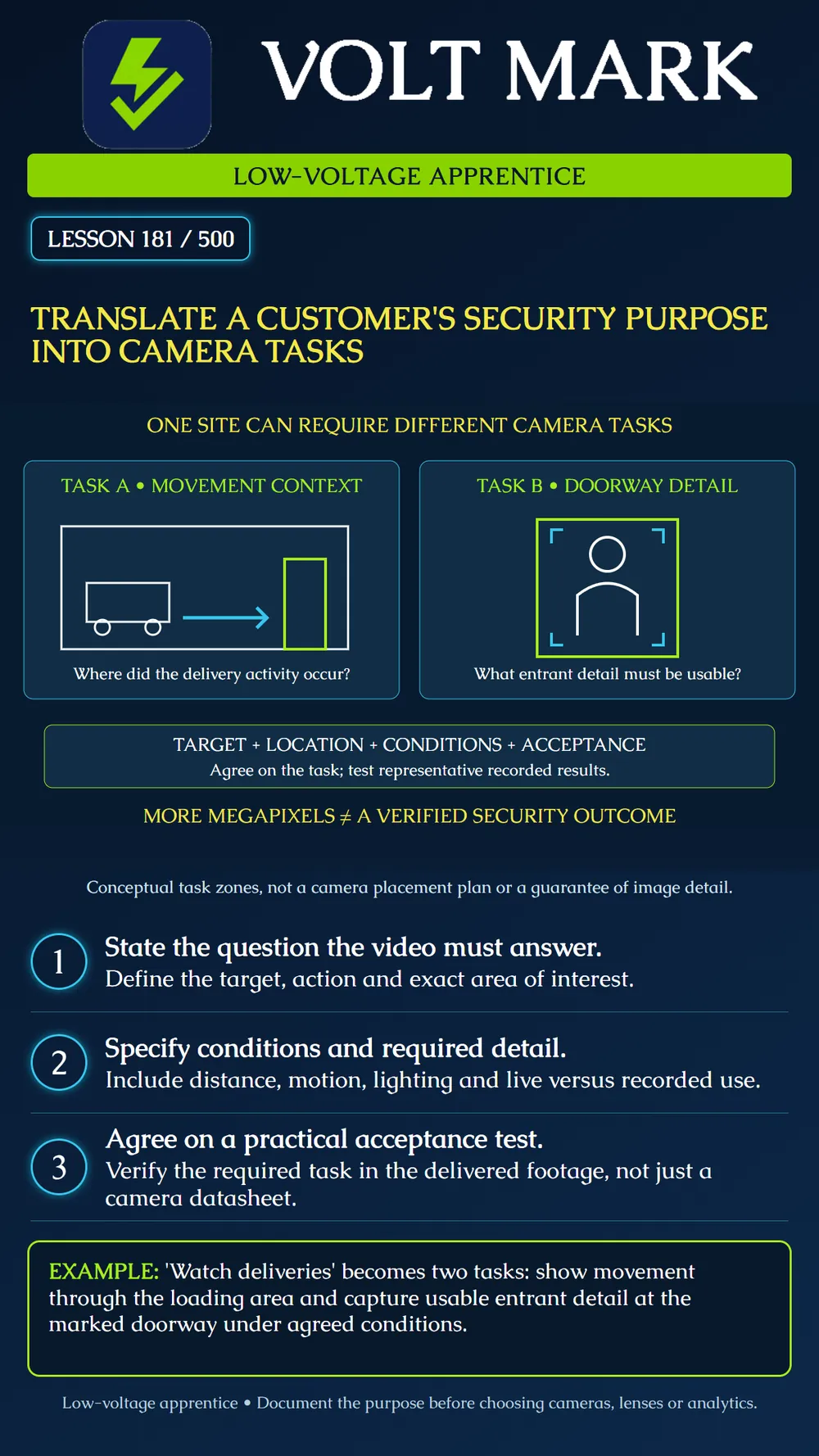
The two panels show different questions at one fictional delivery area. Task A concerns movement context. Task B marks a specific doorway where more useful detail may be required. The diagram does not assert that one camera can accomplish both tasks or prescribe the number, mounting point or lens. It shows why the site should be divided into defined areas of interest.
Target: What person, vehicle, object or action must be visible? Avoid substituting assumptions about identity or intent for an observable event. Location: At which doorway, line, lane or part of the scene must the task succeed? Mark the boundary on a drawing rather than writing 'everywhere.' Conditions: What distances, movement, direction, lighting and obstructions are relevant? Which day/night or seasonal conditions are within the agreed scope? Acceptance: Who will review the result, through which live or recorded viewing path, and what evidence will demonstrate success?
Also identify whether the task is for a human operator, a software analytic or both. An alert and a useful recorded image are separate deliverables. Define the desired operator response and responsible role without assuming that a camera itself prevents an incident.
A fictional customer says, 'We need to watch deliveries.' Clarify the purpose before proposing a product.
Task A draft: From the approved loading-area view, a reviewer must be able to follow a delivery vehicle's movement between the marked entrance line and the unloading zone during agreed operating conditions.
Task B draft: At the marked pedestrian doorway, recorded footage must provide the agreed entrant detail for the owner's review process during representative arrivals. If personal identification is required, explicitly state that objective and have the designer establish the corresponding criteria; the phrase 'clear image' is insufficient.
Task C draft, only if requested: A separately specified analytic should alert the designated operator when a qualifying target crosses the approved boundary during a defined schedule. Its detection performance, nuisance conditions and response workflow need their own acceptance criteria.
These are original drafting examples. They are not completed designs or guaranteed identification outcomes. If the customer does not need Task C, do not silently add analytics.
Create a task sheet with a unique ID, customer purpose, target, area boundary, required detail, relevant movement and lighting, live/recorded use, review role and acceptance reference. Record assumptions, exclusions and open questions.
For the delivery example, include representative conditions such as a person moving through the doorway and a vehicle partly obscuring the loading zone. Discuss which limitations matter to the purpose. A daytime stationary demonstration should not be described as proof of nighttime moving-target performance.
Use privacy boundaries and the owner's authorized recording scope as design constraints. Do not expand the scene into unrelated private areas simply to make framing easier. Audio, biometric analysis and automated identity decisions require separate explicit project requirements and appropriate review; they are not implied by an ordinary video task.
The responsible designer and owner should agree on a representative demonstration and a documented pass/fail basis. Test the actual delivered viewing path when that is the requirement: camera capture, configured recording, playback and any required export. A sharp local live image does not establish that the stored or exported footage preserves the same useful information.
Use authorized participants or suitable training targets, not unsuspecting people, for planned demonstrations. Record the scene, conditions, camera configuration reference, recording settings and reviewer result. Note untested conditions honestly. Do not infer face identity from a small silhouette or claim that digital enlargement creates missing detail.
Rewrite three vague requests: 'cover the parking lot,' 'see the front door,' and 'catch stock losses.' For each, write one observable question, define the target area and list the unanswered conditions. Then ask a second learner whether the requirement can be tested without guessing what 'good video' means.
Free study material for low-voltage apprentices. This is a national foundation course: requirements differ by state and by local jurisdiction, and a practice that is common in one place is not a rule everywhere. Nothing here is a licence, a certification, or authority to work unsupervised, and completing it does not count as apprenticeship hours or continuing-education credit. Check the codes adopted where you are working, the licensing authority for that work, and your employer's safety programme. VoltMark is not affiliated with, endorsed by, or sponsored by NFPA, OSHA, NICET, BICSI, FOA, or any state or local licensing authority.

Electrician licensing exam prep: practice questions, timed exam simulations, and step-by-step help finding every answer in the NEC.