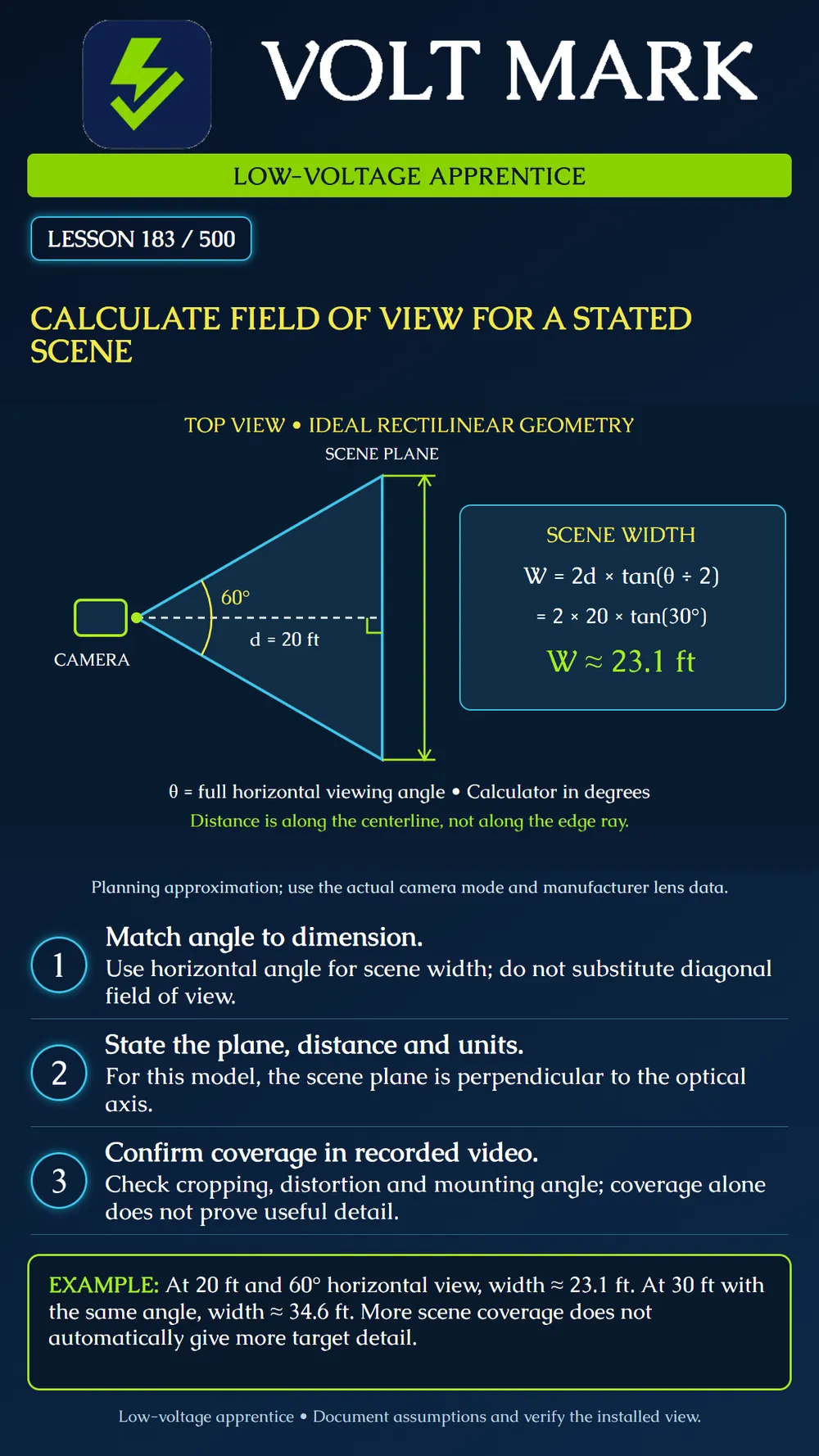
Calculate approximate horizontal scene width from a stated horizontal viewing angle and distance. Explain the assumptions before using the result for camera placement. This is a planning exercise, not an acceptance certificate.
W = 2d × tan(θ/2) for an ideal rectilinear view. W is the width across a scene plane perpendicular to the optical axis; d is distance along that axis to the plane; θ is the full horizontal angle. Use consistent length units and degree mode for an angle in degrees. The viewpoint is optical: measuring from the camera housing introduces an approximation. Confirm actual lens and camera data. Horizontal, vertical and diagonal angles are different inputs. Distortion and image cropping can change usable boundaries. A fisheye image or tilted ground footprint cannot be treated as this same simple rectangle.
A fictional camera provides a 60° horizontal view in its selected mode. Its perpendicular target plane is 20 ft away. Half-angle = 30°. tan(30°) ≈ 0.577350269. W = 2 × 20 × 0.577350269 = 23.09401077 ft. Report about 23.1 ft, together with the assumptions. The centerline splits the view into two right triangles. Each half-width is about 11.55 ft. The 20 ft dimension is on the centerline, not the sloping boundary.
For a required centered scene 18 ft wide, the calculated spare width is 23.094 - 18 = 5.094 ft total, or about 2.55 ft each side. That geometric difference is not a guaranteed installation allowance. Placement uncertainty, obstructions and the real output image must still be checked. It says nothing by itself about readable badges or useful face detail.
At 30 ft with the same 60° angle: W = 2 × 30 × tan(30°) = 34.64101615 ft, about 34.6 ft. Distance and width both increased by 1.5 in this model. More of the scene now fits; the required detail must be evaluated separately in Lesson 184.
θ = 2 × arctan(W / (2d)). A required width of 18 ft at 20 ft gives approximately 48.46° full horizontal angle. This just spans that centered width in the ideal model. It is not a complete purchase specification or a margin for site uncertainty.
Record the camera ID and exact model, lens setting, source of horizontal-angle data, recording mode, aspect ratio and crop. Identify the target plane and distance measurement. Note required width, centering, calculated width, units and rounding. Mark obstructions and describe the planned comparison with recorded video. Assign responsibility for deciding whether the customer task is met. An elevated camera tilted toward a floor has an oblique ground footprint. Identify the actual plane represented by any calculation; use suitable manufacturer tools and site checks instead of labeling this triangle a complete ground survey.
A brief says only "90-degree view." Ask which dimension and camera mode it describes before calculating horizontal width. For a 40° horizontal angle and a perpendicular plane 10 m away: W = 2 × 10 × tan(20°) = 7.27940469 m, about 7.28 m. Explain why this result alone cannot establish identification performance. If a column blocks the doorway, a wider calculated view does not remove that obstruction. Mark the blocked region and refer the placement decision for design resolution.
Edmund Optics, Understanding Focal Length and Field of View: https://www.edmundoptics.com/knowledge-center/application-notes/imaging/understanding-focal-length-and-field-of-view/ Basis: width/distance/angle relationship and approximation limits. Worked numbers and scenarios are original. Axis Communications, Lenses in surveillance: https://whitepapers.axis.com/en-us/lenses-in-surveillance Basis: lens and camera field-of-view context; verify the actual configuration.
Free study material for low-voltage apprentices. This is a national foundation course: requirements differ by state and by local jurisdiction, and a practice that is common in one place is not a rule everywhere. Nothing here is a licence, a certification, or authority to work unsupervised, and completing it does not count as apprenticeship hours or continuing-education credit. Check the codes adopted where you are working, the licensing authority for that work, and your employer's safety programme. VoltMark is not affiliated with, endorsed by, or sponsored by NFPA, OSHA, NICET, BICSI, FOA, or any state or local licensing authority.

Electrician licensing exam prep: practice questions, timed exam simulations, and step-by-step help finding every answer in the NEC.