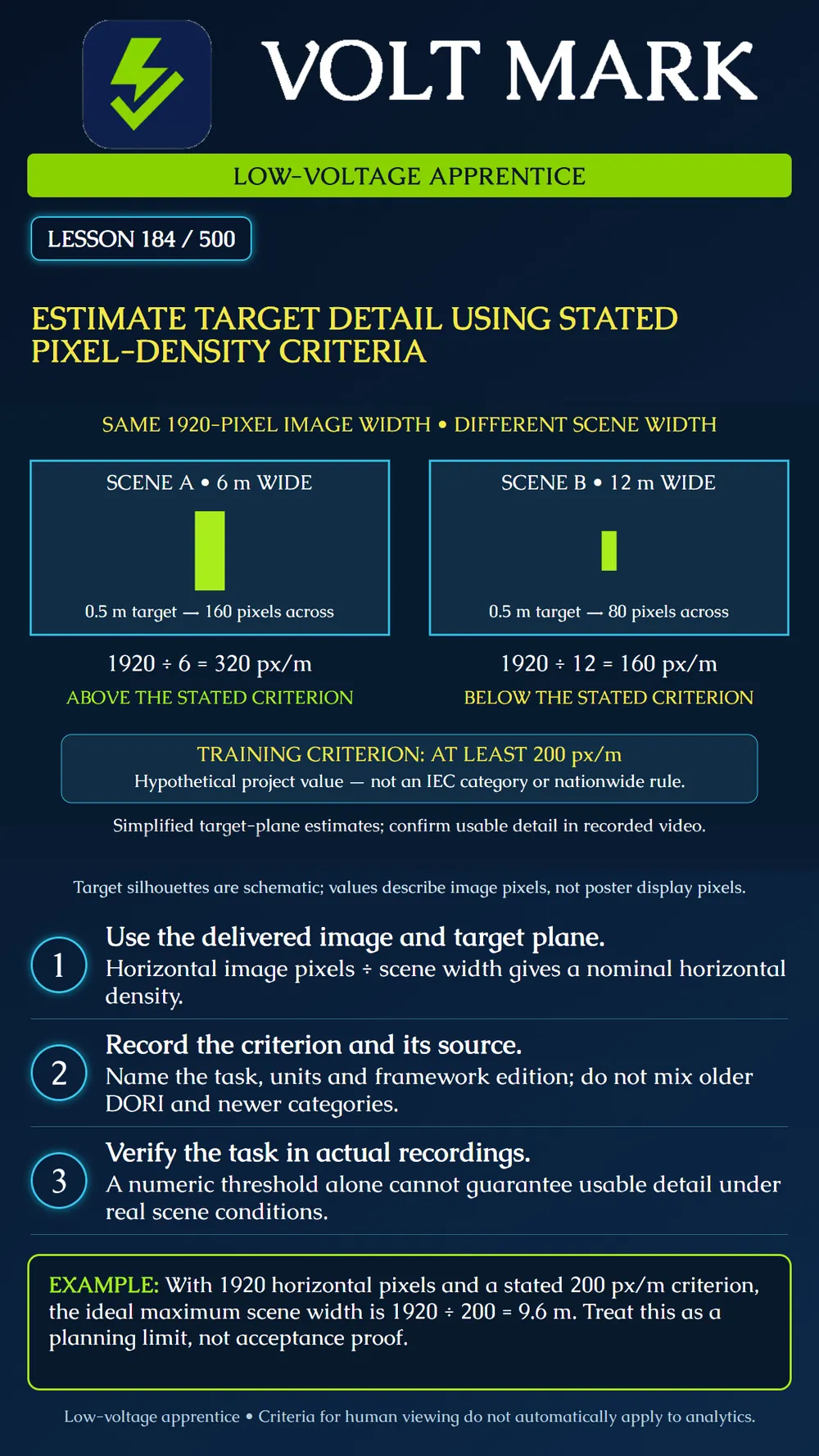
Estimate nominal horizontal pixel density at a specified target plane. Compare it with an explicitly stated criterion and keep that comparison separate from proof that a camera performs its intended task.
D = N / W, where D is horizontal pixels per unit length, N is horizontal pixels in the relevant delivered image, and W is the corresponding scene width at the target plane. A target of width T spans approximately D × T pixels under the simplified geometry. Keep W and T in the same units. For a stated minimum density C, the ideal maximum scene width is Wmax = N / C. These are geometric sampling estimates, not measures of optical sharpness.
A fictional training brief specifies at least 200 px/m. This value is invented for arithmetic practice: it is not an IEC category, legal requirement or recommendation for a particular security task. Both proposed recordings contain 1920 horizontal pixels. Scene A covers 6 m at the target plane: 1920 / 6 = 320 px/m. Scene B covers 12 m: 1920 / 12 = 160 px/m. A half-metre-wide training target spans approximately 160 pixels in A and 80 pixels in B. A exceeds the stated numerical criterion; B falls below it. Neither conclusion establishes that a person can be identified, a plate can be read or an analytics event will be reliable. At exactly 200 px/m, the ideal maximum scene width is 1920 / 200 = 9.6 m. Do not label this a proven field operating distance.
Axis's September 2026 explanation distinguishes the older IEC 62676-4:2014 DORI framework from the 2025 categories: overview, outline, discern, perceive, characterize, validate and scrutinize. Its 2025 table assigns 250 px/m to characterize, 500 px/m to validate and 1500 px/m to scrutinize. Do not silently relabel those values with older category names. The source describes human interpretation of visual-camera images; analytics and thermal tasks need their own criteria. Density remains a planning guide because lighting, optics, compression and display conditions affect results. This lesson references the manufacturer's public explanation, not an independently reviewed full copy of the IEC standard. It does not establish any state's adopted requirements.
A draft worksheet lists "4K camera" but the recording profile actually stores a 1920-pixel-wide stream. The worksheet also lists a 12 m scene width. Recalculate with the delivered stream and document why a sensor marketing label was insufficient. A colleague proposes enlarging the recording on a monitor to meet the criterion. Explain that interpolating a larger display does not recreate missing scene information. Another colleague crops the middle of the image. Record both the retained original horizontal pixels and the corresponding retained scene width. Cropping without new optical sampling does not automatically increase original detail per metre. Do not use an upscaled crop's output dimensions to claim recovered information.
Use width at the actual target location, not the nearest convenient wall. Perspective means one estimate need not describe every depth or corner. Strong distortion and oblique views need suitable tools or direct target checks. For unit conversion, 200 px/m equals 60.96 px/ft because one foot is 0.3048 m. It does not equal 656 px/ft. State which unit is used beside every threshold and result.
For an authorized test plan, define a representative target, position, motion and scene condition. Capture through the intended recording profile and inspect the stored result using the intended playback workflow. Record settings, location and observed task outcome. Mark untested conditions as untested rather than inferring night performance from a daylight image. No test on a real system is performed in this lesson.
Camera ID; intended task; target location; image dimensions; scene width; calculation; criterion value and units; source and edition; target width if used; recording profile; representative conditions; observed outcome; exceptions; reviewer. Keep "numeric planning criterion met" and "task demonstrated in recording" as separate fields.
Axis Communications, Pixel density based on IEC 62676-4:2025 (September 2026): https://whitepapers.axis.com/en-us/pixel-density-based-on-iec-62676-4-2025 Source-dependent framework summary above is limited; exercises, diagrams and worked project values are original.
Free study material for low-voltage apprentices. This is a national foundation course: requirements differ by state and by local jurisdiction, and a practice that is common in one place is not a rule everywhere. Nothing here is a licence, a certification, or authority to work unsupervised, and completing it does not count as apprenticeship hours or continuing-education credit. Check the codes adopted where you are working, the licensing authority for that work, and your employer's safety programme. VoltMark is not affiliated with, endorsed by, or sponsored by NFPA, OSHA, NICET, BICSI, FOA, or any state or local licensing authority.

Electrician licensing exam prep: practice questions, timed exam simulations, and step-by-step help finding every answer in the NEC.