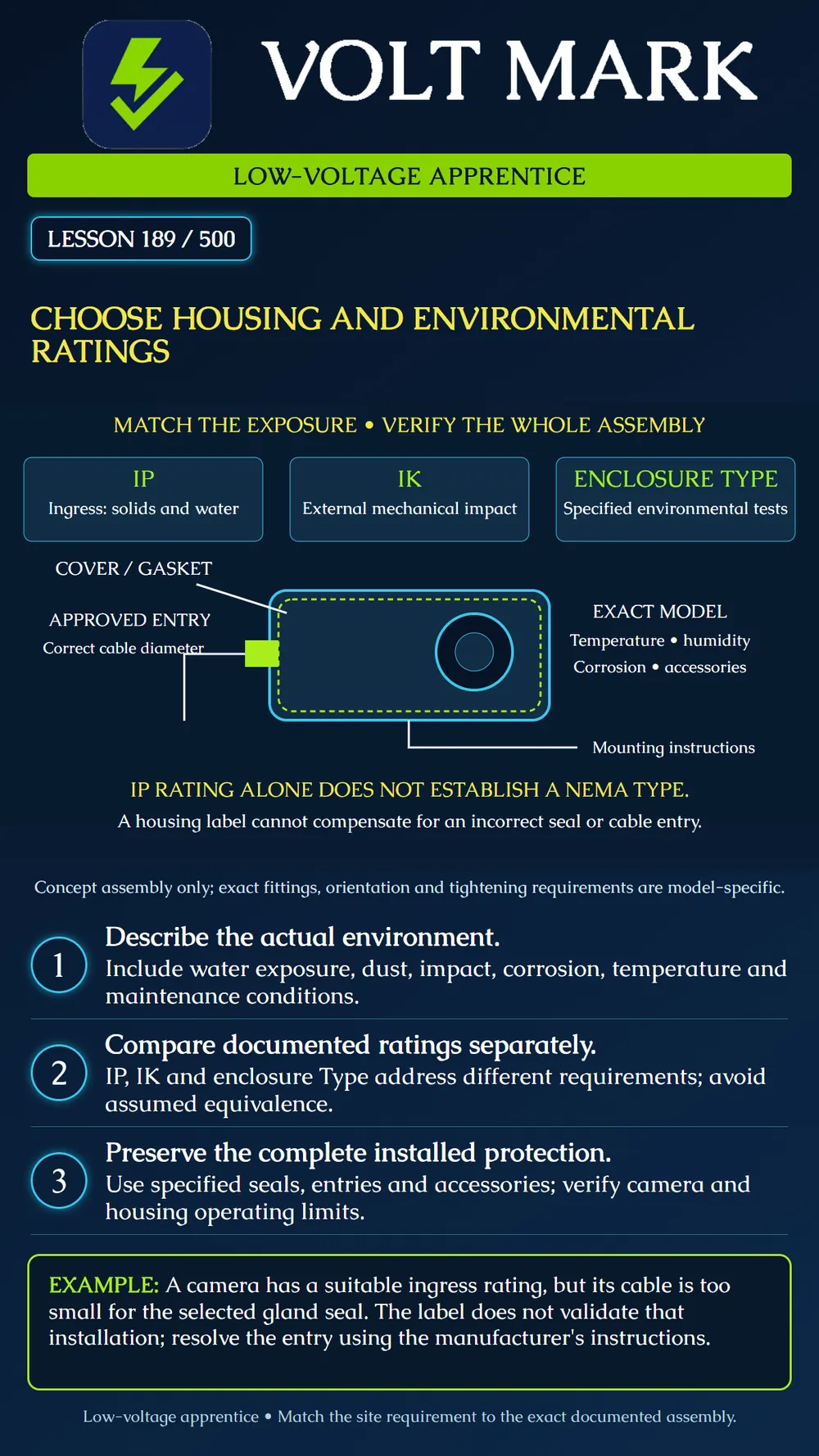
Match camera housing documentation to actual site conditions and identify installation details that can defeat the intended protection.
The IP code addresses protection associated with solids, access and water under defined tests. For example, the two digits in IP66 represent dust-tight protection and powerful-water-jet protection. That is not a blanket permission for every immersion, cleaning chemical or temperature condition. IK addresses external mechanical impact. It does not establish water protection. NEMA enclosure Types include defined environmental and construction requirements beyond an IP code. Type 4X includes additional corrosion protection, but does not mean resistance to every chemical. An IP marking alone does not establish a NEMA Type. Check the documented Type and required approval separately. This overview follows the Axis datasheet guide. It is not an independently reviewed copy of every applicable standard or a statement of universal local acceptance.
Build a site description before comparing products. Record the planned indoor or outdoor location, water exposure, dust, likely mechanical contact, corrosion sources and temperature extremes. Include cleaning practices: a sheltered location may still face washing or chemical exposure. Record relevant humidity and condensation conditions, direct solar exposure, startup conditions and accessories needed for the intended operation. Then compare the exact camera/housing combination with its instructions and datasheets. Do not assume a temperature range applies to every accessory or operating mode.
A fictional loading dock exposes its camera to rain and occasional cleaning. The project also specifies an enclosure Type and a temperature range. Candidate A has an IP marking but no evidence for the required Type in the submitted document. Do not convert the IP marking into the missing Type. Candidate B documents the Type but has an operating range that does not cover the stated minimum temperature. Do not treat the environmental label as a temperature approval. Candidate C appears to meet the documented requirements but requires a particular mount and cable-entry kit. Verify those items before calling the proposed assembly complete. These candidates are invented to teach evidence checking; they are not product recommendations.
A manufacturer guide for the Axis M31-R series makes protection conditional on the specified network cable/connector and correct cover installation; it also requires an approved housing for outdoor use. This older, model-specific example illustrates why a camera marking alone is insufficient. Its parts and mounting directions must not be copied to other cameras. For the actual project, identify the specified gasket, cable entry, cable diameter range, unused-entry closures, fasteners and tightening requirements. Verify compatible mounting accessories and installation orientation. Record what the manual requires rather than inventing a universal torque or sealant. Do not improvise holes, remove intended drainage features or substitute fittings while continuing to claim the original assembly protection without supporting instructions.
A technician selected a gland for a larger cable diameter than the cable installed. The nut feels tight but the sealing insert does not properly fit the jacket. The correct lesson is to resolve the component mismatch using the instructions, not to use tightening force as proof of sealing. A gasket is pinched under one corner of the cover. Photograph and record the condition, correct it through authorized maintenance and reinspect the closure. A clear live image says nothing about that physical seal. A second box contains an exposed connection outside the rated camera body. Include that connection and box in the environmental review instead of stopping at the camera label.
A robust outdoor housing is not automatically suitable for a classified hazardous location. Where the site specification identifies such a location, obtain the exact applicable equipment selection and approval requirements from the responsible designer. Do not infer suitability from IP, IK or Type 4X alone. This lesson teaches nationwide fundamentals; the project, adopted requirements and responsible authority determine local acceptance. It does not assign one housing rating to every US county.
Record the location, exposures, required ratings and their source, exact models, documented ratings, operating limits, accessories, entry details and manual revision. Add photos of accessible completed seals and closures where appropriate. List unresolved documentation gaps. Do not improvise a water-spray or immersion test on installed equipment to manufacture evidence of a laboratory rating. Use the manufacturer's approved inspection and any specified project acceptance method.
Axis Communications, Quick guide to Axis datasheets: https://whitepapers.axis.com/en-us/quick-guide-to-axis-datasheets Basis: distinct IP, IK, Type and environmental specifications. Axis M31-R Series Installation Guide: https://www.axis.com/dam/public/ba/18/67/axis-m31-r-series--installation-guide-en-US-47574.pdf Basis: model-specific cable/connector, closure and housing conditions; not a generic installation recipe. NEMA public enclosure FAQ and enclosure-types PDF links were found but returned 404 on direct retrieval. They are not represented as fully read sources; no direct NEC quotation is used. Scenarios and record format are original.
Free study material for low-voltage apprentices. This is a national foundation course: requirements differ by state and by local jurisdiction, and a practice that is common in one place is not a rule everywhere. Nothing here is a licence, a certification, or authority to work unsupervised, and completing it does not count as apprenticeship hours or continuing-education credit. Check the codes adopted where you are working, the licensing authority for that work, and your employer's safety programme. VoltMark is not affiliated with, endorsed by, or sponsored by NFPA, OSHA, NICET, BICSI, FOA, or any state or local licensing authority.

Electrician licensing exam prep: practice questions, timed exam simulations, and step-by-step help finding every answer in the NEC.