Read model-specific lens requirements, distinguish framing from focus and verify target detail across the intended scene.
Focal length and sensor configuration affect field of view. Focus determines which scene distances are rendered acceptably sharp. A fixed focal length does not necessarily mean fixed focus. A varifocal lens permits focal-length adjustment but requires refocusing after that adjustment. A true parfocal zoom retains focus while its focal length changes; motorized systems may achieve similar user behavior through automatic compensation. Do not infer performance from a button labeled Zoom. Depth of field is the range of distances appearing acceptably sharp under specified conditions. One sharply focused target does not prove the entire scene is sharp. These concepts follow the Axis lens guide.
Record the exact camera and lens model, available focal-length range, focus controls, minimum working-distance information, sensor compatibility and day/night provisions from the relevant documentation. Identify any required lens driver or calibration step. A physically similar thread or connector alone is insufficient proof of compatibility. Use the actual camera instructions. The Q1647 manual, for example, describes selecting an autofocus area and fine-tuning focus, as well as options for focus compensation with IR or temperature. These are bounded examples, not promises that every camera offers those controls.
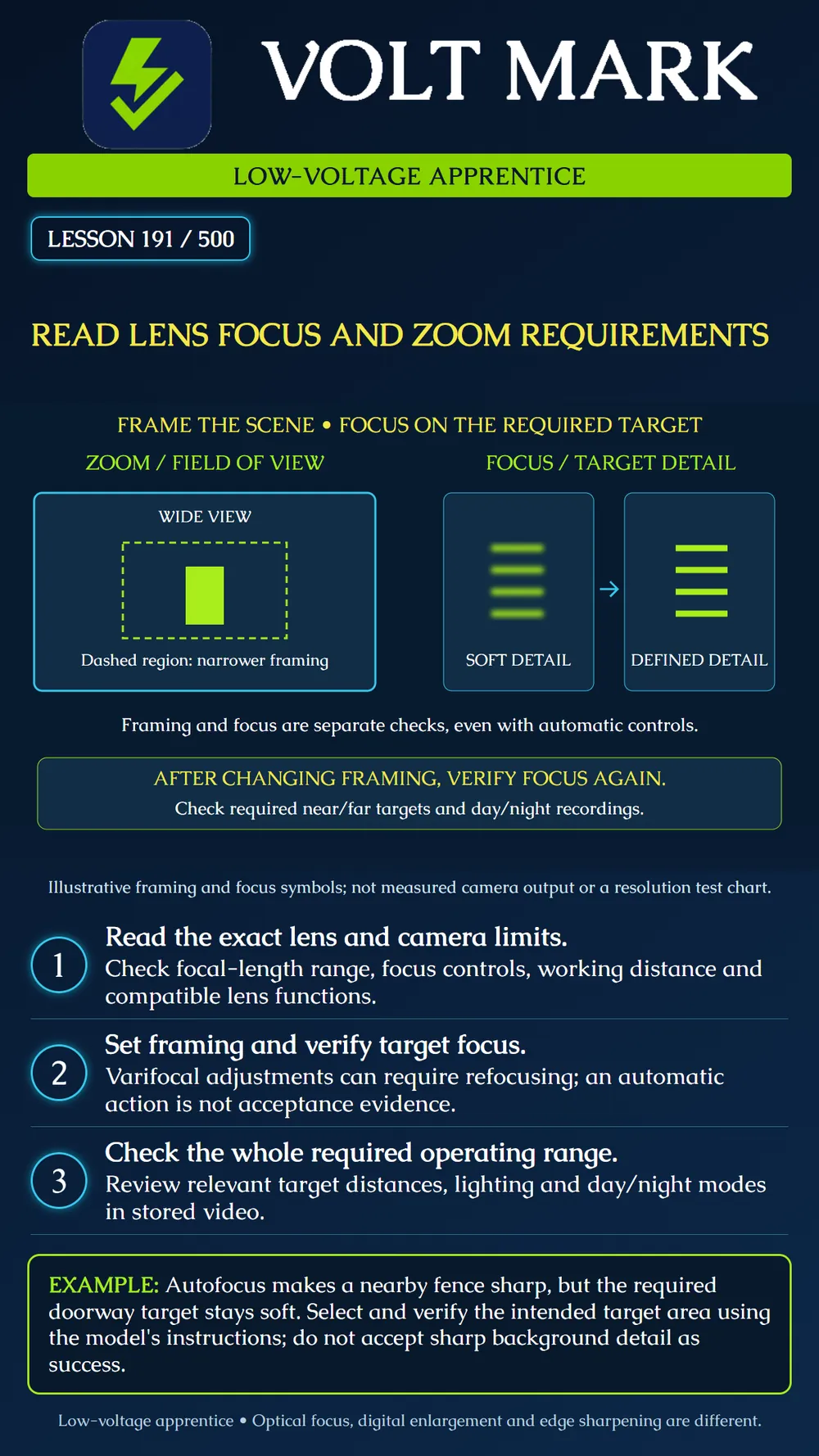
The left panel places a narrower framing region inside a wider view. It is a field-of-view concept, not a claim that digital cropping captures more optical information. The right panel shows the same-size detail pattern soft and defined. This illustrates a focus question without changing the target's displayed size. The pattern is not a calibrated chart or a sample camera recording.
A fictional camera must show a marked doorway target. A nearby fence occupies part of the image. An automatic focus operation makes the fence clear while the required target remains soft. Record the target and its location. Consult the model procedure for selecting or controlling the focus area. Verify the target result rather than relying on a completed autofocus indicator. After an authorized framing change, reassess both coverage and focus. Narrower framing may remove a required side approach. A sharper image of the wrong scene does not meet the original task.
The project requires useful detail at a near position and a farther doorway. A technician checks only the near position and marks the camera complete. Prepare separate result fields for each required position. Include representative lighting and the intended night mode. Mark an unavailable condition untested. Do not imply that a daytime focus check establishes nighttime performance. If neither focus setting satisfies the intended range, document the conflict for design resolution. Do not quietly delete the far target from the acceptance requirement.
Compare stationary and moving targets. If stationary detail is clear and motion detail is smeared, exposure may be involved. If both are soft, investigate focus, optics and the actual recording profile among other possibilities. A focus adjustment cannot restore information already lost through severe compression or insufficient scene sampling. Digital enlargement changes display scale; edge sharpening changes edge appearance. Neither proves that the lens captured the required detail. Review the recorded target at the intended playback conditions.
Record the before/after view, settings and clip references. Check related functions after changing framing. For example, a scene region used for an application or privacy setting may need review under the relevant instructions. Do not assume its previous placement remains correct. This lesson makes no live adjustment and supplies no generic lens-replacement procedure.
Camera/lens ID; documentation revision; intended target; target locations; lens range; selected framing; focus method and area; relevant operating mode; recorded near/far results; day/night result; other scene settings rechecked; exceptions; reviewer. Distinguish "control ran" from "required detail demonstrated." Record evidence for the latter.
Axis, Lenses in surveillance: https://whitepapers.axis.com/en-us/lenses-in-surveillance Basis: lens types, field of view, focus and depth-of-field distinctions. Axis Q1647 Network Camera manual: https://help.axis.com/en-us/axis-q1647 Basis: model-specific zoom, autofocus-area and compensation examples. Diagrams, scenarios and worksheet are original.
Free study material for low-voltage apprentices. This is a national foundation course: requirements differ by state and by local jurisdiction, and a practice that is common in one place is not a rule everywhere. Nothing here is a licence, a certification, or authority to work unsupervised, and completing it does not count as apprenticeship hours or continuing-education credit. Check the codes adopted where you are working, the licensing authority for that work, and your employer's safety programme. VoltMark is not affiliated with, endorsed by, or sponsored by NFPA, OSHA, NICET, BICSI, FOA, or any state or local licensing authority.

Electrician licensing exam prep: practice questions, timed exam simulations, and step-by-step help finding every answer in the NEC.