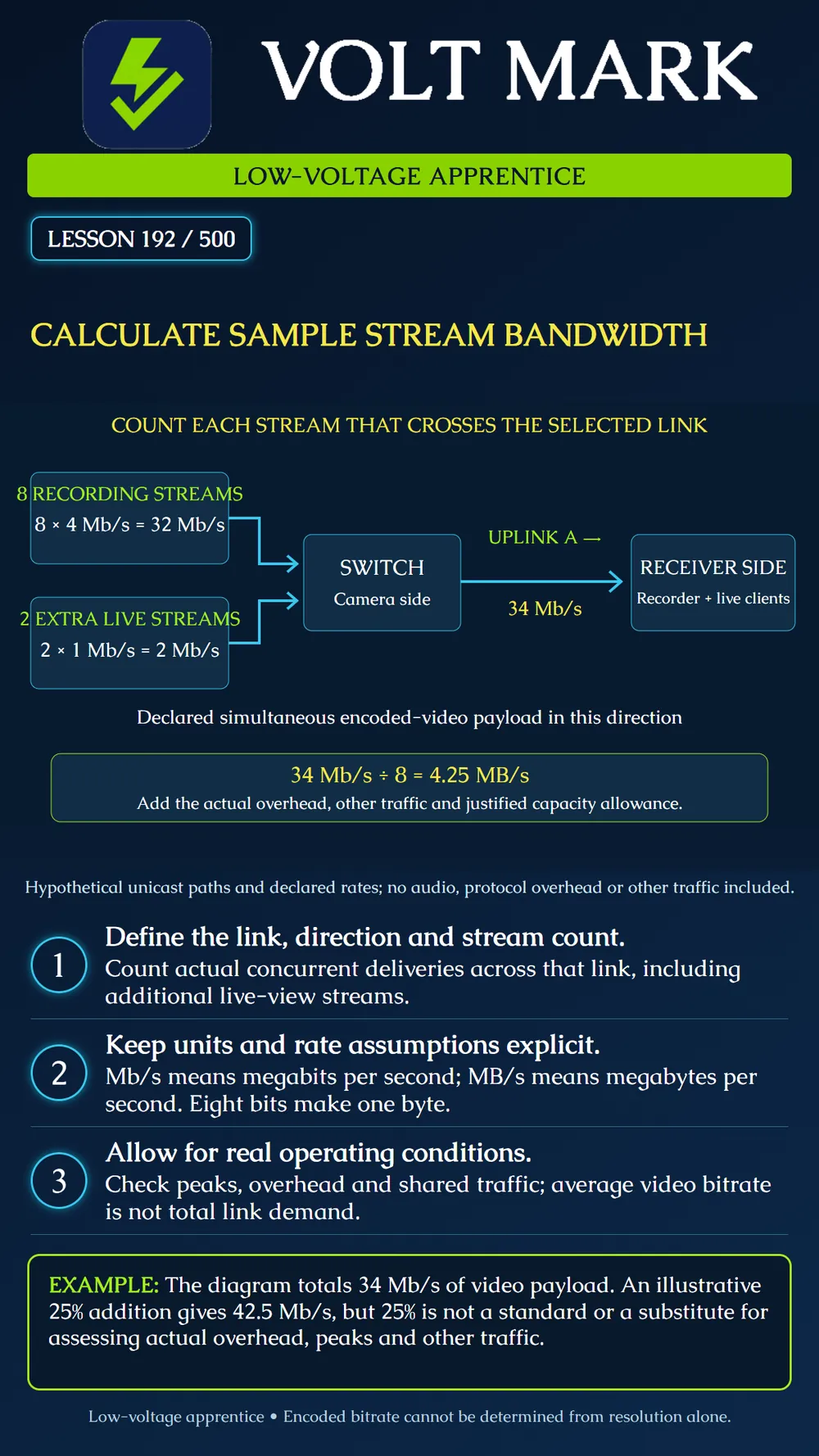
Sum declared encoded-video rates across a specified network link. State units, concurrent stream assumptions and what the result excludes.
"How much bandwidth do eight cameras need?" is incomplete. Name the link and direction, the active recording and live-view streams, their encoded rates and any other traffic. Axis explains that video bitrate varies with scene complexity, settings and bitrate-control strategy. An average value does not establish every short-term peak. Resolution and frame rate alone do not determine an encoded bitrate.
Eight cameras each supply one recording stream at a declared 4 Mb/s. Two cameras also supply separate 1 Mb/s live-view streams. All ten streams cross Uplink A in the camera-to-receiver direction. Recording payload = 8 × 4 = 32 Mb/s. Additional live payload = 2 × 1 = 2 Mb/s. Total declared encoded-video payload = 32 + 2 = 34 Mb/s. The example excludes audio, metadata, packet overhead, management traffic, retransmissions and unrelated applications. It also assumes these declared rates are simultaneous. It is not a measurement of an installed system.
Here M is decimal: 1 Mb/s = 1,000,000 bits per second. One byte contains eight bits, so 34 Mb/s / 8 = 4.25 MB/s. Do not multiply by eight when converting bits per second to bytes per second. Do not confuse either rate with a stored quantity such as MB or TB; storage also requires duration, addressed in Lesson 193. If a monitoring tool uses a different unit convention, document and convert it before comparing values.
The upper group represents eight deliveries, not one physical camera. The lower group represents two additional deliveries from cameras already included above. The selected total applies to the marked uplink and direction. The receiver-side box groups the recording and live-view destinations for clarity. It does not claim the recorder automatically forwards every live stream.
Axis transport documentation distinguishes unicast deliveries from multicast distribution to multiple receivers. The resulting traffic depends on the network paths and receiver behavior. If a viewer receives a forwarded copy from a server after Uplink A, that forwarding does not automatically create another camera-originated copy on Uplink A. If a viewer requests an additional direct stream across that link, count it there. Do not multiply every camera by every display without checking the architecture. Conversely, do not assume a shared encoder configuration means there is only one network delivery. Multicast needs a supported, deliberately designed network; this lesson does not change transport settings.
Suppose an instructor asks only for arithmetic with a hypothetical 25% addition: 34 × 1.25 = 42.5 Mb/s. The difference is 8.5 Mb/s. This is a classroom subtotal with an invented allowance, not a universal design margin. It does not prove a link or recorder adequate. Determine whether a real input rate already includes protocol overhead before adding overhead again. Record where a measurement was taken and what its counters include. For a rated 100 Mb/s link, 34 Mb/s is 34% of the nominal rate arithmetically. That comparison alone is not acceptance evidence; competing traffic, bursts, actual usable capacity and device limits remain to be assessed.
Three additional direct live streams at 2 Mb/s each are proposed across Uplink A. Added payload = 3 × 2 = 6 Mb/s. The new declared payload is 40 Mb/s. If those streams instead originate on the receiver side and never traverse A, the A total is unchanged by that forwarding. Draw the route before changing the total. If a camera temporarily rises above its declared average in a busy scene, label the original result an average-based estimate rather than pretending the higher rate is impossible.
A worksheet should identify link, direction, stream source and destination, number of simultaneous deliveries, codec/profile, rate basis, measurement interval, included traffic and exclusions. Record expected busy-scene conditions and additional traffic. Use authorized monitoring and representative recording checks. Compare measured results with the planned capacity and recorder limits. Missing video or congestion requires diagnosis; reducing quality until the network graph looks quiet may defeat the camera task. No actual traffic measurement or network configuration is performed in this lesson.
Axis, Bitrate control for IP video: https://whitepapers.axis.com/en-us/bitrate-control-for-ip-video Basis: scene-dependent bitrate and bitrate-control limitations. Axis developer documentation, RTSP(S) and (S)RTP transport: https://developer.axis.com/video-streaming-and-recording/video-streaming/concepts/protocols-and-transport-capabilities/ Basis: unicast/multicast delivery context. All numerical rates, topology and exercises above are original hypothetical teaching examples.
Free study material for low-voltage apprentices. This is a national foundation course: requirements differ by state and by local jurisdiction, and a practice that is common in one place is not a rule everywhere. Nothing here is a licence, a certification, or authority to work unsupervised, and completing it does not count as apprenticeship hours or continuing-education credit. Check the codes adopted where you are working, the licensing authority for that work, and your employer's safety programme. VoltMark is not affiliated with, endorsed by, or sponsored by NFPA, OSHA, NICET, BICSI, FOA, or any state or local licensing authority.

Electrician licensing exam prep: practice questions, timed exam simulations, and step-by-step help finding every answer in the NEC.