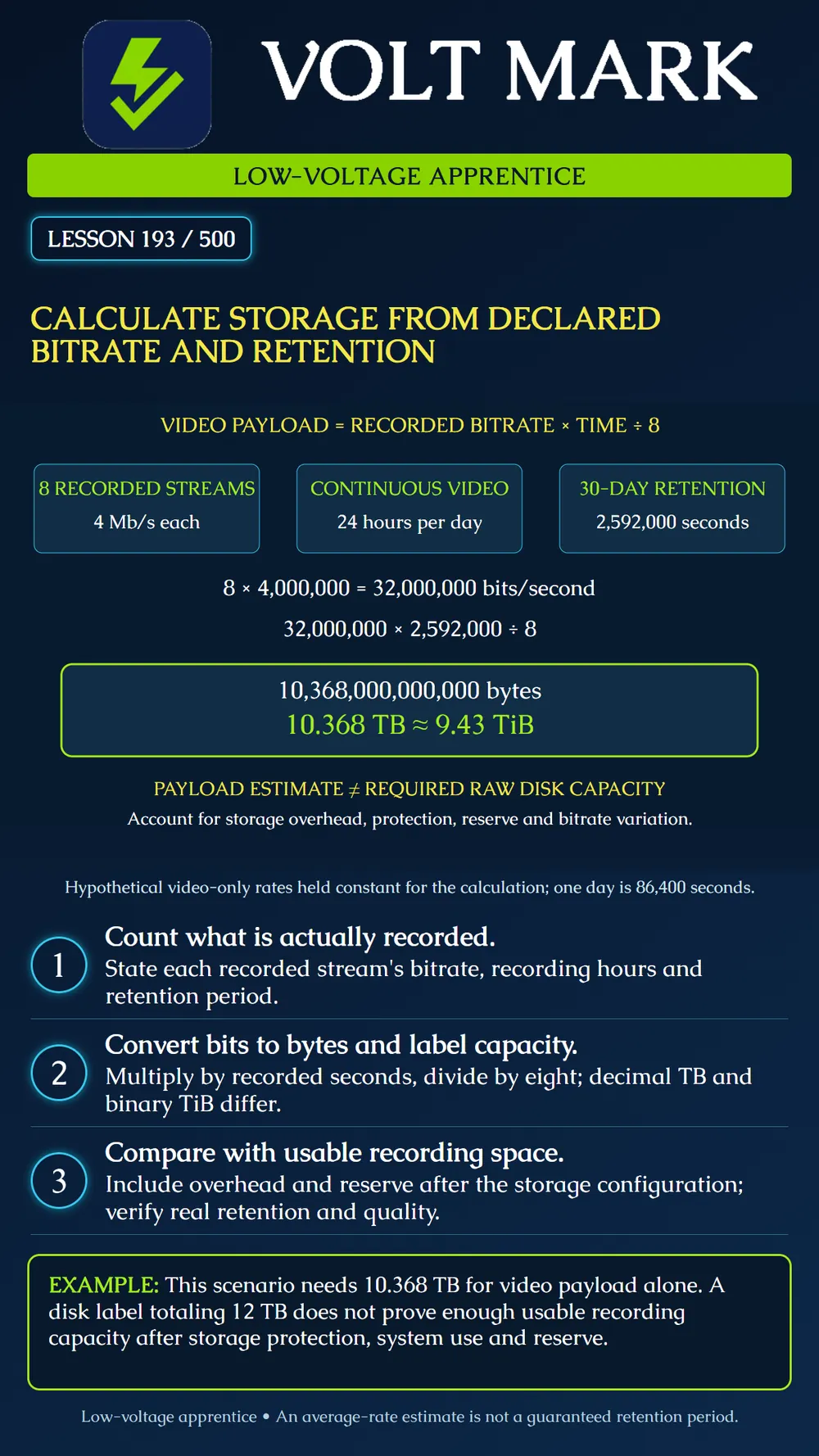
Calculate recorded-video payload from explicit bitrate and time assumptions. Distinguish this result from the raw disk capacity a system needs.
List the streams actually recorded, their declared rates, recording schedules and required retention. A live-only stream crossing a network link does not automatically consume recording space. Multiple recorded profiles or copies do. Axis explains that encoded bitrate changes with scenes and control settings. An average-rate estimate is conditional on the actual long-term rate and schedule. A configured retention value does not create capacity.
Eight streams are recorded continuously for 30 days. Each has a declared video bitrate of 4 Mb/s, taken as constant for this exercise. Audio, metadata and storage overhead are excluded. Aggregate bitrate = 8 × 4,000,000 = 32,000,000 bits/second. Recorded seconds = 30 × 24 × 60 × 60 = 2,592,000. Bytes = 32,000,000 × 2,592,000 / 8. Result = 10,368,000,000,000 bytes. Using decimal units, this is 10.368 TB.
The same result can be checked per camera: 4,000,000 / 8 = 500,000 bytes/second. 500,000 × 86,400 = 43,200,000,000 bytes/day = 43.2 GB/day. 43.2 × 30 × 8 = 10,368 GB = 10.368 TB. The word "day" here means exactly 86,400 seconds, not a calendar interval adjusted for local clock changes.
NIST distinguishes decimal prefixes from binary prefixes. One byte is eight bits. One TB is 10^12 bytes; one TiB is 2^40 bytes, or 1,099,511,627,776 bytes. 10,368,000,000,000 / 1,099,511,627,776 ≈ 9.43 TiB. The two numbers describe the same quantity. This conversion is not lost storage and is separate from formatting or protection overhead. Check how the actual tool labels its units.
For the same eight streams recorded exactly 12 hours per day for 30 days, recorded time halves and payload is 5.184 TB. That result assumes the same rate throughout the recorded intervals. For event recording, do not invent a fixed low activity percentage without evidence. Include the configured pre-event and post-event intervals and understand how overlapping events are handled. A busy day can consume much more than a quiet-day sample suggests. If a low-rate continuous stream and an event stream are both recorded, count the actual stored streams and intervals rather than assuming one replaces the other.
The example is encoded video payload. Account separately for recorded audio, relevant metadata, container/database/filesystem needs and product-required free space. Do not automatically add every network-packet header to disk storage: identify what the recorder actually writes. Compare the result with the recording allocation available after the chosen disk-protection arrangement, system usage and reserve. Raw drive labels are not the same as usable video allocation. Storage protection also does not by itself constitute an independent backup. Use the exact recorder documentation and configuration; no universal RAID capacity formula or reserve percentage is prescribed here.
A proposal says "12 TB installed, therefore 30 days guaranteed." The worksheet's calculated video payload is 10.368 TB. Request the actual recording allocation, storage configuration, other stored data, reserve policy and rate assumptions. The two numbers alone cannot establish adequacy. A second proposal uses a 20% addition to payload. Another says 20% of total usable space must remain free. These are different statements: adding 20% multiplies the base by 1.2, whereas reserving 20% of total space requires dividing the relevant occupied amount by 0.8. Neither percentage is adopted as a standard in this lesson.
Record the intended quality and duration together. Reducing the encoded data until a storage target fits may make the original video task fail. Compare representative storage growth and bitrate with the estimate. Verify that recordings from the required past interval can actually be found and played, and investigate gaps or early cleanup. Label early projections as projections until enough evidence exists for the actual period. Do not change retention, delete recordings, format media or alter RAID as part of this exercise.
Recorded stream IDs; rate basis; units; schedule; retention; calculated video payload; additional stored data; usable allocation; reserve; configuration reference; observed growth; oldest accessible recording; playback result; exceptions. Keep the requested retention and demonstrated retention separate.
NIST, Prefixes for binary multiples: https://physics.nist.gov/cuu/Units/binary.html Basis: byte and decimal/binary unit definitions. Axis, Bitrate control for IP video: https://whitepapers.axis.com/en-us/bitrate-control-for-ip-video Basis: variable bitrate and storage-budget assumptions. Axis Camera Station Pro User manual: https://help.axis.com/en-us/axis-camera-station-pro Reference for product-specific recording and storage configuration; no configuration action is performed. All numerical scenarios and exercises are original.
Free study material for low-voltage apprentices. This is a national foundation course: requirements differ by state and by local jurisdiction, and a practice that is common in one place is not a rule everywhere. Nothing here is a licence, a certification, or authority to work unsupervised, and completing it does not count as apprenticeship hours or continuing-education credit. Check the codes adopted where you are working, the licensing authority for that work, and your employer's safety programme. VoltMark is not affiliated with, endorsed by, or sponsored by NFPA, OSHA, NICET, BICSI, FOA, or any state or local licensing authority.

Electrician licensing exam prep: practice questions, timed exam simulations, and step-by-step help finding every answer in the NEC.