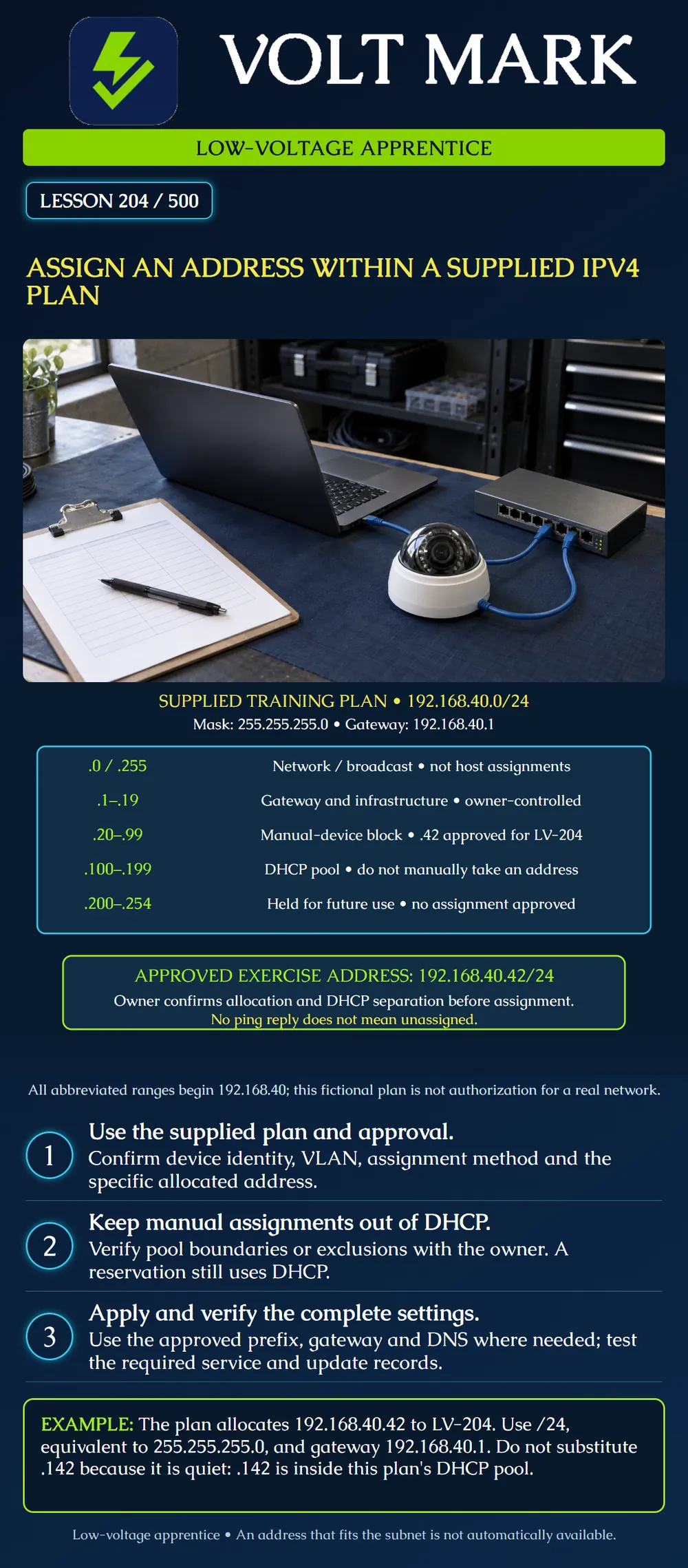
Select the explicitly approved address from a supplied IPv4 plan, record all required settings and describe an authorized verification process. The plan below is fictional. No real camera, controller, network or DHCP service is configured in this lesson.
Network:192.168.40.0/24. Subnet mask:255.255.255.0. Gateway:192.168.40.1. Network identifier:192.168.40.0. Subnet broadcast:192.168.40.255. Infrastructure block:.1 through .19, controlled by the network owner. Manual-device block:.20 through .99. DHCP pool:.100 through .199. Future-use block:.200 through .254, held by the owner. All abbreviated addresses above begin192.168.40.
For this exercise only, the owner has confirmed that192.168.40.42 is unallocated, assigned it to fictional device LV-204 and confirmed separation from DHCP offerings. Other addresses in the manual-device block are not automatically available. They may already be assigned or held.
A /24 leaves eight IPv4 host bits. Two to the eighth power is256 addresses. In this ordinary /24 subnet, removing the network identifier and subnet broadcast leaves254 host-address values. That is the size of the host space, not a count of free addresses.
The supplied ranges account for the whole host space: .1–.19 contains19 addresses. .20–.99 contains80. .100–.199 contains100. .200–.254 contains55. 19+80+100+55=254.
The candidate .42 lies within the supplied manual-device block and does not equal .0, .1 or .255. This arithmetic confirms plan consistency; the owner's allocation record establishes that .42 is the approved choice. A mathematical fit alone cannot establish ownership or availability.
For fictional LV-204, compare candidates 192.168.40.42, .142 and .255 under the supplied /24 plan. The ordinary host range is .1 through .254, so .255 is rejected as broadcast. Both .42 and .142 are mathematical host values, but .142 belongs to the DHCP pool. The owner explicitly allocated .42 to LV-204 and separated it from DHCP offerings.
The completed proposal is manual address 192.168.40.42, mask 255.255.255.0 and gateway 192.168.40.1. Required DNS values still need the owner's input if services use names. This is a proposed paper assignment; saved settings, conflict checks and application operation have not been observed.
A second fictional device needs an address. A trainee proposes .43 because it is in the manual block, or .142 because it did not answer ping. Has either been approved? List the information needed before implementation and the evidence needed afterward.
Answer: Neither has an explicit owner allocation. Request the chosen address, method, intended interface/VLAN, required service settings and coordinated DHCP exclusion or pool boundary as applicable. After authorized implementation, verify saved values, device identity, conflict evidence and required services, then update the allocation record. A valid host value or quiet ping is insufficient.
Mistake: Selecting any address in the manual block because the arithmetic says it is a host value. Correction: Use the owner's explicit allocation; in this exercise only .42 is confirmed for LV-204.
Mistake: Taking .142 after a quiet ping test. Correction: Retain .142 in the documented DHCP pool and request an allocation; silence does not release an address.
Mistake: Manually entering an address when the approved method is a DHCP reservation. Correction: Leave the endpoint in DHCP mode and have the authorized administrator verify the server's reservation and client identity.
Microsoft describes DHCP scopes, exclusions and reservations. Excluded addresses are not offered by that DHCP server; reservations provide a designated address through DHCP rather than by manually configuring the endpoint. Avoid overlapping manual assignments with addresses a DHCP service may lease. Source: https://learn.microsoft.com/en-us/windows-server/networking/technologies/dhcp/dhcp-scopes
RFC5227 describes IPv4 address-conflict detection based on ARP, including checks before using an address and detection of conflicts during operation. This is protocol behavior, not a substitute for an approved allocation record. Source: https://www.rfc-editor.org/rfc/rfc5227.html Sources accessed2026-09-30. The address plan, calculations and cases are original instructional examples.
The owner may require a manually configured address or a DHCP reservation. Follow that decision. With a manual assignment, enter the approved values on the correct device interface through its supported process. With a DHCP reservation, the authorized DHCP administrator creates the appropriate assignment and the endpoint remains configured to obtain settings through DHCP.
Do not manually take an address merely because a DHCP reservation looks similar to a fixed address. Confirm the intended method and client identity. If more than one authorized DHCP service participates in the design, the owner must coordinate the applicable allocation information. A statement on a worksheet does not itself change a server's offerings.
A powered-off device can still own an address in the inventory. A working device may not answer ping. An address might also be held for a future installation. Therefore a quiet .142 is not permission to take it; in this example it belongs to the DHCP pool.
Follow the approved duplicate-address check and supported device behavior. If a conflict appears, stop using the proposed assignment through the authorized process and refer the evidence to the owner. Do not disable conflict detection, impersonate another device or keep guessing addresses until one seems to work.
For fictional LV-204, the worksheet specifies: Assignment method:manual, as supplied by the exercise. Address:192.168.40.42. Prefix/mask:/24 or255.255.255.0. Gateway:192.168.40.1. VLAN/network zone:the owner's approved192.168.40.0/24 device network. DNS:obtain the approved values if the device's required services use names; none are invented in this exercise.
A gateway is not automatically a DNS server. Do not copy public resolver addresses from an unrelated example. Likewise, the suffix .1 is this plan's gateway choice, not a universal rule.
Identify the physical device and the interface being configured. Confirm the current connection and how the approved management session will be restored after an address change. Preserve the existing settings and the authorized recovery plan before applying a change.
In a sanctioned lab, enter the supplied address and mask/prefix exactly as the product requires. Apply gateway and other approved settings. A temporary loss of the management session can occur when its address changes; reconnect using the documented method rather than resetting the device immediately.
This lesson does not supply product-specific button sequences because they vary. Follow the actual model's instructions and the site's change process.
Confirm the saved configuration, correct device identity and intended VLAN/port. Test the required local service and any approved routed or name-based dependency separately. A ping reply alone does not establish a working camera stream, controller session or recording function.
Record any conflict warning or unexpected address behavior. If the test fails, compare the observed settings with the supplied plan before proposing a correction. Do not change the subnet mask to make an incorrectly chosen address appear local.
Update the allocation record with the device ID, interface identity, physical location, address, method, date, approving owner and verification result. For this paper exercise, record the proposed assignment as a training result, not as a deployment completed on real equipment.
Texas journeyman, 15 questions, scored by topic against the 70% mark. No card, and no account needed to start.
Free study material for low-voltage apprentices. This is a national foundation course: requirements differ by state and by local jurisdiction, and a practice that is common in one place is not a rule everywhere. Nothing here is a licence, a certification, or authority to work unsupervised, and completing it does not count as apprenticeship hours or continuing-education credit. Check the codes adopted where you are working, the licensing authority for that work, and your employer's safety programme. VoltMark is not affiliated with, endorsed by, or sponsored by NFPA, OSHA, NICET, BICSI, FOA, or any state or local licensing authority.

Electrician licensing exam prep: practice questions, timed exam simulations, and step-by-step help finding every answer in the NEC.