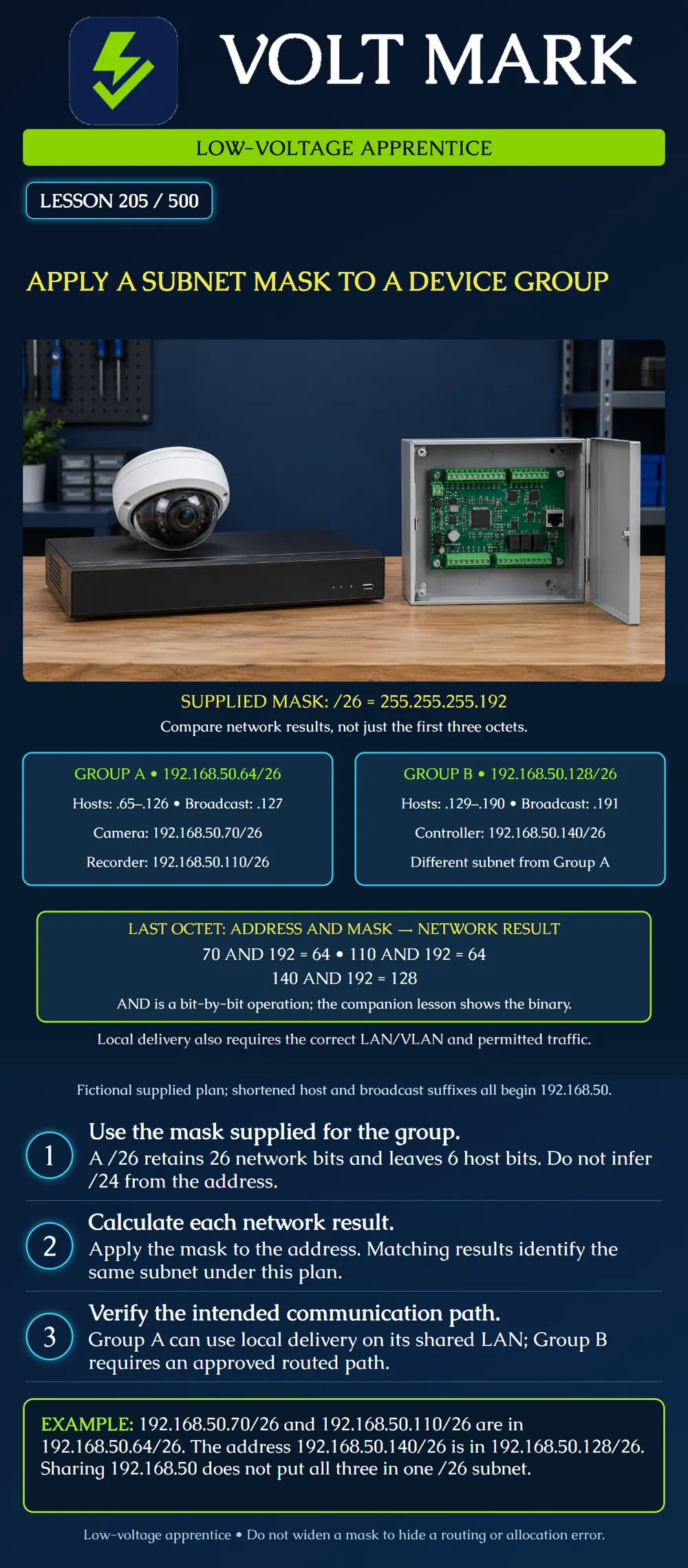
Apply a supplied IPv4 mask to a group of fictional low-voltage devices, calculate network membership and explain the intended local or routed path. No actual device settings are changed.
Camera:192.168.50.70/26. Recorder:192.168.50.110/26. Controller:192.168.50.140/26. The approved mask for all three is255.255.255.192. Camera and recorder are intended to share Group A's LAN/VLAN. The controller belongs to Group B's separate network. Routing between groups is subject to the approved network design and access policy.
The first three dotted numbers happen to match, but the mask extends beyond those24bits. Do not assume a /24 because an address starts with192.168 or because that mask was used on the previous lesson.
Mistake: Treating .70 and .140 as local because their first three octets match. Correction: Apply the supplied /26 to both addresses; their networks are .64/26 and .128/26.
Mistake: Assigning .127 to another Group A device because it is below .128. Correction: Check the complete block boundaries: .127 is this /26 subnet's broadcast, not a host allocation.
Mistake: Widening the camera to /24 to avoid a failed routed connection. Correction: Compare saved masks with the approved /26 plan and refer routing or policy failures to the owner instead of redesigning the subnet.
Microsoft explains that a mask separates network and host portions and helps determine whether a destination is local or remote. Its examples show that changing a mask changes network membership. This lesson uses explicit prefixes and original arithmetic rather than inferring historical address classes. Source: https://learn.microsoft.com/en-us/troubleshoot/windows-client/networking/tcpip-addressing-and-subnetting
RFC1878 is an informational IPv4 subnet table. It lists /26 as255.255.255.192 with64 addresses per block. It is used here for that correspondence, not as a universal host-count rule for every prefix or a current deployment specification. Source: https://www.rfc-editor.org/rfc/rfc1878.html Sources accessed2026-09-30.
An IPv4 address has32bits. A /26 mask has26 leading ones and6 trailing zeros: 11111111.11111111.11111111.11000000 Each all-one octet equals255. In the final octet,128+64=192. Thus the decimal mask is255.255.255.192.
The six host bits give2^6=64 address values per block. For the ordinary /26 subnets in this exercise, the first is the network identifier and the last is the subnet broadcast, leaving62 host values. That does not mean62 addresses are available to assign: gateways, existing devices and allocations consume host values.
AND produces1 only where both corresponding input bits are1. A mask1 retains the corresponding address bit; a mask0 makes the result bit0. The first three address octets are unchanged here because their mask octets are255.
Camera's final octet: 70 = 01000110 192 =11000000 AND =01000000 =64 Camera network:192.168.50.64/26.
Recorder's final octet: 110 =01101110 192 =11000000 AND =01000000 =64 Recorder network:192.168.50.64/26.
Controller's final octet: 140 =10001100 192 =11000000 AND =10000000 =128 Controller network:192.168.50.128/26.
The poster's "70 AND192" is a bitwise calculation, not ordinary addition or multiplication. Write the binary rows if the decimal expression is unfamiliar.
Inside192.168.50.0/24, four /26 blocks begin at final-octet values0,64,128 and192. Their full ranges are0–63,64–127,128–191 and192–255.
Group A network:192.168.50.64. Group A host range:192.168.50.65–192.168.50.126. Group A broadcast:192.168.50.127.
Group B network:192.168.50.128. Group B host range:192.168.50.129–192.168.50.190. Group B broadcast:192.168.50.191.
The camera and recorder fall within Group A's host range; the controller falls within Group B's. The final octets .64 and .128 are network identifiers in this plan, even though those numbers could serve other roles under a different prefix. Interpret the full address together with its mask.
With their supplied masks and common LAN/VLAN, camera and recorder regard each other as local. Their local path still depends on correct switching and permitted traffic. Matching subnet results do not create a physical path, authenticate a device or guarantee that a service is running.
The camera regards192.168.50.140 as remote under the supplied /26. In a simple host configuration with no more-specific route, it uses the approved default gateway to reach Group B. The router needs the correct routes and the destination needs a return path. Gateway addresses are not invented here; obtain them from the owner-provided design.
A default gateway used by an ordinary directly connected host must be reachable through its local network arrangement. Do not copy a gateway from another group merely because both addresses start with192.168.50.
Suppose the camera is mistakenly set to /24 while the recorder and controller retain /26. The camera now calculates a broader local network and may attempt local address resolution for destinations that the approved design expects it to reach through a router. Other hosts may make different path decisions.
The corrective action is to compare each saved setting with the supplied plan and have the authorized person restore the approved value. Widening everyone to /24 just to make one test work would change the design and could defeat intended network separation. A mask is also not a substitute for firewall policy; the network owner must implement the required access controls.
For each device, record its ID, interface, address, supplied prefix, decimal mask, calculated network, host-range check, VLAN and approved gateway where needed. Identify required local and remote services. Record expected results before testing.
In a sanctioned lab, apply only the owner-approved settings through the model's supported process. Reconnect through the approved management path and verify saved values. Test the required local and routed functions separately. Keep mathematical checks separate from actual deployment evidence.
Texas journeyman, 15 questions, scored by topic against the 70% mark. No card, and no account needed to start.
Free study material for low-voltage apprentices. This is a national foundation course: requirements differ by state and by local jurisdiction, and a practice that is common in one place is not a rule everywhere. Nothing here is a licence, a certification, or authority to work unsupervised, and completing it does not count as apprenticeship hours or continuing-education credit. Check the codes adopted where you are working, the licensing authority for that work, and your employer's safety programme. VoltMark is not affiliated with, endorsed by, or sponsored by NFPA, OSHA, NICET, BICSI, FOA, or any state or local licensing authority.
Electrician licensing exam prep: practice questions, timed exam simulations, and step-by-step help finding every answer in the NEC.